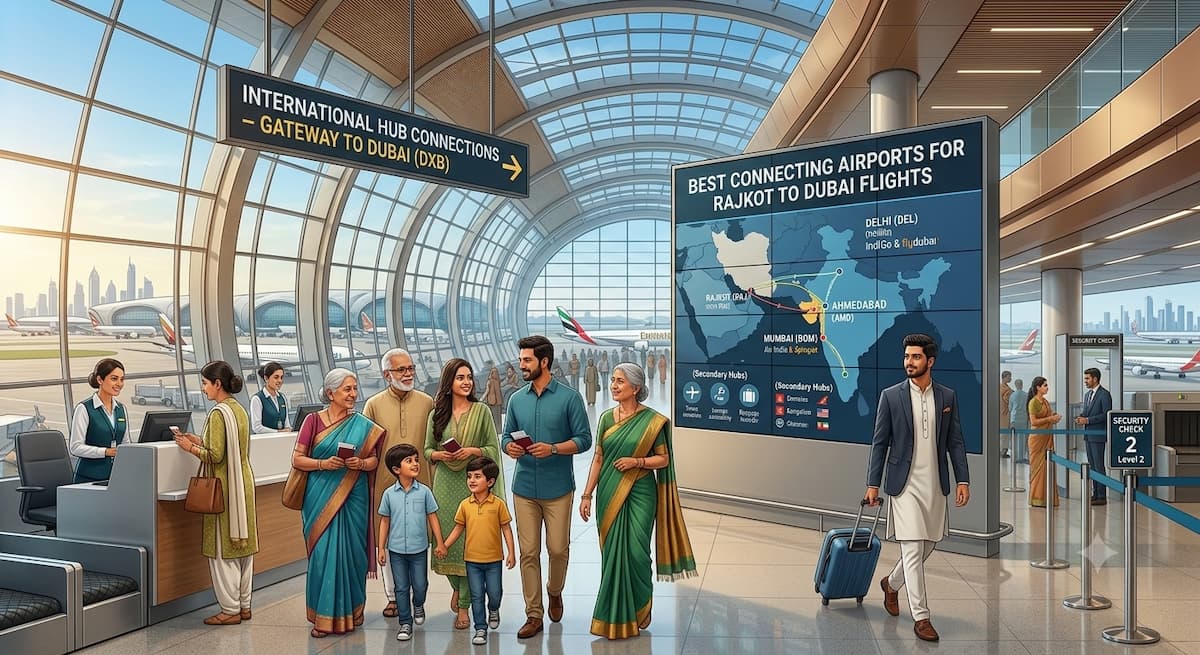
By Trekhops Travel Desk · Flight schedules, fares, and recommendations updated in 30th July 2026
Methodology: These recommendations are built from current airline schedules, published airport transfer guidance (including official Mumbai and Delhi airport minimum-connection-time standards), publicly available fare data, and Trekhops Travel Desk's day-to-day experience booking this route. Flight schedules, airline frequencies, and fares change throughout the year — always verify the latest details before booking.
Last schedule review: July 2026, using published schedules from Emirates, IndiGo, Air India, Air India Express, and flydubai. Airport transfer recommendations were verified against official airport guidance available at the time of publication.

Airline schedules, baggage policies, airport transfer procedures, and visa requirements can change throughout the year. This guide is reviewed periodically, but travelers should always verify the latest information directly with the airline before booking.

There’s no single best Rajkot to Dubai flight — a budget-watching student, a business traveler needing a fresh 9am start, and a family with a toddler would each choose differently, and none of them would be wrong.
Since Rajkot has no direct flight to Dubai (HSR has no international service), every itinerary here involves a connection — through Ahmedabad (AMD) or Mumbai (BOM), most commonly. That connection is really the whole decision: get the gateway and timing right for your priorities, and the airline and fare mostly sort themselves out.
This guide compares the three things travelers usually optimize for — price, speed, and avoiding a bad layover — compares Ahmedabad and Mumbai as gateways in real detail, and matches sixteen traveler types to their best routing. By the end, you’ll know exactly which flight fits how you travel, not just which one is cheapest on paper.
Who This Guide Is For
This guide is designed for travelers starting their journey from Rajkot who want to choose the right Dubai flight — not simply the cheapest one. It will be especially useful if you are:
- Comparing Ahmedabad and Mumbai departure options
- Unsure whether to book one ticket or separate tickets
- Looking for the fastest overall journey
- Trying to avoid overnight layovers
- Traveling with children, senior citizens, or large baggage
- Choosing between Emirates, IndiGo, Air India, Air India Express, and flydubai
This guide focuses specifically on travelers departing from Rajkot. If you’re already flying from Ahmedabad, Mumbai, Delhi, or another Indian city, you’ll find more relevant advice in our dedicated city-specific Dubai flight guides.
Quick Answer
- Cheapest: Mumbai connection, low-cost carrier (IndiGo or Air India Express)
- Fastest: Ahmedabad route, timed road transfer + Emirates nonstop
- Best for Families: Mumbai with a full-service airline (Air India) and a long layover
- Best for Business: Mumbai with a flexible fare
- Best for Seniors: Mumbai with wheelchair assistance pre-booked
- Best for Backpackers: Mumbai, ultra-low-cost, cabin baggage only
Detailed reasoning for each follows below.
Quick Recommendation: if you already know your single top priority, jump straight to that option below — Budget, Fastest, or Avoiding Layovers — rather than reading the full guide top to bottom.
Key takeaways: Mumbai is usually cheaper and more flexible because five airlines compete for the route; Ahmedabad is usually faster because it removes the connecting-flight risk entirely, not because the flying itself is shorter. Separate tickets are meaningfully riskier than they look on price alone. A visa is mandatory for Indian travelers and worth sorting in parallel with your flight search, not after — see our Dubai Visa Guide for the full requirement, or the checklist near the end of this guide.
Step 1: Decide What Matters Most Before Booking
Every Rajkot–Dubai itinerary trades off between the same seven things: price, total travel time, layover comfort, ticket flexibility, departure timing, airport stress, and connection reliability. No itinerary wins on all seven — ranking your top two narrows the rest of the decision fast.
A few of these deserve a quick note.
Total travel time isn’t the same as flight duration — the ground leg and connection are usually the bigger lever, not the flying itself.
Departure timing matters more than it seems: an early Rajkot departure gives you the whole day’s international schedule to connect into, while a late one can narrow same-day options to nothing.
Connection reliability comes down to one distinction that shapes most of this guide — a single through-ticket (sometimes a codeshare) means the airline owns any delay and has to rebook you; two separate tickets, a self-transfer, mean you own that risk yourself.
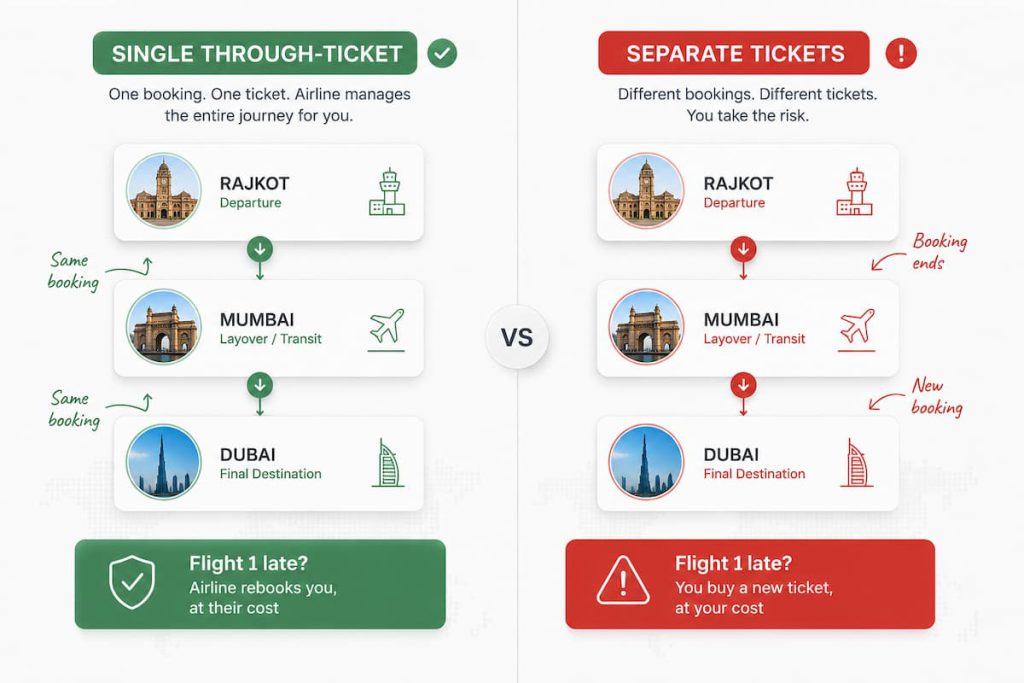
If the first flight runs late: a through-ticket means the airline rebooks you at their cost; separate tickets mean you buy a new one at yours.
One more distinction worth knowing: a layover is a short connection you’re not meant to leave the airport for. A stopover is a deliberately extended break, chosen on purpose — different decision entirely.
Night flight timing: an evening or red-eye domestic departure can look convenient on paper, but it’s the single most common cause of an accidental overnight layover on this route, since it often lands after the day’s international departures have already gone. A morning Rajkot departure is almost always the safer choice unless you’ve specifically confirmed a same-night international connection exists.
Decision Checklist
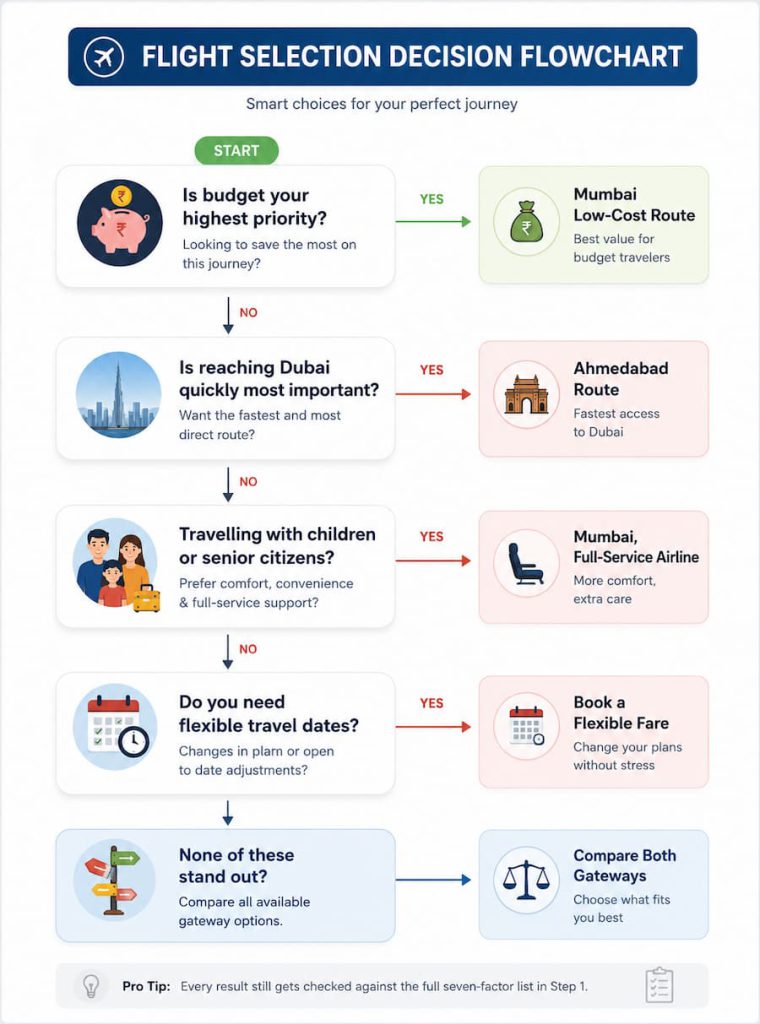
Rank price, total time, layover comfort, flexibility, departure timing, airport stress, and connection reliability from 1 (matters most) to 7. Your top two should point straight to one of the three options below.
Flight Selection Decision Flowchart
Option 1: If Your Priority Is Saving Money
A Mumbai connection on a low-cost carrier — IndiGo or Air India Express — booked several weeks ahead, outside Diwali, Eid, or the December–January peak, sits at the cheapest end of this route consistently.
Mumbai wins on price mainly because five airlines (IndiGo, Air India, Air India Express, SpiceJet, and Emirates) compete for the same Dubai-bound seats, which keeps fares down in a way Ahmedabad’s thinner three-carrier schedule doesn’t match. See our Rajkot to Dubai Flight Prices Explained guide for the full fare breakdown — the published range runs roughly ₹15,000 to ₹42,000 one-way, with the cheapest fares clustering on exactly this pattern.
The cheapest fare on any given day is rarely the one with the tightest connection — airlines price the inconvenient middle-of-the-day gaps lower because fewer people want them. A 4–5 hour layover is often meaningfully cheaper than a 2-hour one, same route, same day. That trade is worth it if the saving is real and the extra time is 2–3 hours; it’s less clearly worth it for a small saving and an 8-plus-hour wait or an accidental overnight stop.
Example — Budget Traveler (Rajkot → Mumbai → Dubai): domestic flight (~1h15m) → 4–5 hour layover on a single through-ticket → nonstop to Dubai (~3 hrs). Total door-to-door: roughly 9–10 hours. Best suited to a solo traveler or student trading time for savings.
Pros: genuinely the lowest total cost on this route, with the most departure-time choices of any option.
Cons: usually the longest layover, with baggage and meals often costing extra on top of the base fare — and not the right call if you’re traveling with toddlers, carrying heavy luggage, or have an important commitment the next morning.
Best for: students, budget travelers, and anyone whose main constraint is the ticket price rather than the clock.
Quick Recommendation: if keeping costs low is your highest priority, a Mumbai low-cost connection booked 4–6 weeks in advance generally offers the best value, provided you’re comfortable with a longer layover.
Option 2: If Your Priority Is Reaching Dubai Quickly
A well-timed Ahmedabad connection is usually the fastest realistic option — not because the flying is dramatically shorter, but because there’s no flight-to-flight connection to protect.
It seems like it shouldn’t work: road plus flight beating flight plus flight. Ahmedabad feels faster because it removes the uncertainty of a domestic flight connection, not because the flying itself is dramatically shorter — you exchange one predictable road journey for an additional flight, which makes the overall trip simpler to manage even before it’s faster. You drive on your own schedule, check in once, and fly straight to Dubai on Emirates’ 2h50m nonstop (our Rajkot to Ahmedabad Transport Guide covers road and rail options for that leg specifically). That certainty is what offsets the extra driving time.
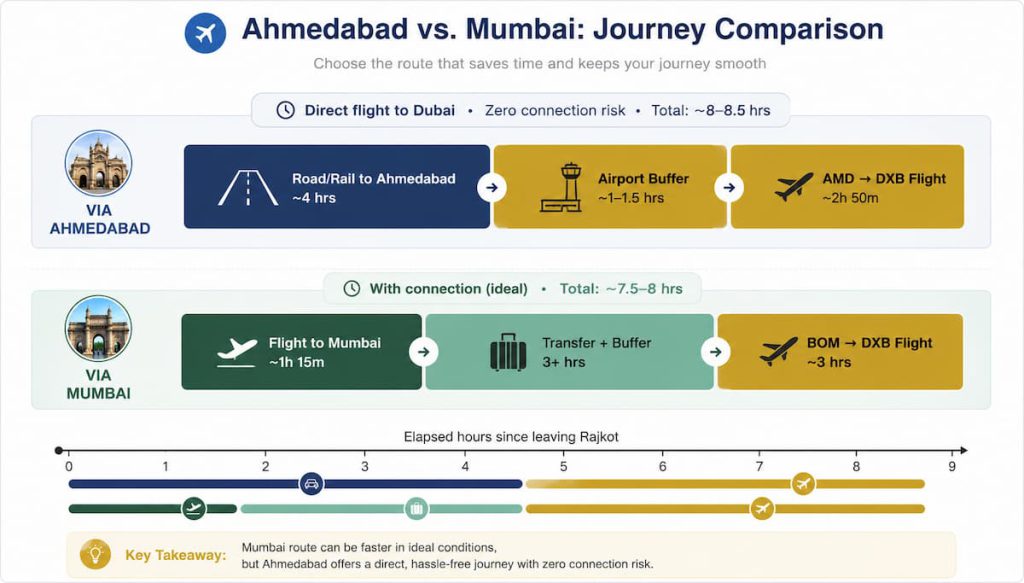
Example — Fastest Journey (Rajkot → Ahmedabad → Dubai): road or rail (~4 hrs) → airport process → nonstop flight (2h50m). Depart Rajkot around 6:00am, arrive Ahmedabad by 10:00am, board with a 90-minute buffer. Total door-to-door: roughly 8–8.5 hours, with zero connection risk in the chain.
A Mumbai routing can match it on paper: an early domestic flight (first nonstop around 7:55am) lands by 9am, and with a genuine 3-hour-plus buffer, connects into an early-afternoon Dubai departure. The flying time is short either way — the real difference is how much you trust the connection. At Mumbai specifically, the airport’s own guidance recommends 3–4 hours for this transfer, since T1 and T2 aren’t linked internally and need a 25–30 minute shuttle. Travelers often overestimate the time Mumbai actually saves here — on paper the domestic flight looks faster than a 4-hour drive, but once the recommended connection buffer is added back in, the two routes usually land within an hour of each other.
Pros: the shortest realistic total journey time on this route, with full control over your own ground-leg timing.
Cons: requires disciplined timing and clear roads — not the right call if you dislike long road travel, if you’re traveling during heavy monsoon weeks, or if you’re unsure about highway conditions on travel day.
Best for: business travelers, anyone on a tight single-day window, and travelers who’d rather manage their own timing than trust a connection.
Quick Recommendation: if reaching Dubai fast is what matters most, a well-timed Ahmedabad connection beats Mumbai on total time — but only if you can commit to a disciplined ground-leg departure.
Option 3: If You Want to Avoid Long or Overnight Layovers
Overnight layovers on this route are almost always a timing mistake, not bad luck. International departures from Mumbai and Ahmedabad cluster at certain times of day, and a domestic arrival that misses that window — even by an hour — can mean a 6–10 hour wait or a genuine overnight stop.
Mumbai’s own airport guidance puts the sweet spot at 3–4 hours for a domestic-to-international connection: long enough to absorb a normal delay, short enough that you’re not burning half a day in the terminal. A connection booked right at the legal minimum looks fine on paper until the first flight runs 40 minutes late — which is exactly where the single-ticket-versus-separate-tickets distinction from Step 1 matters most.
Good layover range: 3–4 hours for a domestic-to-international connection at either gateway; add 30 minutes for a terminal change.
Avoid tight connections on separate tickets, during Diwali/Eid/December–January peak travel, or when traveling with children or elderly family.
Overnight stops occasionally make sense if the fare saving is real and you’re not on a tight schedule — otherwise, search the international leg’s schedule first and work backward to a domestic flight that lands comfortably ahead of it.
Pros: the safest, most predictable connection experience, working equally well through either gateway.
Cons: eats more of your travel day than a tighter connection — worth it for families, seniors, and first-time international travelers, less necessary if you’re already on a protected through-ticket with a shorter airline-guaranteed connection.
The Two Routes, Shape by Shape
Which Gateway City Fits Your Trip?
Two gateways handle nearly every practical Rajkot–Dubai itinerary.
Ahmedabad (AMD)
Ahmedabad (AMD) is reached from Rajkot by road or rail — 3.5–4.5 hours, not by flight, since there’s no practical direct connection. Emirates flies the Dubai sector nonstop 9 times a week in 2h50m, with IndiGo and flydubai adding further options. It’s a compact, single-complex airport: low walking distances, lighter crowds, and no domestic-to-international transfer to manage, since you arrive by road already outside the terminal — a genuine advantage for a first-time international traveler.
Mumbai (BOM)
Mumbai (BOM) is reached by a genuine nonstop domestic flight, 1h10–1h35m, with 6–9 flights a day. From there, five airlines — IndiGo, Air India, Air India Express, SpiceJet, and Emirates — fly Dubai nonstop, spread from early morning past midnight. Mumbai’s biggest advantage isn’t simply having more flights — it’s having departures spread throughout the day. Even if your domestic flight is delayed, there’s often another Dubai departure later the same day; Ahmedabad’s smaller schedule means missing one departure is more likely to push your trip to the following day’s service. It’s a bigger, busier, two-terminal operation: T1 and T2 aren’t linked internally, security queues can run long at peak times, but lounge availability is genuinely better than Ahmedabad’s.
Why Delhi Usually Isn’t Recommended
Delhi offers one of India’s largest Dubai flight networks — Emirates alone runs 28 flights a week there — but it’s genuinely farther from Rajkot than Ahmedabad or Mumbai, and that extra distance usually outweighs any scheduling advantage. Abu Dhabi is reachable via Etihad from all three Indian gateways as a deliberate alternative, adding a 90-minute-to-2-hour road transfer into Dubai itself. Delhi is worth considering only if you’re already planning to route through it for another reason, or a specific fare makes it clearly worthwhile — not as a default third option. Our Best Connecting Airports for Rajkot to Dubai Flights guide covers Delhi, Abu Dhabi, and Sharjah in full depth.
Estimated Cost by Route
| Route | Approximate Fare | Best For |
|---|---|---|
| Rajkot → Mumbai → Dubai | ₹15,000–30,000 | Lowest overall cost |
| Rajkot → Ahmedabad → Dubai | ₹18,000–35,000 | Fastest journey |
| Rajkot → Abu Dhabi → Dubai | Varies by date and carrier | Alternative routing on specific fares |
These are broad ranges, not quotes — always compare live fares for your actual travel dates before booking.
| Factor | Ahmedabad | Mumbai |
|---|---|---|
| Distance from Rajkot | ~208 km, road/rail | ~1,000 km, flight |
| Dubai flight frequency | Emirates 9/week + IndiGo, flydubai | 5 airlines, ~65–70/week |
| Overall airport stress | ⭐⭐⭐⭐⭐ easy | ⭐⭐⭐ moderate |
| Security queues | ⭐⭐⭐⭐⭐ short | ⭐⭐⭐ can run long at peak |
| Walking distance / crowds | ⭐⭐⭐⭐⭐ light | ⭐⭐⭐ busier |
| Terminal simplicity / navigation | ⭐⭐⭐⭐⭐ single complex | ⭐⭐⭐ two terminals, shuttle needed |
| Food options | ⭐⭐⭐ limited | ⭐⭐⭐⭐⭐ extensive |
| Lounge options | ⭐⭐ limited | ⭐⭐⭐⭐⭐ strong |
| Schedule flexibility | ⭐⭐ | ⭐⭐⭐⭐⭐ |
| Cheapest / Fastest | Fastest ⭐⭐⭐⭐⭐ | Cheapest ⭐⭐⭐⭐⭐ |
| Best for | Shortest, simplest trip | Widest choice of times |
| Average total journey time | Comparable when timed well | Comparable when timed well |
| Connection complexity | Very low | Moderate |
| Overall airport experience | Simpler | More facilities |
| Best for first-time travelers | Yes | No |
| Best for maximum flexibility | No | Yes |
Connection reliability rates evenly between the two — Ahmedabad by removing the connection entirely, Mumbai through a well-buffered single ticket. Neither is objectively safer; they get there differently.
Does the season change this?
During summer, Ahmedabad’s simpler airport experience is a genuine plus while everything is quiet anyway. Around winter holidays, Diwali, or Eid, Mumbai’s deeper schedule gives you more room to work around demand spikes and sold-out Ahmedabad flights. Outside those windows, the fare gap between the two narrows, so the usual trade-offs above apply cleanly. Our Best Time to Visit Dubai guide covers the weather side of that same seasonal picture, if timing your trip matters as much as timing your flight.
Quick Recommendation: default to Mumbai for schedule depth and flexibility, and default to Ahmedabad when simplicity or speed matters more than choice — recheck this if your dates land near a peak period, since Mumbai’s advantage grows then.
Which Airline Is Best for Your Travel Style?
Gateway is only half the comparison — which airline you fly matters just as much, and the five that actually operate this route (across both gateways) suit genuinely different travelers.
| Airline | Cabin Baggage | Checked Baggage | Meals | Seat Selection | Fare Flexibility | Best For |
|---|---|---|---|---|---|---|
| Emirates | Included | 30kg+ standard | Included | Included on most fares | Good, at a price | Premium travelers |
| IndiGo | Included | Often extra on lowest fare | Paid extra | Paid extra | Basic tiers limited | Budget travelers |
| Air India | Included | Included on base fare | Included | Often included | Moderate | Families |
| Air India Express | Included | Included, ~20-30kg | Paid or limited | Paid extra | Basic tiers limited | Lowest fares |
| flydubai | Included | Varies by fare | Paid on lowest tiers | Paid extra | Moderate | Emirates-ecosystem connections |
Emirates offers the strongest all-round service and baggage allowance, nonstop from both gateways, at the highest fares of the five. IndiGo counters with the most frequent departures and widest schedule spread, at the cost of baggage, seats, and meals priced separately. Air India bundles meals and baggage into its base fare, which suits families well, though flexible-fare options can be thinner on some dates. Air India Express offers genuinely good value for a near-full-service experience on a narrower schedule than IndiGo. flydubai’s real advantage is convenient onward connectivity once you’re in Dubai, on a smaller overall network than the other four.
None of these is “best” outright — reliability and on-time performance are broadly comparable across all five on this specific route, so the real differences are what’s included in the fare and how deep the schedule runs, not which airline is inherently better. Match the row above to whichever traveler-style priority from the section below matters most to you.
Which Flight Option Matches Your Travel Style?
| Traveler Type | Best Routing | Key Reason |
|---|---|---|
| Budget travelers | Mumbai, low-cost, booked early | Lowest fares from real airline competition |
| Families with children | Mumbai, full-service, long layover | Kid-friendly timing, included baggage |
| Couples | Mumbai, full-service, mid-day departure | Best price-comfort balance for two |
| Solo travelers | Mumbai, low-cost | Cheapest, no group buffer needed |
| Senior citizens | Mumbai, full-service, assistance booked | Fewer charges, pre-bookable help |
| Business travelers | Mumbai, flexible fare | Same-day rebooking if plans shift |
| Luxury travelers | Mumbai (choice) or Ahmedabad (simplicity) | Strong Emirates product either way |
A few of these are worth a sentence of “why,” beyond the table.
Families do best with Mumbai’s schedule depth for picking a genuinely kid-friendly departure time, paired with a full-service carrier’s included baggage and meals — a late-morning departure, 3–4 hour layover, and early-evening international leg means no rushing and no red-eye wake-up call.
Business travelers benefit most from a flexible fare specifically, since Mumbai’s nonstop options mean genuine same-day rebooking if a meeting shifts, and that flexibility usually pays for itself the first time plans move.
Luxury travelers genuinely face a choice rather than an obvious answer — Mumbai for the deepest premium-cabin selection, or Ahmedabad for a single predictable Emirates experience — since both gateways carry a strong Emirates product.
More Traveler Scenarios
Nine situations that don’t fit neatly into the table above, each with a routing note distinct from what’s already been said:
- First-time international travelers: Ahmedabad if the road transfer is manageable, or Mumbai with an extra-generous 4-hour buffer — either removes or pads the connection enough to forgive the small process mistakes everyone makes on their first trip.
- Travelers with elderly parents: Mumbai, full-service, wheelchair assistance booked for each parent by name — don’t assume one request covers both.
- Honeymoon couples: Mumbai, premium cabin, an unhurried mid-day departure — this is the one trip where paying slightly more for calm is almost always worth it.
- Backpackers: Mumbai, ultra-low-cost, cabin baggage only — skipping checked baggage removes the hidden cost that erodes budget-fare savings.
- Heavy luggage: Mumbai, full-service carrier with a higher base allowance, checked and paid in advance rather than discovered at the counter.
- Onward international connections: one single through-ticket covering the whole journey — a second international flight riding on this one arriving on time raises the stakes considerably.
- Weekend business trips: Ahmedabad for a Thursday-out, Sunday-back pattern, since every extra transit hour is a bigger share of a short trip.
- Short holidays (3–4 days): same logic as weekend trips — speed earns a higher priority than it would on a longer trip.
- Long holidays (7–10 days): Mumbai, optimized purely for price — a few extra transit hours barely register against a week or more on the ground.
Need Help Choosing?
Share the following with our travel experts:
- Your travel dates
- Number of travelers
- Approximate budget
- Cabin baggage or checked baggage
- Whether saving money or saving time matters more
We’ll compare Ahmedabad and Mumbai itineraries and recommend the option that offers the best overall value — not simply the lowest fare — through our Dubai Tour Packages from Rajkot.
Who Should Avoid Each Route?
Neither Ahmedabad nor Mumbai is the right choice for every traveler.
Ahmedabad may not be ideal if you:
- Don’t want a 4-hour road journey before your flight
- Are traveling during severe monsoon conditions
- Prefer public transport over private road transfers
- Have a very early morning departure that leaves little margin for the drive
Mumbai may not be ideal if you:
- Want the simplest possible journey with no connection to manage
- Feel uncomfortable navigating airport transfers on your own
- Prefer avoiding a domestic-to-international connection entirely
- Are traveling with very young children and want fewer moving parts in the itinerary
Should You Pay More for a Better Flight?
A higher fare only has real value if it buys you something you’d actually use: a materially shorter total journey, a departure time that avoids an overnight stop, meaningfully more baggage, or flexibility when your dates genuinely aren’t locked. It’s rarely worth it for a marginally shorter flight that doesn’t change door-to-door time, or a domestic-hop cabin upgrade that doesn’t touch the international leg. The honest test: can you name the specific hour, kilo, or guarantee the extra fare buys? If not, it usually isn’t worth it.
Three real scenarios worth thinking through:
A flight ₹4,000 cheaper with an 8-hour layover makes sense for a budget or solo traveler with no time pressure — it stops making sense the moment a hotel night gets added, since that alone can erase the saving. A flight ₹2,000 more that saves 5 hours is almost always justified for a business traveler or short trip, where those hours are worth more than the fare gap — less justified on a long, relaxed holiday. Separate tickets saving ₹3,500 should be weighed against the risk, not just the saving: a missed connection with no through-ticket protection can cost far more than ₹3,500 in a same-day replacement fare plus a hotel. Treat it as a bet, not free money.
Understanding Fare Types
| Fare Type | Changes & Cancellation | Baggage | Best For |
|---|---|---|---|
| Basic / Saver | Not permitted, or high fee; non-refundable | Cabin bag only, or minimal checked | Fixed dates, lowest cost priority |
| Standard | Permitted with a fee; partial credit | Standard checked allowance included | Most travelers |
| Flexible | Free or low-fee changes; often refundable | Standard or higher, usually included | Genuinely uncertain dates |
The jump from Basic to Standard usually costs less than expected; Standard to Flexible costs considerably more, and is worth it mainly when dates are genuinely uncertain, not just “possibly.”
Where Should You Compare Flights?
Compare fares across multiple platforms rather than relying on a single website — airlines sometimes offer lower direct fares, while online travel agencies include promotional discounts or bundled offers that direct booking doesn’t. Common options include official airline websites, Google Flights, Skyscanner, MakeMyTrip, Cleartrip, and EaseMyTrip.
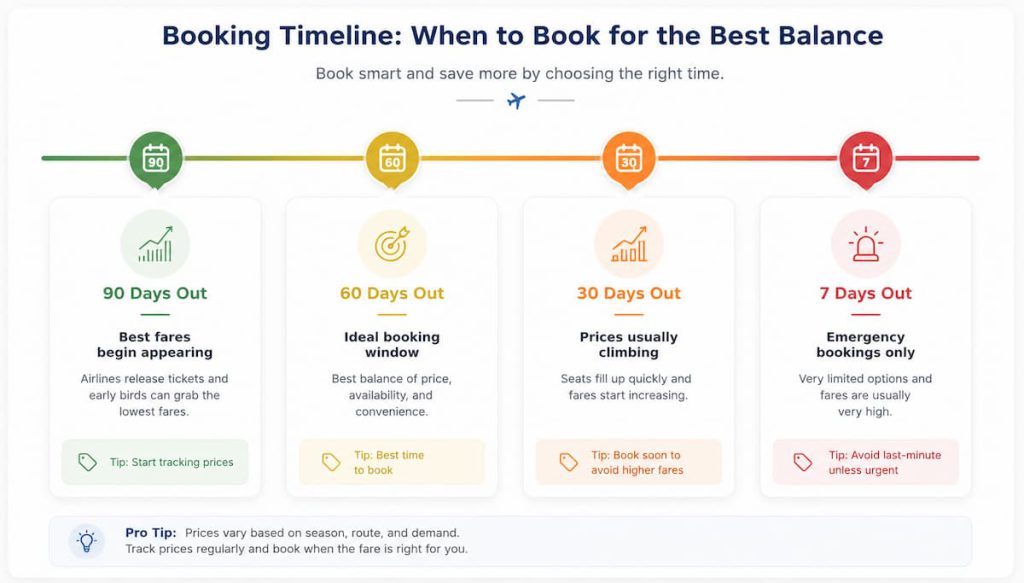
Booking Timeline
Best Route Based on Your Budget
- Under ₹20,000: Mumbai with a low-cost carrier, booked well ahead — this budget realistically means accepting the longer layover from Option 1.
- ₹20,000–30,000: Compare both gateways directly for your dates — this range is where Ahmedabad and Mumbai fares genuinely overlap, so the tie-breaker becomes your actual priority (speed vs. flexibility), not the price itself.
- ₹30,000 and above: Choose based on convenience and priority rather than price — at this level, the fare difference between options is small enough that layover comfort, schedule fit, or airline preference should drive the decision.
Hidden Costs to Budget For
The flight ticket is only part of your travel cost. Also factor in: road transfer to Ahmedabad airport, airport parking if you’re driving yourself, the taxi or shuttle between Mumbai’s terminals if your itinerary needs it, checked baggage fees on the lowest fare tiers, seat selection charges, meals on low-cost airlines, travel insurance, and foreign currency exchange. None of these show up on the fare comparison page, but all of them show up on the actual trip.
Common Myths
Myth: Ahmedabad is always cheaper.
Reality: not necessarily — Mumbai’s competition often keeps its fares lower, and Ahmedabad can occasionally cost more for the same dates.
Myth: Mumbai is always faster.
Reality: it depends entirely on connection timing — a well-timed Ahmedabad route frequently beats Mumbai on total door-to-door time, precisely because it has no connection to protect.
Myth: Emirates is always the best option.
Reality: the right airline depends on your priorities — Emirates leads on service and baggage, but IndiGo or Air India Express can be the better call for a budget-focused trip.
Common Mistakes When Choosing a Rajkot to Dubai Flight
- Choosing only by ticket price hides a bad layover or excluded baggage until the real cost shows up later — compare the full itinerary, not the headline number.
- Ignoring total journey duration — the ground leg and connection often add more hours than the flight itself.
- Booking very tight layovers to chase a slightly cheaper fare, which feels efficient until one flight runs late.
- Forgetting baggage rules on the cheapest fare tier, then paying far more at the airport.
- Ignoring airport transfer time and cost — the Rajkot taxi, or Mumbai’s inter-terminal shuttle, is real time and real money.
- verlooking schedule changes — airlines do shift flight times after booking; reconfirm both legs a few days before you fly.
- Booking separate tickets without understanding the risk deserves its own callout, since it’s the costliest mistake on this route:
On a single through-ticket, a delayed first flight is the airline’s problem — they rebook you. On two separate tickets, it’s entirely yours: a new fare, possibly a new day, and any hotel cost, all out of pocket.
Flight Selection Checklist
Before you book, run through this list:
- Compare total travel time door-to-door, not just flight durations
- Check the exact baggage allowance for your fare class
- Review layover duration against the 3–4 hour range
- Confirm any terminal change and budget the shuttle time
- Read the fare conditions, check-in deadline, and boarding cutoff for each leg
- Verify your passport validity and UAE visa requirements — mandatory for Indian travelers in almost all cases, and worth starting in parallel with your flight search; see our Dubai Visa Guide
- Consider travel insurance, especially on separate tickets or peak season
- If driving to Ahmedabad, check road conditions the morning of travel — see our Rajkot Airport Departure Guide
- Once you land, our Dubai Metro Guide covers getting into the city without a taxi
Travel Desk Tips
- Avoid booking separate tickets whenever possible — the protection is worth more than the saving in most cases
- Compare baggage fees before comparing headline fares
- Price both Ahmedabad and Mumbai for your specific travel dates before committing
- Book roughly 6 weeks out for the best balance of price and availability
- Time an Ahmedabad road transfer to land 3 hours ahead of your flight, not the earliest you could theoretically leave
- Search the international leg’s schedule first, then work backward to a domestic flight that lands comfortably ahead of it
At a Glance
| Priority | Recommended Option |
|---|---|
| Cheapest | Mumbai Low-Cost |
| Fastest | Ahmedabad |
| Best for Families | Mumbai Full-Service |
| Best for Seniors | Mumbai with Assistance |
| Best for Business | Flexible Fare |
| Best Airline | Depends on your priorities — see the airline table above |
| Best Booking Window | 4–6 Weeks Before Departure |
Continue Planning Your Dubai Trip
If you’re still planning your journey, these guides may help:
- Rajkot to Dubai Flight Prices
- Rajkot to Ahmedabad Transport Guide
- Best Connecting Airports for Rajkot to Dubai Flights
- Dubai Visa Guide
- Best Time to Visit Dubai
- Dubai Metro Guide
- Dubai Tour Packages from Rajkot
Frequently Asked Questions
Can I fly directly from Rajkot to Dubai?
No — Rajkot (HSR) has no international service, so every itinerary connects through another Indian city, most commonly Ahmedabad or Mumbai.
What is the cheapest way to fly from Rajkot to Dubai?
Generally a Mumbai connection on IndiGo or Air India Express, booked 4–6 weeks ahead outside festival weeks, in the roughly ₹15,000–₹42,000 published range.
What is the fastest route?
A well-timed Ahmedabad connection usually wins, since there’s no flight-to-flight connection to protect.
Which airport is better — Ahmedabad or Mumbai?
Neither wins outright. Ahmedabad is faster and simpler when timed well; Mumbai offers a far deeper schedule and more flexibility.
Is Mumbai always cheaper?
Usually, but not always — Ahmedabad’s fare can occasionally undercut Mumbai on specific dates, so it’s worth a five-minute comparison rather than assuming.
How do I avoid overnight layovers?
Book the earliest realistic domestic departure and treat 3–4 hours as your minimum buffer at Mumbai specifically.
Can baggage be transferred automatically?
Yes, on a single through-ticket — it’s checked once, all the way to Dubai. On separate tickets, you collect and recheck it yourself.
How early should I reach Ahmedabad airport?
Roughly 90 minutes ahead of a 2h50m international flight is a reasonable buffer, on top of however long your road transfer takes.
Can I travel through Abu Dhabi instead?
Yes, via Etihad from any of the three Indian gateways — it’s a valid alternative if a specific fare or schedule makes it worthwhile, adding a road transfer into Dubai itself.
Which route is best for families?
Mumbai, full-service carrier, generous 3–4 hour layover.
Is booking one ticket better than separate tickets?
Generally yes — a single through-ticket means the airline owns rebooking if the first flight runs late.
When should I book for the best choice of flights?
Four to six weeks ahead for most trips; two to three months if your dates overlap Diwali, Eid, or the December–January peak.
Which airline offers the best baggage allowance?
Emirates includes the most as standard across fare tiers; Air India and Air India Express include a reasonable allowance on their base fare; IndiGo’s lowest fare tier often excludes checked baggage entirely, so check the specific fare class rather than assuming.
Is Mumbai Airport difficult to transfer between terminals?
Not difficult, but it does take real time — T1 and T2 aren’t linked internally, so a dedicated shuttle covers the gap, and the airport’s own guidance recommends budgeting 3–4 hours total for a domestic-to-international connection because of it.
Can I transit through Dubai without a visa?
This guide covers the Rajkot–Dubai leg specifically, where Dubai is your destination, not a transit stop — if you’re continuing on to a third country, transit visa rules depend on your onward destination and airline, so confirm directly with your carrier.
Which airport has better lounges?
Mumbai, clearly — its international side has meaningfully more lounge options than Ahmedabad’s smaller airport.
Is self-transfer (separate tickets) worth the savings?
Only with a very generous, deliberate buffer. The saving is real, but so is the risk — see the Common Mistakes section above for what a missed self-transfer connection actually costs.
Which route has fewer delays?
Neither route has meaningfully different on-time performance in general terms — the bigger factor is connection design, not the airline or gateway. A single through-ticket absorbs a delay far better than separate tickets do, regardless of which gateway you choose.
Can I check baggage through to Dubai on a connecting itinerary?
Yes, automatically, if both legs are on one through-ticket. On separate tickets, you’ll need to collect and recheck your baggage yourself at the connecting airport.
Is Ahmedabad Airport easier than Mumbai Airport for first-time international travelers?
Generally yes — its smaller, single-complex layout means less walking, lighter crowds, and no domestic-to-international terminal transfer to navigate, since you arrive by road already outside the terminal.
Should I book directly with the airline or through a travel website?
Compare both — airlines sometimes offer lower direct fares, while travel websites and agencies occasionally include promotional discounts or bundled offers that direct booking doesn’t.
How much should I budget for airport transfers from Rajkot?
This varies by mode and provider, so it’s worth checking current rates directly rather than assuming a fixed figure — factor it in as a real cost alongside the flight, not an afterthought.
Which route is better during the monsoon season?
Mumbai carries less monsoon-related risk, since the domestic flight isn’t affected by road conditions the way an Ahmedabad drive can be — if you do choose Ahmedabad during heavy monsoon weeks, build extra buffer time into your road transfer.
Final Recommendation
Every traveler’s priorities are different. A route that’s perfect for a business traveler may not be the best choice for a family or a budget traveler. Compare complete itineraries — not just ticket prices — before booking.
There’s no universal best Rajkot–Dubai flight — only the best one for the trip you’re actually planning. Every choice here reduces to the same tensions: price against time, convenience against flexibility, a simpler airport against more flight choices, a lower fare against lower risk, one protected ticket against two cheaper but unprotected ones.
| Priority | Best Choice | Main Trade-Off |
|---|---|---|
| Cheapest | Mumbai Low-Cost | Longer layover |
| Fastest | Ahmedabad | Road transfer required |
| Families | Mumbai Full-Service | Higher fare |
| Business | Mumbai Flexible Fare | More expensive |
| Senior Citizens | Mumbai + Assistance | Larger, busier airport |
| First-Time Travelers | Ahmedabad | Fewer flight options |
| Most Flight Choices | Mumbai | Bigger, busier airport to navigate |
| Simplest Airport / Lowest Stress | Ahmedabad | Narrower schedule to work around |
| Premium Experience | Emirates, either gateway | Highest fare of the five airlines |
| Lowest Connection Risk | Single through-ticket | Fewer fare options than mixing tickets |
Reality check: there isn’t a permanently “best” Rajkot to Dubai route. The cheapest option today may not be the cheapest next month, and the fastest itinerary can become the slower one if road traffic delays your arrival at Ahmedabad. Always compare both gateways for your actual travel dates before booking, rather than relying on what was true last time.
Quick Recommendation: if none of these priorities stand out sharply for your trip, Mumbai on a full-service carrier with a 3–4 hour layover is the safest default — it’s rarely the single cheapest or fastest choice, but it’s never a bad one.
The smartest travelers on this route compare the full journey — price, total time, layover quality, baggage, and flexibility together — rather than the fare alone. Trekhops can help match the right routing to your travel style through our Rajkot to Dubai packages.
Last reviewed: July 2026. This guide is updated whenever major airline schedules, airport procedures, or route availability change.
Planning a Trip to Dubai?
If you’re an Indian traveller based in one of the cities listed below — or nearby — check out our Dubai Tour packages from India by clicking the link for your city.
- Dubai Tour Packages from Rajkot
- Dubai Tour Packages from Visakhapatnam
- Dubai Tour Packages from Vijayawada
- Dubai Tour Packages from Vadodara
- Dubai Tour Packages from Trivandrum
- Dubai Tour Packages from Trichy
- Dubai Tour Packages from Surat
- Dubai Tour Packages from Pune
- Dubai Tour Packages from Nagpur
- Dubai Tour Packages from Mumbai
- Dubai Tour Packages from Lucknow
- Dubai Tour Packages from Kolkata
- Dubai Tour Packages from Kochi
- Dubai Tour Packages from Kerala
- Dubai Tour Packages from Kannur
- Dubai Tour Packages from Jalandhar
- Dubai Tour Packages from Indore
- Dubai Tour Packages from Hyderabad
- Dubai Tour Packages from Guwahati
- Dubai Tour Packages from Goa
- Dubai Tour Packages from Delhi
- Dubai Tour Packages from Coimbatore
- Dubai Tour Packages from Chennai
- Dubai Tour Packages from Calicut
- Dubai Tour Packages from Bhopal
- Dubai Tour Packages from Bangalore
- Dubai Tour Packages from Amritsar
- Dubai Tour Packages from Ahmedabad
- Dubai Tour Packages from Jaipur
- Dubai Tour Packages from Chandigarh