By Trekhops Editorial Team, Dubai Travel Specialist · Published Jan 11, 2026 · 10 min read
The Dubai Metro is the single biggest money-saver available to a tourist in this city — a clean, driverless, air-conditioned line that connects the airport, the Burj Khalifa, Mall of the Emirates, and the Marina for less than the price of a coffee. It’s also completely cashless, has cabins you can be fined for standing in, and bans drinking water on board. Knowing both halves of that sentence before your first ride is the difference between the Metro being your best friend and your first awkward story.
Key Takeaways
- Fares run AED 3-7.50 per journey by zones crossed, with a daily cap of AED 14 on the standard Silver card — after that, the rest of the day’s rides are free
- Buy a Silver Nol card (AED 25 with AED 19 credit loaded) for any stay over a couple of days; cash is not accepted anywhere on the system
- The Red Line alone covers the airport, Downtown/Burj Khalifa, Mall of the Emirates, and the Marina — most tourist itineraries never need the Green Line
- Two finable cabin rules: men in the women-and-children cabin, and Silver-card holders in the Gold Class cabin
- No eating, drinking, or gum anywhere in the paid areas — enforced with on-the-spot fines
- Metro-to-bus or Metro-to-tram transfers within 30 minutes count as one journey, not two fares
The Network in One Paragraph: Red Line, Green Line, and What’s Coming
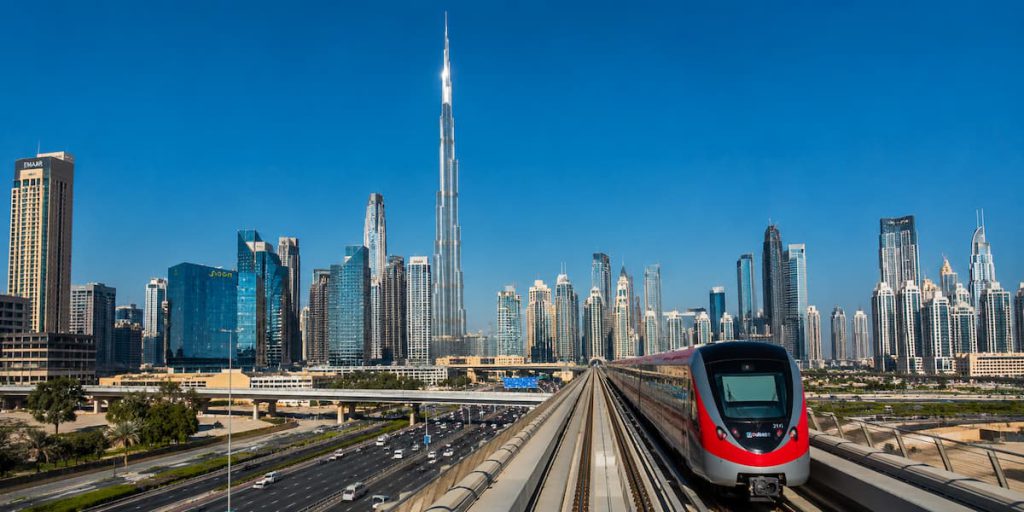
Two lines run today. The Red Line is the tourist workhorse — roughly 52km from Rashidiya past both airport terminals, through BurJuman, down the length of Sheikh Zayed Road past Burj Khalifa/Dubai Mall, Mall of the Emirates, and the Marina cluster (DMCC and Dubai Marina stations), out to Ibn Battuta and the Expo extension. The Green Line loops through the older city — Deira, the Gold Souk area, Bur Dubai, and the Creek — and connects to the Red Line at two interchange stations, Union and BurJuman. If you remember only those two station names, you can navigate the entire system.
A third line is under construction: the Blue Line, adding 30km and 14 stations, with an announced opening of September 9, 2029. It’s irrelevant to your 2026 trip except as an answer to “why is there construction there” — but worth knowing so an older map doesn’t confuse you.
Nol Cards: The Four Types and the Only One Most Tourists Need
The Metro is entirely cashless — no cash at gates, no conductors, no paying on board. Everything runs through the Nol card system, and there are four variants:
- Silver (AED 25, includes AED 19 travel credit) — the standard card, valid five years, works on Metro, buses, tram, water buses, and even RTA paid parking. This is the one to buy for any visit longer than a day or two.
- Gold (AED 25, includes AED 19 credit) — same purchase price, but every journey costs double in exchange for access to the Gold Class cabin at the front of the train: wider seats, fewer people. A comfort choice, not a necessity.
- Red ticket (AED 2 + fare) — a single-use paper ticket from vending machines. Costs more per trip than card fares; only sensible if you’ll genuinely ride once or twice total.
- Blue/Personal (AED 70) — a registered card with 50% discounts for students, seniors, and people of determination. Requires documentation; not aimed at short-stay tourists.
Buy your Silver card at any station’s ticket office or vending machine — it takes two minutes, including at the airport stations, which is exactly where most visitors should get one. Top-ups work at machines, ticket offices, and the RTA’s apps.
Fares, Zones, and the Daily Cap Trick
Dubai’s transport map divides into seven zones, and your fare depends purely on how many you cross: AED 3 within one zone, AED 5 across two adjacent zones, and AED 7.50 for three or more — that last figure covering even the full airport-to-Marina run. You tap in at the entry gate and tap out at exit; the system calculates the fare automatically. Forget to tap out and you’re charged the maximum fare, which is the most common way visitors accidentally overpay.
The detail that makes the Metro absurdly good value: the AED 14 daily cap on Silver cards. Once your day’s travel hits AED 14, every additional journey until midnight is free. Two long cross-city trips get you there, so on a busy sightseeing day — airport hotel to Dubai Mall, Mall of the Emirates in the afternoon, Marina for dinner — you’re effectively riding unlimited for about ₹320. A comparable taxi day would run several hundred dirhams.
One more fare mechanic worth using deliberately: transfers between Metro, bus, and tram within 30 minutes count as a single journey, charged by total zones rather than as separate fares, with up to three transfers allowed. Practical translation: the feeder bus from your hotel to the station, the Metro ride, and the tram hop at the Marina end can all be one fare if you keep moving.
The Cabin System: Where Standing in the Wrong Place Costs Money
Dubai Metro trains are divided into sections, and two of them are enforced with fines rather than suggestions. At one end sits the women and children cabin — reserved for women and kids under 12, clearly marked with pink signage on the platform floor and train doors. Men who board it, even accidentally in a rush, face an on-the-spot fine, and inspectors do check. Women are free to use any cabin; the reservation runs one way.
At the front of the train is Gold Class — the premium cabin with wider seats and lighter crowds. It requires either a Gold Nol card or Gold-fare payment; sitting there on a Silver card is treated exactly like fare evasion. For families travelling together, the practical arrangement is simple: the standard cabins are open to everyone, so groups typically just board those together rather than splitting up.
The Rules That Actually Get Tourists Fined
Dubai’s Metro etiquette is enforced, not aspirational, and the fines land on visitors precisely because the rules differ from most cities’ unwritten norms. The big ones: no eating or drinking anywhere in the paid areas — that includes water (outside genuine medical need), coffee, and chewing gum, and it’s the single most common tourist violation. No sitting on the floor, even on a long ride with tired kids. Seats marked for people of determination, seniors, and pregnant women should be surrendered on request. And hold your Nol card until you’ve tapped out — the exit gates need it, and losing your card mid-journey means paying the maximum fare plus the hassle.
Timing matters too: the Metro runs from early morning until around midnight (later on Thursday/Friday nights, shorter hours on Sundays, with schedule changes on public holidays), and frequencies thin out noticeably in late evening. If your night runs past midnight — a desert safari drop-off, a late Marina dinner — plan on a taxi for the final leg rather than assuming a train will be there.
The Tourist Route Map: Which Stations Actually Matter
Strip the 55-station network down to what a visitor uses, and it’s about eight stops. Airport Terminals 1 and 3 put you on the Red Line the moment you land. Burj Khalifa/Dubai Mall is Downtown — remembering that the station connects to the mall by a 10-15 minute air-conditioned link bridge, as we covered in our Dubai Mall guide. Mall of the Emirates serves Ski Dubai and the Al Barsha hotel cluster. DMCC and Dubai Marina cover the Marina, with the Dubai Tram connecting onward to JBR and the Palm Monorail. On the Green Line, Al Ras and Gold Souk-area stations drop you into old Deira’s souks, and BurJuman/Union are your interchanges between the two lines.
That single Red Line corridor is also a quiet argument in the where-to-stay decision — hotels within walking distance of a Red Line station make the whole city cheaper to explore, which is a point our area-by-area stay guide weighs in detail.
Metro vs Taxi: The Honest Comparison
The Metro wins on cost by a margin that isn’t close — a full sightseeing day capped at AED 14 versus several hundred dirhams of taxi fares, a saving of 50-70% on most point-to-point trips — and it wins on predictability, since Sheikh Zayed Road traffic at 6pm doesn’t touch it. Taxis win in four specific situations: after midnight when the Metro sleeps; door-to-door trips with heavy luggage; destinations off the two lines (Palm Jumeirah’s interior, Jumeirah beach strip, Global Village); and groups of four, where a shared taxi fare per head narrows the gap considerably. The sensible tourist pattern is a hybrid — Metro for the Red Line corridor that covers most of your itinerary, taxis for the gaps — rather than loyalty to either.
For a Hindi-English visual walkthrough of the whole system — buying the card, the gates, the cabins:
Frequently Asked Questions
How much does the Dubai Metro cost?
With a standard Silver Nol card: AED 3 within one zone, AED 5 across two adjacent zones, and AED 7.50 for three or more zones. Daily spending caps at AED 14, after which further rides that day are free.
Which Nol card should tourists buy?
For stays over a day or two, the Silver Nol card (AED 25 including AED 19 of credit) — it works on Metro, buses, tram, and water buses. Single-use Red tickets cost more per trip and only suit one-off rides.
Does the Dubai Metro go to the airport?
Yes — the Red Line has stations at both Terminal 1 and Terminal 3, with direct trains to Burj Khalifa/Dubai Mall and onward to the Marina without changing lines.
What are the Dubai Metro women’s cabin rules?
Each train has a dedicated cabin for women and children under 12, marked on the platform. Men entering it face a fine. The Gold Class cabin requires a Gold card — standing in it with a Silver card is also finable.
Can you eat or drink on the Dubai Metro?
No — eating, drinking (including water, outside medical need), and gum in trains and paid station areas carry on-the-spot fines. It’s the rule visitors most commonly trip over.
Is the Dubai Metro better than taxis for tourists?
For the Red Line corridor — airport, Downtown, Mall of the Emirates, Marina — the Metro is dramatically cheaper and immune to traffic. Taxis win for late nights, awkward routes, and luggage days.
The Bottom Line
Buy a Silver Nol card at the airport station before you’ve even left the terminal, learn the two interchange names (Union and BurJuman), respect the two enforced cabins, and keep your water bottle in your bag until you’re out of the gates. Do that, and the Metro turns Dubai from an expensive city to move around into a genuinely cheap one. It slots into every other piece of your planning too — the fare math above is exactly why our where-to-stay guide keeps coming back to Red Line proximity.
Prefer to skip the route-planning entirely? Our Dubai tour packages include transfers where they make sense and Metro-smart itineraries where they don’t — the best of both.
Trekhops Editorial Team is a Dubai Travel Specialist, who plans itineraries around the AED 14 daily cap on principle.