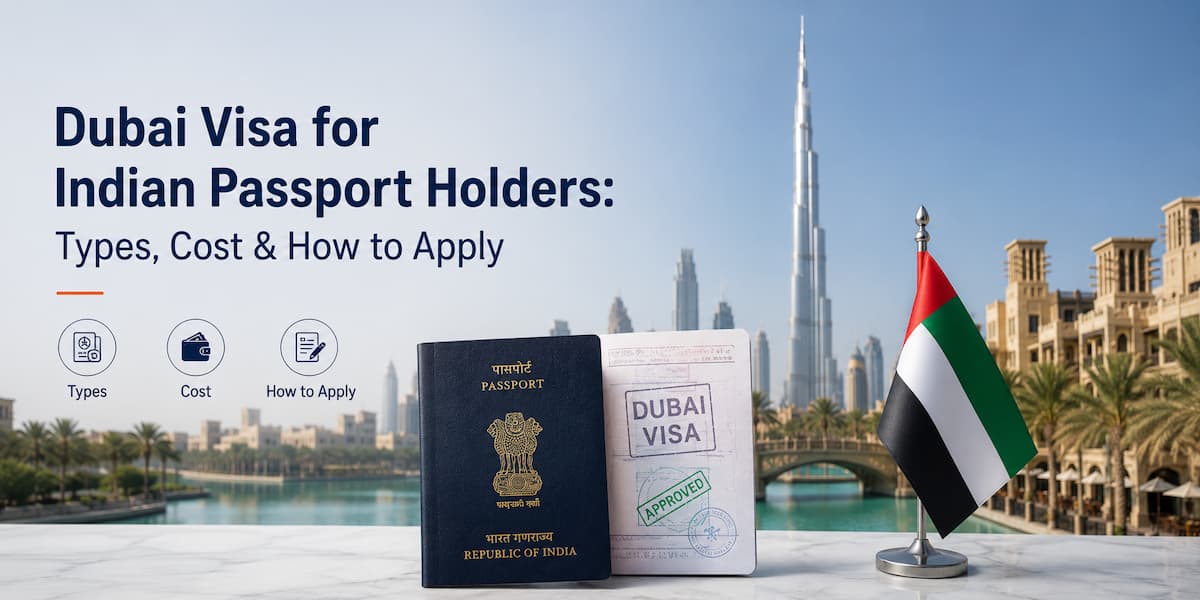
By Trekhops Editorial Team, Dubai Travel Specialist · Published Jan 9, 2026 · 9 min read
Short answer: yes, you need a visa, and no, you can’t just land and get stamped in for free. The longer answer is that a small number of Indian travellers skip the paperwork entirely because of a visa they already hold for a different country — and most guides bury that detail instead of leading with it.
Key Takeaways
- India is not visa-free for the UAE — every Indian passport holder needs an e-visa or a visa on arrival
- If you hold a valid US, UK, EU, Australian, Canadian, Japanese, New Zealand, South Korean, or Singaporean visa/residence permit (6+ months left), you likely qualify for visa on arrival instead
- Standard tourist e-visas run ₹8,000-21,000 depending on 30-day vs 60-day and how you apply — always confirm the live fee before paying
- Processing is normally 3-4 working days; apply at least 2 weeks before you fly, not the week of
- Most rejections come down to document quality and detail mismatches, not eligibility — both are fully within your control
Do You Actually Need a Visa? (And the Exception Most People Miss)
Yes — India isn’t on the UAE’s visa-free list, so unlike a US, UK, or EU passport holder, you can’t just book a flight and turn up. That said, there’s a genuinely useful exception. If you hold a valid, unexpired visa or residence permit from the United States, United Kingdom, an EU country, Australia, Canada, Japan, New Zealand, South Korea, or Singapore — with at least 6 months left on it — you qualify for a single-entry, 14-day visa on arrival at any UAE entry point, no advance application needed.
This rule has been in place since January 2024 and applies specifically to ordinary Indian passports; a US Green Card counts too. If none of that applies to you, you’re in the same boat as most Indian travellers: you’ll need to apply for a standard tourist e-visa before you fly, which is what most of this guide covers.
Visa Types and What They Actually Cost
Once you know you need the standard route, there are really four options worth knowing about, and the fee you’ll be quoted depends heavily on where you apply and how fast you need it.
- 30-day single-entry tourist visa — the default choice for a standard holiday. Typically ₹8,000-13,000 including service fees.
- 60-day single-entry tourist visa — worth it if your trip runs long or you’re combining Dubai with a side trip to Abu Dhabi, Oman, or elsewhere in the region. Typically ₹13,500-21,000.
- Multiple-entry visa (1-year validity) — built for people who’ll be back within the year; each individual stay is still capped at 30 or 90 days. Better value than applying fresh every trip if you visit more than once or twice a year.
- Visa on arrival — only if you qualify via the exception above. Roughly ₹5,500-6,500, paid at the airport itself.
One more in the pipeline: a GCC Unified Tourist Visa — a single visa valid across several Gulf states — has been approved in principle and is expected to roll out sometime around late 2025 or 2026. It isn’t fully operational yet, so don’t plan a trip around it until it’s confirmed live.Visa on Arrival*~₹6,00030-Day Tourist Visa~₹9,00060-Day Tourist Visa~₹16,0001-Yr Multiple Entry~₹18,000*Only if eligible via a qualifying US/UK/EU/etc. visa. Figures approximate — confirm current fees with GDRFA/ICP or your provider.
How to Apply, Step by Step
- Pick your channel. Apply directly through the UAE’s own ICP Smart Services or GDRFA Dubai portals, through an airline you’re already booked with (Emirates and Air India both process visas via their “manage booking” tools), or through a travel agent or platform like VFS Global for a small added convenience fee. All of them run through the same underlying government approval — an agent doesn’t get you approved faster, just handles the paperwork for you.
- Upload your documents. Passport, photo, ticket, and accommodation proof, all scanned in colour, PDF or JPEG. Blurry or cropped scans are the single most avoidable cause of delay.
- Pay the fee. Card, net banking, or through your agent depending on the channel.
- Wait 3-4 working days for standard processing, or pay extra for 24-48 hour express processing if you’re cutting it close.
- Receive your e-visa by email as a PDF — the UAE doesn’t issue a physical visa sticker anymore. Print it and carry it to immigration; you’ll need it even though it’s not stuck in your passport.
Documents checklist: passport valid 6+ months from entry date · recent colour photo (white background) · confirmed return or onward ticket · hotel booking or accommodation proof · scanned passport copy (first and last page) · PAN card copy (requested by some providers) · travel insurance (not universally mandatory, but several agents now bundle it in, and it’s worth having regardless).

Why Applications Actually Get Rejected
Eligibility almost never the problem for Indian applicants — document quality is. The recurring causes, in order of how often they show up:
- Blurry or incomplete scans — a photographed document on a phone, at an angle, with a corner cut off. Use an actual scanner or a proper scanning app.
- Detail mismatches — your name, date of birth, or passport number entered slightly differently from how it appears on your passport. Immigration systems flag this automatically; there’s no benefit of the doubt.
- Passport validity under 6 months from your planned entry date. Renew first, apply second — not the other way round.
- Unresolved history — a previous UAE visa you didn’t use, an old overstay, or a pending residence visa issue. Sort this out with GDRFA before reapplying, rather than hoping it goes unnoticed.
- Applying too close to your travel date, which leaves no buffer to fix a document issue if one comes up. Two to three weeks ahead is a safer window than a few days.
Every one of these is fixable before you submit, which is really the point — a rejection here is almost always a documentation problem, not a “you’re not eligible” problem.
For a walkthrough of the actual portal screens and upload steps, this is a useful watch:
Frequently Asked Questions
Do Indian citizens need a visa to visit Dubai?
Yes. India is not on the UAE’s visa-free list, so every Indian passport holder needs either a pre-arranged tourist e-visa or, if eligible, a visa on arrival. There’s no walking off the plane and getting stamped in for free.
Can Indians get a UAE visa on arrival?
Only if you hold a valid, unexpired visa or residence permit (6+ months validity) from the US, UK, EU, Australia, Canada, Japan, New Zealand, South Korea, or Singapore. If you qualify, you get a single-entry, 14-day visa on arrival. Everyone else must apply for an e-visa in advance.
How long does a Dubai tourist visa take to process for Indians?
Standard processing is typically 3-4 working days. Express or urgent processing is available through most channels for an extra fee, usually turning it around in 24-48 hours.
How much does a Dubai visa cost for Indian citizens?
Roughly ₹8,000-13,000 for a 30-day single-entry visa and ₹13,500-21,000 for a 60-day version, including standard service fees. Visa-on-arrival, where eligible, runs closer to ₹5,500-6,500. Always confirm the current fee before paying.
What documents do I need for a UAE tourist visa from India?
A passport valid 6+ months from your entry date, a recent colour photograph, a confirmed return or onward ticket, and proof of accommodation such as a hotel booking. Some channels also ask for a scanned PAN card copy or basic financial proof.
Can I extend my Dubai tourist visa after I arrive?
Yes, most short-term tourist visas can be extended, typically twice, for around 30 days each time, through GDRFA or your visa provider. Apply before your current visa expires — overstaying even by a day brings daily fines.
What are the most common reasons Indian UAE visa applications get rejected?
Blurry or incomplete document scans, name or date-of-birth mismatches against the passport, a passport with under 6 months validity, and unresolved issues from a past UAE visa are the recurring causes.
Do I need a travel agent to apply for a Dubai visa from India?
No. You can apply directly through the UAE’s own ICP or GDRFA portals, or through an airline like Emirates or Air India via “manage booking”. Agents just add convenience and a service fee on top of the same government process.
The Bottom Line
Check the visa-on-arrival exception first — it’s the detail most travellers never think to look for, and it can save you both money and a two-week wait. If you don’t qualify, apply for the standard e-visa at least two to three weeks out, keep your scans sharp and your details consistent with your passport, and the rest of this is genuinely routine. Once your visa is sorted, pair it with our guide on the best time to visit Dubai from India to lock in your travel window, or see our existing breakdown for planning a Dubai trip from Delhi if that’s your starting point.
Once your dates and visa are settled, our Dubai tour packages can take the rest of the planning off your hands.
Trekhops Editorial Team is a Dubai Travel Specialist, who has guided Indian travellers through the visa process for both first-time and repeat Dubai trips.