By TrekHops Travel Desk · Published July 14, 2026 · Last Updated August 03, 2026 · 8 min read
If you’re flying from Rajkot to Dubai, there’s one thing worth knowing before anything else: Rajkot Airport doesn’t have a direct Dubai flight. Despite the “International” in its name, Hirasar Airport currently handles only domestic scheduled flights.
Your trip actually happens in two parts — a domestic flight from Rajkot to a connecting city, then an international flight onward to Dubai. Immigration, baggage handling, and boarding all work differently than a nonstop international departure, and that difference is what catches most first-time travelers off guard.
This guide walks you through exactly what to expect at each stage: check-in and security at Rajkot, how your connection actually works, and the practical details — facilities, transport, documents — that make departure day run smoothly from start to finish.
Who This Guide Is For
- ✓ First-time international travelers
- ✓ Families
- ✓ Senior citizens
- ✓ Travelers from Rajkot and Saurashtra
- ✓ Anyone connecting via Mumbai or Delhi
Rajkot Airport at a Glance
Your journey at a glance: Rajkot → connecting city (Mumbai or Delhi) → immigration → Dubai
| Topic | Quick Answer |
|---|---|
| Airport Name | Rajkot Greenfield International Airport (Hirasar), officially Rajkot International Airport |
| Airport Code | HSR |
| Location | Hirasar village, Rajkot district, Gujarat |
| Distance from Rajkot City | About 30 km, on the Rajkot-Ahmedabad highway corridor |
| Terminal Information | Single terminal: 20 check-in counters, 4 aerobridges, 3 baggage belts, 8 immigration counters, 7 boarding gates |
| International Flights | Scheduled service is domestic only; Dubai is reached via a connecting flight |
| Parking | On-site multi-level parking with a separate drop-off area |
| Transport Options | Prepaid taxi, app-based cabs, private car, GSRTC bus |
| Recommended Arrival Time | 2 hours before your domestic departure |
Key takeaway: Your Rajkot departure is processed as domestic. Immigration and customs for Dubai happen at your connecting city, not here. Everything else in this guide builds on that one fact.
Understanding Rajkot Airport
Domestic vs. International Capability
Every Dubai-bound traveler asks the same question first: can I fly direct from Rajkot? Not yet.
Hirasar’s terminal includes 8 immigration counters and 7 boarding gates, clearly built with future international departures in mind. But infrastructure and scheduled service are two different things — no airline runs scheduled international passenger flights out of Rajkot today. Every flight in and out of Hirasar is domestic, which is exactly why the rest of this guide is built around a two-flight journey rather than one.
Why a Connection Is Required
Since Hirasar has no direct international service yet, every Rajkot-to-Dubai itinerary routes through a connecting city — making you a transit passenger for part of your journey rather than someone starting and ending at the same airport. Mumbai and Delhi aren’t just Rajkot’s two busiest domestic routes; they’re also two of India’s biggest gateways to Dubai, served by multiple airlines with frequent daily departures.
That overlap is exactly why most Rajkot-Dubai tickets are built around Mumbai or Delhi, rather than Ahmedabad, which — despite being in the same state — isn’t currently on Rajkot’s own flight map. Our Rajkot to Dubai Flights guide covers the full route in more depth, and our Best Connecting Airports for Rajkot-Dubai Flights guide digs further into your routing options.
Airport Overview
Rajkot Greenfield International Airport sits in Hirasar village, about 30 km from central Rajkot. It’s owned and operated by the Airports Authority of India (AAI), and its official name — Rajkot International Airport — already signals it was built with more than domestic traffic in mind.
The airport opened in 2023, with commercial flights fully shifting from the old in-city Rajkot Airport on September 10, 2023. That older airport still operates today, but only for general aviation and VIP traffic — every scheduled passenger flight now uses Hirasar.
Airport History
The old in-city Rajkot Airport had a runway capped at 1,800 metres, with no room left to expand. Hirasar removes that ceiling, built for widebody aircraft — part of why its immigration counters already exist even though they’re not yet in use.
Planning Your Connection
Once you know a connection is required, these are the decisions that actually shape your trip.
Is Rajkot the right airport for you?
Rajkot is a practical choice for many Dubai-bound travelers, but not every itinerary benefits equally from starting here.
| Rajkot Airport is ideal if… | Consider another airport if… |
|---|---|
| You live in Rajkot or nearby Saurashtra cities | You want a nonstop Dubai flight |
| You prefer a shorter drive to the airport | You want the shortest possible total journey time |
| You’re comfortable with one domestic connection | You’re carrying unusually heavy baggage and want to avoid a transfer |
| Mumbai or Delhi flight schedules suit your plans | A direct flight from Ahmedabad or Surat saves you significant time |
For most travelers based in Rajkot, Jamnagar, Junagadh, Porbandar, and nearby areas, Rajkot remains the most practical departure airport despite requiring one connection.
Choosing between Mumbai and Delhi
Both cities work as a connection point, but they’re not identical. Mumbai generally offers more Dubai-bound flight frequency, since it’s one of India’s busiest Gulf gateways. Delhi works just as well operationally, and plenty of travelers find its domestic-to-international flow just as manageable for a first transfer.
| Situation | Better Option | Why |
|---|---|---|
| Maximum flight choices | Mumbai | Higher overall Dubai-bound frequency |
| Better schedule flexibility | Mumbai | More options if your domestic flight shifts |
| Family travel | Either, with a longer layover | The buffer matters more than the city |
| First international trip | Either, with a 3-4+ hour connection | Extra time matters more than which airport |
| Separate flight tickets | Either, with extra buffer either way | You’re managing the connection risk yourself regardless of city |
The connecting airport itself usually matters less than allowing enough transfer time. A comfortable layover is often more valuable than choosing one airport over the other.
Who flies from Rajkot
Two airlines currently serve Rajkot: IndiGo and Air India, running roughly 10 flights a day between them. Together they connect Rajkot to Mumbai, Delhi, Bengaluru, Pune, Hyderabad, and Goa — with Mumbai and Delhi as the busiest routes, the same two cities that work best for a Dubai connection. Our Airlines Flying from Rajkot to Dubai guide has a closer look at who flies where.
Step-by-Step: Your Departure Journey
Before you leave for Rajkot Airport: ✓ Passport ✓ Visa ✓ Confirm your baggage policy ✓ Check your flight status ✓ Carry a charger
The full sequence, from curb to cabin, across both legs of your trip:
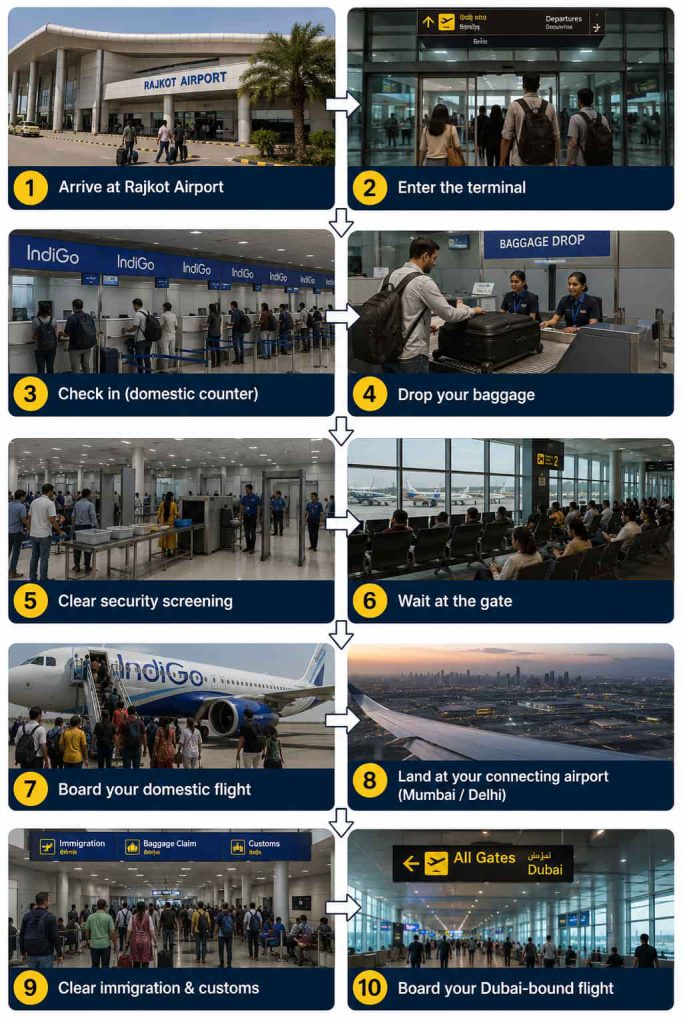
A rough timeline, working backward from your domestic departure:
| Time Before Departure | What Happens | Typical Duration |
|---|---|---|
| T-3h00 or earlier | Leave Rajkot city | Depends on your location |
| T-2h00 | Check-in and baggage drop | 20-30 minutes |
| T-1h30 | Security screening | 15-25 minutes |
| T-0h45 | Wait near the boarding gate | Variable |
| T-0h20 | Boarding begins | 15-20 minutes |
1. Arriving at the Airport
Budget your road transfer time separately from your airport time. Hirasar is about 30 km from central Rajkot, and city traffic can add to that. Drop-off and short-term parking sit right at the terminal entrance.
2. Entering the Terminal
Staff typically check that you have a valid ticket or booking confirmation before you enter — standard at Indian airports, so only ticketed passengers generally go past this point. If you need someone to accompany you inside, for elderly assistance say, ask your airline about arranging that in advance rather than assuming it on the day. Keep your ID and booking reference somewhere easy to reach; a digital copy in DigiLocker works as valid ID alongside your physical documents.
3. Check-In
Head to your airline’s counter — IndiGo and Air India both have dedicated desks among the terminal’s 20 check-in counters. Domestic check-in counters typically close 45-60 minutes before departure, though this varies by airline, so don’t leave it to the last minute; if you haven’t checked in online, you can also print your boarding pass here. If your Rajkot-Dubai ticket is a single PNR — one combined booking covering both flights — ask the agent whether they can also issue your connecting boarding pass; this varies by airline and routing.
Before you leave the counter, confirm:
- Is your baggage tagged through to Dubai?
- Do you already have your Dubai boarding pass?
- Which terminal you’ll need at your connecting airport?
4. Baggage Drop
Through baggage matters most right here. Ask directly: is your checked baggage tagged all the way through to Dubai, or only as far as your connecting city? Travelers who skip this question often find out only after landing that they need to collect and re-check their bags — which eats directly into their connection time.
5. Security Screening
Standard domestic screening applies — there’s no separate international security process at Rajkot, since your first leg is domestic. Expect the usual: laptops and liquids out, boarding pass and ID ready. Solid homemade food is generally fine through domestic security in India; it’s liquids and gels that face restrictions.
6. Waiting Area
Once through security, you’re in the gate area, with seating, food and beverage counters, retail space, and water points if you need a refill. Check the departure board for your gate number, and if you have data access, this is a good moment to double-check your connecting flight’s gate or terminal information too.
7. Boarding
Boarding at Hirasar uses the terminal’s aerobridges where assigned, or occasionally a short walk to the aircraft. Gates typically close a set number of minutes before departure — once that boarding cut-off passes, a late passenger can be denied boarding even with a valid ticket, so don’t cut this one close.
8. Arrival at Your Connecting Airport
Your journey shifts from a domestic arrival to an international departure here — Mumbai and Delhi both handle this exact shift for thousands of passengers a day.
Follow signage for “connections” or “transfers” rather than the general arrivals exit. Some transfers let you stay airside the whole way, without leaving the secure zone — a domestic-to-international connection isn’t one of them. Because you’re moving from a flight that didn’t need immigration to one that does, you’ll go through passport control and international security regardless of how your baggage is handled; treat it as a landside-style transfer even if you never technically leave the building. If anything about your booking needs sorting out, the transfer desk can help.
9. Immigration and Customs
This step happens here, not at Rajkot. In practice, that means a physical passport check and an exit stamp from India, plus customs clearance if you’re carrying anything dutiable. If applicable, you’ll also collect and re-check your baggage here before heading toward international departures for your Dubai flight.
10. International Departure
From here, it’s a standard international departure: transfer security screening, your Dubai boarding pass, and the gate. The time between your two flights is your layover — build in extra room if it’s your first time navigating a transfer at a large hub airport. Once you land, our Dubai Airport Arrival Guide picks up where this one leaves off.
Airport Facilities
The terminal is modern and built to handle far more passenger volume than the old in-city airport ever could. The basics are covered without a second thought: 20 check-in counters, standard domestic security, restrooms, and drinking water throughout the building.
Beyond that, a few additions round out the experience: the Yatri Udan café, the “Flybrary” reading corner, a dedicated kids’ play zone, retail space, and charging points at most seating areas — genuinely useful if you’re facing a long travel day with children in tow.
A few things are worth confirming rather than assuming. Dedicated lounge access is still limited at newer airports like Hirasar. Wi-Fi coverage can vary, so don’t rely on it for anything time-critical, including online check-in. And currency exchange, the prayer room, and specific accessibility arrangements are best confirmed with your airline or airport staff on arrival rather than taken for granted.
| Facility | What to Expect |
|---|---|
| Check-in counters | 20 counters across the terminal |
| Security | Standard domestic screening |
| Waiting lounge | General seating throughout the gate area |
| Food & beverage | Multiple outlets, including a Yatri Udan café |
| Restrooms | Available throughout the terminal |
| Drinking water | Water points across the terminal |
| Shops | Retail space near the gate area |
| Wi-Fi | Typically available; check current signage on arrival |
| Charging points | Present at most seating areas |
| Accessibility | Standard AAI provisions; confirm specific needs with your airline in advance |
| Medical assistance | On-site medical support, standard at AAI airports |
| Kids’ facilities | A dedicated kids’ play zone |
| Reading area | A small library corner known as the “Flybrary” |
| Prayer room | Confirm current availability with airport staff on arrival |
Getting to Rajkot Airport
Distance and Route
Hirasar Airport is about 30 km from central Rajkot, on the highway corridor that also connects Rajkot toward Ahmedabad. In normal traffic, budget 35-50 minutes for the drive, and add extra time if you’re leaving during the city’s peak traffic hours.
Transport Options
| Option | Good For | What to Know |
|---|---|---|
| Prepaid taxi | Most travelers | Counters operate inside the terminal; fares commonly run roughly ₹600-1,200 depending on vehicle type (estimate — confirm at the counter) |
| App-based cabs | Convenience | Ola and Uber both operate here, though late-night availability can be less consistent than in bigger metros |
| Private car / self-drive | Flexibility | Straightforward on the Rajkot-Ahmedabad corridor; factor in city traffic near Rajkot |
| GSRTC bus | Budget travelers | Electric buses connect Rajkot Central Bus Port to the airport; the most economical option, but check current schedules in advance |
| Hotel transfer | Families, first-timers | Many Rajkot hotels arrange airport transfers — ask when booking |
Reaching Hirasar from Nearby Towns
Hirasar doesn’t just serve Rajkot city — it’s the natural regional airport for much of Saurashtra. Approximate road distances:
- Jamnagar: roughly 90-110 km
- Junagadh: roughly 130-150 km
- Porbandar: roughly 200-220 km (allow 3-4 hours by car)
If you’re traveling in from one of these towns, add that transfer time on top of your airport buffer, and consider whether an overnight stay near Rajkot makes more sense than a same-day dash.
Parking
The terminal has dedicated multi-level parking along with a short-term drop-off area separate from long-stay parking, built for far more passenger volume than the old in-city airport could ever handle. Current parking rates are best confirmed directly with the airport operator, since these are periodically revised.
Best Time to Leave the City
Work backward from your 2-hour arrival window, then pad it for city traffic rather than assuming a clear run.
What Dubai-Bound Travelers Should Know
This section covers the concerns specific to connecting through to Dubai, not just flying domestically. In brief:
| Rajkot Airport | Connecting Airport |
|---|---|
| Domestic check-in | International check-in (if required) |
| Domestic security | Immigration |
| No passport control | Passport control |
| Board domestic flight | Board Dubai flight |
Everything below unpacks what that actually means for your specific booking.
Where Immigration Actually Happens
Immigration for Rajkot-Dubai passengers takes place at the connecting airport, not at Rajkot Airport. Because your first flight is domestic, Rajkot only handles domestic check-in and security — immigration begins only after you reach your connecting airport, before boarding your Dubai flight.
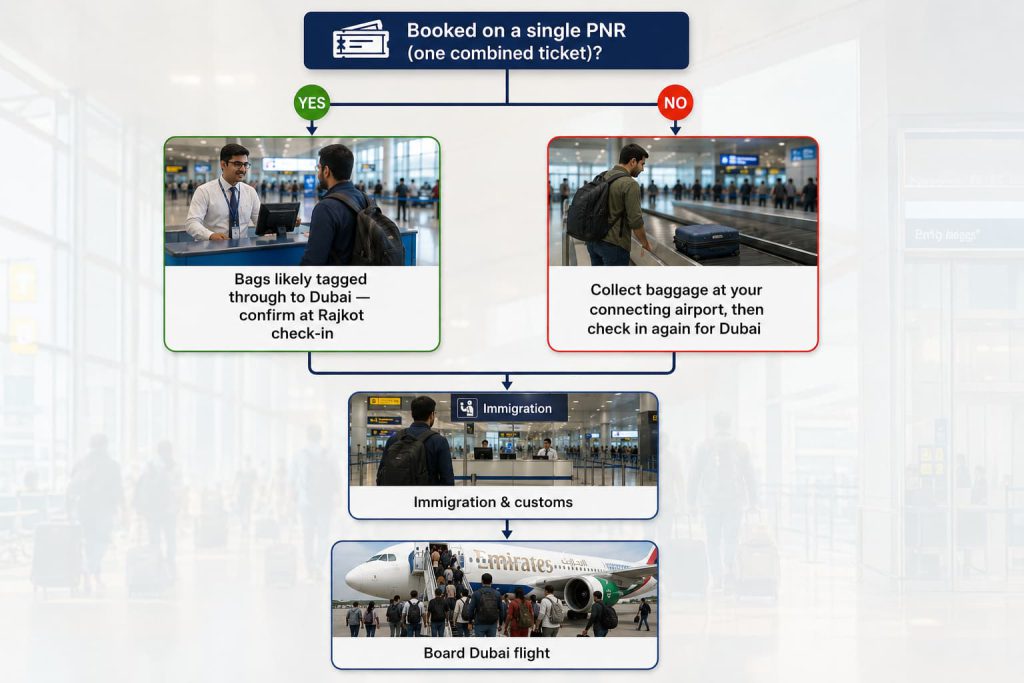
Through Check-In vs. Separate Check-In
How your ticket was booked determines a lot about your day — and it comes down to whether you’re on a single PNR or two separate ones.
| Feature | One Ticket (Single PNR) | Separate Tickets (Separate PNRs) |
|---|---|---|
| Boarding pass | May receive both at Rajkot | Separate check-in at each airport |
| Baggage | May be tagged through to Dubai | Usually collect and re-check |
| Missed connection | Airline generally responsible for rebooking | You’re responsible for a new ticket |
| Check-in process | Simpler, often one step | Multiple check-ins |
| Transfer time needed | Less | More |
That “missed connection” row matters more than it looks. If your Rajkot-Dubai booking is on one ticket and your domestic flight runs late, the airline is generally on the hook for getting you on the next available Dubai flight — a protection sometimes called connection protection (or a protected connection). Book the two legs separately, even with the same airline, and a delay becomes entirely your problem to solve and pay for.
If you’re not sure which situation applies to you, ask your airline or travel agent before departure day, when there’s more room to adjust than at the check-in counter.
Baggage Transfer
Through-tagging isn’t guaranteed just because you’re on one ticket — it depends on whether the two airlines involved have an interline baggage agreement covering that specific routing. Same-airline connections (Air India to Air India, say) almost always qualify; a connection across two different airlines depends on whether they’ve set that agreement up for your route, which is exactly why confirming at the Rajkot counter matters more than assuming. If your bag isn’t through-tagged, budget real time at your connecting airport to collect and re-check it — usually the single biggest time cost in a self-transfer.
Boarding Passes
Through-ticketed passengers can sometimes get both boarding passes issued at Rajkot. If not, you’ll collect your Dubai boarding pass at your connecting airport’s transfer or international check-in desk.
Transit Procedures at Your Connecting Airport
Follow signage for “connections” or “transfers” rather than general arrivals when you land. Which terminal you land in matters: at Mumbai, Air India’s domestic and international flights both operate from Terminal 2, so an Air India connection often means no terminal change at all, while IndiGo’s domestic flights typically use a different terminal, meaning a short shuttle transfer between buildings. At Delhi, every international departure operates from Terminal 3, where Air India’s domestic flights also depart from; other carriers’ domestic terminal assignments shift periodically, so check your specific boarding pass rather than assuming. Our Mumbai Airport Transfer Guide and Delhi Airport Transfer Guide cover this in more depth for whichever hub you’re connecting through.
Documents to Keep Accessible
Keep these within easy reach, not buried in checked luggage:
- Passport, with your Dubai entry documentation however you’ve arranged it
- Connecting flight booking reference and boarding pass details
- Domestic boarding pass through to your connecting city
Keeping everything together avoids delays during immigration and boarding, especially if you’re navigating a large connecting airport for the first time. For the visa side specifically, our Dubai Visa Guide walks through what’s needed — worth sorting out well before departure day.
Transit Time Considerations
Mumbai’s own airport guidance recommends at least 3-4 hours for an international connection, more if you’re changing terminals — a reasonable floor even if you’re connecting through Delhi instead. Airlines and airports don’t publish one fixed minimum connection time (MCT) for domestic-to-international transfers in India, so exactly how much you need depends on your situation:
| Situation | Suggested Buffer |
|---|---|
| Single PNR, bags through-tagged | 2-3 hours |
| Separate tickets | 4-5 hours |
| Traveling with senior citizens | 4+ hours |
| Family with young children | 4+ hours |
| Wheelchair or mobility assistance | 5+ hours |
These are practical starting points, not official rules — which is exactly why building in your own margin matters more than chasing an exact number. A few situations raise the risk regardless of buffer: the last domestic flight of the day (no recovery option if it’s delayed or cancelled), an unusually short self-transfer, or travel during peak periods when both airports are busiest. None of these rule out a trip — they just deserve extra room.
Practical Tips for a Smooth Departure
A short, phase-by-phase checklist to work through before you leave — organized around the moments that actually matter on departure day, rather than a generic packing list.
If this is your first international trip: A longer connection is usually less stressful than the shortest possible itinerary. Build the buffer in now, not on the day.
15 Practical Tips Every First-Time International Traveler Should Follow
Before leaving home
- Confirm whether your Rajkot-Dubai ticket is one combined booking or two separate ones
- Check your Dubai entry requirements and visa status in advance
- Charge your phone and pack a portable charger
Before entering the airport
- Build in extra time for the road transfer from Rajkot or a nearby town
- Keep your ID and booking confirmation somewhere accessible
During check-in
- Ask whether your baggage is through-tagged to Dubai
- Confirm whether you can collect your connecting boarding pass here
- Check your baggage allowance for the international leg — it may differ from the domestic one
Before security
- Keep liquids, laptops, and other screening items easy to reach
- Double-check you’re not carrying anything restricted for international travel
During transit at your connecting hub
- Follow “connections” or “transfer” signage rather than general arrivals
- Give yourself a generous buffer — don’t cut a first-time transfer close
- Keep your connecting boarding pass and passport together
Before boarding to Dubai
- Reconfirm your gate, since connecting flights can shift gates
- Have your passport and boarding pass ready before you reach the gate
- Keep valuables and documents in your carry-on, not checked baggage
None of these steps takes long on its own. Together, they’re the difference between a departure day that runs smoothly and one where small gaps compound into real stress.
Common Mistakes First-Time Travelers Make
These are the slip-ups that come up again and again for first-time travelers on this exact route, most of them easy to avoid once you know to look out for them.
Arriving Too Late
It’s tempting to treat this as “just a domestic flight” and arrive with less buffer than you would for international travel. But the overall journey is still an international trip — buffer skipped at Rajkot often gets borrowed, uncomfortably, from your connection time later.
Assuming Immigration Happens at Rajkot
Some travelers assume that because Hirasar has immigration counters, their passport gets stamped here. It doesn’t, not for this route, not today. Check your actual ticket routing rather than assuming.
Carrying Prohibited Items
Standard restrictions apply on both legs, but international rules can be stricter on liquids, certain electronics, and other items. If you’re unsure about something, check before you pack it — our Cabin Baggage Rules guide covers what’s restricted on both legs.
Not Checking Baggage Allowance
Domestic and international baggage allowances often differ, sometimes significantly. A bag that’s fine for the Rajkot-Mumbai leg could put you over the limit for Mumbai-Dubai. Check both allowances separately before you pack.
Forgetting Passport or Visa Documents
Because the first leg feels routine and domestic, it’s surprisingly easy to leave home without double-checking passport and visa documents. Treat departure-day document checks the same way you would for any international trip, because it is one.
Ignoring Transit Instructions
Walking out through general arrivals instead of following transfer signage can cost real time, sometimes enough to jeopardize a tight connection. Look for “connections” or “transfer” signage the moment you land.
Underestimating Traffic to Hirasar
Thirty kilometers can mean anywhere from 35 minutes to well over an hour, depending on when you’re traveling. Build your buffer around worst-case traffic, not best-case.
Rajkot Airport vs Major Gujarat Airports
If you’re flexible on where you start your journey, it’s worth knowing how Rajkot compares to Gujarat’s other major airports for a Dubai trip.
| Airport | Direct Dubai Flight | Typical Drive from Rajkot | Typical Total Journey | Best For |
|---|---|---|---|---|
| Rajkot (HSR) | No | — (this is your home airport) | Longer (one connection required) | Rajkot & Saurashtra residents |
| Ahmedabad (AMD) | Yes | 4-5 hours | Shorter | Travelers prioritizing a nonstop flight |
| Surat (STV) | Yes | 6-7 hours | Shorter | South Gujarat travelers |
Ahmedabad’s Sardar Vallabhbhai Patel International Airport is Gujarat’s largest gateway, with direct Dubai service and the widest airline choice in the state — worth the several-hour road trip from Rajkot only if a nonstop flight outweighs the extra ground travel. Surat offers direct Air India Express service to both Dubai and Sharjah, resumed in May 2026 after a temporary suspension, but the drive alone makes it impractical for most Rajkot-based travelers.
Despite not having a direct Dubai flight, Rajkot remains the practical choice for most Saurashtra-based travelers: it’s close, has real capacity, and connects easily to Mumbai and Delhi, both major Dubai gateways in their own right. The extra connection adds time, not complexity, once you know what to expect. Our Rajkot to Dubai Flight Prices guide has a deeper dive into pricing across these options.
Quick Summary
If you only remember five things before flying from Rajkot to Dubai, make them these:
- Rajkot currently operates domestic flights only.
- Dubai journeys require a connection, usually through Mumbai or Delhi.
- Immigration happens at the connecting airport, not at Rajkot.
- Ask whether your baggage is tagged through to Dubai.
- Leave enough layover time, especially if you’re traveling on separate tickets.
Frequently Asked Questions
How early should I arrive?
Arrive at Hirasar at least 2 hours before your domestic departure — enough time for check-in, baggage drop, and security without eating into the buffer you’ll need at your connecting airport. Separately, look up your connecting flight’s international check-in cutoff and build a realistic layover for immigration, security, and any baggage re-check at your hub.
Can I use DigiYatra for my domestic flight at Rajkot?
Not yet, as of today. DigiYatra, India’s facial-recognition boarding system, is expanding fast and now covers around 38 airports nationally, but Rajkot sits on the list of Tier-3 airports expected to get it in an upcoming rollout phase rather than one where it’s already live. Carry standard physical ID and your boarding pass as normal, and check the DigiYatra app directly for the most current status before you travel.
How far is Rajkot Greenfield International Airport from the city?
Hirasar Airport is roughly 30 km from central Rajkot, on the highway corridor that also connects Rajkot toward Ahmedabad. By road, that typically works out to 35-50 minutes in normal traffic, longer during the city’s peak hours. If you’re coming from further afield in Saurashtra, such as Jamnagar, Junagadh, or Porbandar, budget significantly more time.
How many check-in counters does the airport have?
The terminal has 20 check-in counters, along with 4 aerobridges and 3 baggage conveyor belts — a significant capacity jump from the old in-city Rajkot airport, and it noticeably reduces queue times during busier departure banks.
Is there an international terminal?
Not a separate one. Hirasar operates a single terminal building that includes 8 immigration counters and 7 boarding gates, built with future international service in mind, but as of now, every scheduled flight in and out of Rajkot is domestic. IndiGo and Air India are currently the only airlines operating here.
Is parking available?
Yes. The terminal includes dedicated multi-level parking along with a separate short-term drop-off area, built to handle far more traffic than the old in-city airport ever could. Current parking rates aren’t something we’d want to guess at here, since AAI airports periodically revise them. It’s worth confirming directly with the airport operator or checking signage on arrival.
Are food options available after security?
Yes. The terminal’s gate area includes food and beverage outlets, including a dedicated Yatri Udan café, along with retail space. It’s not a large international terminal with dozens of options, but you won’t go hungry waiting for a domestic flight here.
What documents should I keep handy during departure?
Keep your passport, connecting flight booking details, and both boarding passes (domestic and, if issued, your Dubai one) somewhere easily accessible, not in checked luggage. If you’re still sorting out your Dubai entry requirements, our Dubai Visa Guide walks through what’s needed before you get anywhere near the airport.
Is the airport suitable for senior citizens?
Hirasar’s terminal is modern and straightforward in its core passenger flow, with standard AAI accessibility provisions. That said, if you’re traveling with a senior citizen who needs specific assistance, wheelchair support, for instance, it’s worth arranging that directly with your airline in advance rather than assuming it on arrival, especially for the connecting international leg.
Can I check my baggage through to Dubai?
It depends on how your ticket was booked and whether your airlines have an interline baggage agreement for your routing. If your Rajkot-Dubai journey is a single combined booking, your bags may be tagged straight through to Dubai — ask at the Rajkot check-in counter to confirm. If not, you’ll need to collect them after landing at your connecting airport, take them to the international check-in counter, check them in again, and then proceed through immigration and security — extra time you should build into your connection.
Is a 2-hour layover enough at my connecting airport?
It depends on how your flights are booked. For a single combined ticket, airlines generally schedule connections that meet the airport’s own minimum requirements, so 2 hours can work. For separate tickets, 2 hours can be risky — baggage collection, re-check-in, immigration, and security all take additional time on top of it. Most first-time travelers are better off with a longer connection than the minimum.
Can I leave the airport during my layover?
Only if your connection is long enough and your itinerary requires it — for instance, if you need to exit to collect baggage or move between terminals. You’ll still need to complete international check-in, immigration, and security again before boarding your Dubai flight, so factor that into your timing rather than treating it as free time.
What happens if I miss my Dubai flight because my domestic flight was delayed?
It depends on how you booked. If both flights are on one ticket, the airline is generally responsible for rebooking you on the next available Dubai flight, since they sold you the connection. If you booked the two legs as separate tickets, even with the same airline, a missed connection is your responsibility to resolve, usually at your own cost.
Do I clear immigration at Rajkot for a Dubai flight?
No. Your trip starts as a domestic flight, so you go through standard domestic check-in and security at Rajkot, with no passport control step. Immigration, customs, and international security all happen once you land at your connecting airport and transition to your Dubai-bound flight. Hirasar’s terminal does have immigration counters built in, but they’re there for future international service, not for domestic-to-international connections today.
Final Departure Checklist
A last pass before you leave home:
Documents
- Passport, valid with sufficient validity for your trip
- Dubai visa or entry documentation
- Domestic and connecting boarding passes, or booking references
- Travel insurance details
Money & Essentials
- Cash and cards for both legs of your trip
- Any prepaid transport bookings, such as a taxi or transfer
Mobile & Chargers
- Phone fully charged, with boarding passes and documents saved offline
- Portable charger packed in your carry-on
Medicines
- Any regular medication, with prescriptions if needed for international travel
Baggage
- Checked baggage within your international allowance, not just domestic
- Carry-on compliant with security rules for both legs
Emergency Contacts
- Airline contact details for both legs
- A trusted contact aware of your travel plans
Run through this list the night before, not the morning of — it’s much easier to fix a gap when you still have time to spare. For a fuller packing rundown beyond documents and essentials, see our Dubai Packing Guide.
Final Recommendation
Rajkot Airport offers a genuinely straightforward departure experience once you understand one thing: your journey to Dubai happens in two distinct parts — a domestic flight from Rajkot, then an international one from your connecting city, with immigration and customs handled entirely at that second stop.
Before leaving for the airport, remember three priorities:
- Arrive at Rajkot Airport around two hours before your domestic departure.
- Confirm whether your baggage is checked through to Dubai.
- Allow sufficient connection time at Mumbai or Delhi for immigration, security, and any baggage re-check.
Once those three are sorted, the rest follows a straightforward domestic-to-international transfer. Knowing what to expect in advance removes most of the uncertainty and makes departure day run a lot more smoothly.
About the Author: TrekHops Travel Desk is the in-house team behind TrekHops’ Middle East travel guides, drawing on the agency’s day-to-day work booking Gulf itineraries for travelers across Gujarat.
Planning a Trip to Dubai?
If you’re an Indian traveller based in one of the cities listed below — or nearby — check out our Dubai Tour packages from India by clicking the link for your city.
- Dubai Tour Packages from Rajkot
- Dubai Tour Packages from Visakhapatnam
- Dubai Tour Packages from Vijayawada
- Dubai Tour Packages from Vadodara
- Dubai Tour Packages from Trivandrum
- Dubai Tour Packages from Trichy
- Dubai Tour Packages from Surat
- Dubai Tour Packages from Pune
- Dubai Tour Packages from Nagpur
- Dubai Tour Packages from Mumbai
- Dubai Tour Packages from Lucknow
- Dubai Tour Packages from Kolkata
- Dubai Tour Packages from Kochi
- Dubai Tour Packages from Kerala
- Dubai Tour Packages from Kannur
- Dubai Tour Packages from Jalandhar
- Dubai Tour Packages from Indore
- Dubai Tour Packages from Hyderabad
- Dubai Tour Packages from Guwahati
- Dubai Tour Packages from Goa
- Dubai Tour Packages from Delhi
- Dubai Tour Packages from Coimbatore
- Dubai Tour Packages from Chennai
- Dubai Tour Packages from Calicut
- Dubai Tour Packages from Bhopal
- Dubai Tour Packages from Bangalore
- Dubai Tour Packages from Amritsar
- Dubai Tour Packages from Ahmedabad
- Dubai Tour Packages from Jaipur
- Dubai Tour Packages from Chandigarh