Rules verified against the Baggage Rules, 2026 as in force on 12 August 2026. India replaced its decade-old baggage law on 2 February 2026. Most guidance still online — including pages updated in 2026 — quotes figures from the superseded 2016 rules. Every number below is traced to a named notification, circular or official page, listed in How We Verified This and Verify Before You Fly.
The 60-Second Answer
The Dubai to India customs limits that apply to you depend on what you bought, not on one number. If you are an Indian resident flying home from Dubai after a holiday:
| The rule | What it means for you |
|---|---|
| ₹75,000 duty-free headroom | For new purchases, per passenger, arriving by any mode other than land. Replaced the old ₹50,000 figure on 2 February 2026 |
| Every family member over two gets their own | Including young children. Only infants — two years and under — are left out |
| Allowances cannot be pooled | Four people do not have “₹3,00,000 for one necklace”. Each allowance covers that person’s own goods |
| Gold bars and coins get nothing | No free allowance at all, dutiable from the first gram. Gold jewellery is treated differently and can sit inside your ₹75,000 |
| The 20g/40g jewellery allowance is not for tourists | It requires living abroad for more than a year |
| One new laptop per adult (18+) | Duty-free, over and above the ₹75,000. A tablet is not a laptop |
| Above your allowance: 38.5% | Of assessed value, under the baggage rate |
| Declaring is free; not declaring is the expensive part | File on the Atithi app up to three days before you land |
| Caption: The eight rules that decide what you can bring from Dubai to India, at a glance. | |
The rest of this guide explains how to work out which of those lines applies to your suitcase.
What You Need, In Order
- Understand the allowance What changed in February 2026 · How the allowance works · Can families combine allowances?
- Item by item Gold · Electronics · Chocolates and food · Gifts
- At the airport What to declare · How duty is calculated · The arrival process
- Decide and verify Worked scenarios · FAQs
Indian Customs Rules for a Dubai Return: Why This Guide Exists
Almost everything written about Dubai to India customs limits online is describing rules India replaced in February 2026. This guide works from the Dubai to India customs rules as they actually stand today.
Dubai is the easiest place in the world for an Indian family to overspend without noticing. The gold is cleaner, the electronics are cheaper on paper, the chocolate aisles at Dubai Duty Free are the size of a small supermarket, and everything is priced in a currency you are converting in your head.
Then you land in Delhi or Mumbai at two in the morning with four suitcases and a green channel in front of you, and the question becomes a legal one.
Here is the problem this guide solves. “Duty-free” in Dubai means the shop did not charge you UAE tax. It says nothing about what India will charge you. Those are two separate governments with two separate sets of rules, and the second one is the one you have to satisfy.
It matters more this year than usual. On 2 February 2026 India replaced the Baggage Rules, 2016 with the Baggage Rules, 2026. The duty-free allowance went up 50%. The old value caps on jewellery were removed. Declarations moved online. The age slabs for children changed. Almost every article on the internet about bringing goods from Dubai to India was written against the old rules, and a lot of them still say ₹50,000.
Three things shape everything that follows. Gold splits into three separate tracks depending on your travel history and the physical form of the metal, so “how many grams?” is the wrong opening question. Electronics get a specific concession for one device type and not for others. And families should not assume the arithmetic works the way it feels like it should — each passenger has an allowance, but those allowances cannot be combined.
Nothing here is a substitute for the current official position on the day you fly. Rates change by notification, sometimes overnight — gold moved twice between July 2024 and May 2026. Where a figure is volatile, this guide says so and points you to the source rather than printing a number that may be stale by the time you read it.
Quick Answer: What Can You Bring From Dubai to India?
You can bring in ₹75,000 of new goods per passenger duty-free, plus one new laptop per adult, plus your used personal effects without limit. What varies is how each category is treated on top of that.
| Category | What actually decides the outcome | Level of attention |
|---|---|---|
| Gold jewellery | Whether it is used and worn or newly bought; your months abroad; value against your ₹75,000 | High |
| Gold bars, coins, biscuits | Excluded from every free allowance. Dutiable from gram one, and subject to import policy | Highest |
| Smartphones | Whether it is your phone or a new boxed one; value; how many | Medium–High |
| Laptops | One new laptop per adult is separately duty-free. The second one is not | Medium |
| Tablets, smartwatches, cameras, consoles | Ordinary goods inside the ₹75,000. No laptop-style concession | Medium |
| Televisions | Excluded from the free allowance entirely, whatever the size | High |
| Chocolates and packaged food | Quantity and whether it looks personal or commercial. Value counts toward ₹75,000 | Low–Medium |
| Perfumes, cosmetics, watches | Total value against your allowance; repeat items raise questions | Medium |
| Gifts | No separate gift exemption exists. They are just goods | Medium |
| Your own clothes, toiletries, worn jewellery | Used personal effects for daily needs — duty-free, no value limit | Usually lowest |
| Vapes and e-cigarettes | Prohibited. Cannot be cleared by paying duty | Do not carry |
| Drones, satellite phones | Restricted. Need prior authorisation | Do not carry casually |
| Caption: Quick triage of what each shopping category depends on and how much attention it needs. | ||
This is a triage tool, not the rule — it tells you which sections to read carefully, not what you owe.
The “level of attention” column reflects how often a category produces disputes, not how likely you are to be stopped. Clearance runs on risk-based selection, and the Master Circular expressly tells officers to avoid routine or indiscriminate examination of genuine baggage. Most families walk through in under a minute. Preparing matters because if you are the one who gets asked, the answer takes thirty seconds instead of two hours.
Dubai to India Baggage Allowance: What Changed on 2 February 2026
India replaced the Baggage Rules, 2016 with the Baggage Rules, 2026 on 2 February 2026. The allowance rose 50%, jewellery value caps were removed, and declarations moved online. This is the single biggest source of wrong information about Dubai–India customs right now, so it is worth seeing the changes side by side.
| Item | Baggage Rules, 2016 | Baggage Rules, 2026 |
|---|---|---|
| General free allowance (Indian resident) | ₹50,000 | ₹75,000 |
| Free allowance (foreign tourist) | ₹15,000 | ₹25,000 |
| Jewellery allowance, female passenger | 40g and ≤ ₹1,00,000 | 40g, value cap removed |
| Jewellery allowance, other passengers | 20g and ≤ ₹50,000 | 20g, value cap removed |
| Laptop concession | One laptop over and above allowance | One new laptop or notepad, 18+, other than crew |
| Personal jewellery you already own | Contested; “personal effects” excluded jewellery | Expressly treated as personal effects |
| Declaration | Paper form | Electronic, Form CBD-I, filed up to 3 days early |
| Arrivals by land | Reduced allowance | No general free allowance at all |
| Annexure-I television entry | Flat panel (LCD/LED/plasma) | Television — any type |
| Caption: What the Baggage Rules, 2026 changed compared with the Baggage Rules, 2016. | ||
The legal instruments, if you or your accountant want to read them: the rules are Notification No. 14/2026-Customs (N.T.) dated 1 February 2026; the declaration procedure is Notification No. 15/2026-Customs (N.T.); and the operating guidance for officers is Master Circular No. 04/2026-Customs, also dated 1 February 2026.
The change to personal jewellery deserves a sentence of its own, because it settles years of argument. Indian expatriates in the UAE had complained for a long time that a woman travelling to a family wedding could be asked to pay duty on the mangalsutra she had worn out of the country.
Under the 2026 rules, used personal jewellery that a passenger reasonably requires for personal use is treated as personal effects and cleared duty-free. That is now written into the Master Circular, not left to the officer’s view on the night.
Understanding the Dubai to India Customs Allowance
Before any item-specific rule makes sense, you need the frame. Indian customs does not ask “what is this?” first. It asks four questions in order, and the answer to each one changes the next.
What “Duty-Free Allowance” Actually Means
It is not a shopping budget and it is not unlimited. It is a value threshold below which India waives duty on goods you are importing.
That word — importing — is the part people miss. Legally, when you walk out of the airport with a new watch you bought in Dubai Mall, you have imported a watch into India. The Baggage Rules exist to let ordinary travellers do that without filling in a bill of entry. They are a facility, not a right to buy freely.
So the correct mental model is: India taxes imports. The Baggage Rules give you a small, defined exemption. Everything above the exemption is a normal import.
The Two Different Things That Are Both “Duty-Free”
This trips up almost everyone, so it is worth separating clearly.
1. Used personal effects — no value limit.
Rule 3 allows every passenger, including infants, to bring in used personal effects required for satisfying daily necessities of life, plus travel souvenirs, free of duty. There is no rupee cap on this. Your clothes, your shoes, your toiletries, the phone you have been using for two years, the earrings you wore on the flight out — these are not counted against anything.
2. The general free allowance — ₹75,000
Rule 5 gives you, on top of the above, a value allowance for other articles. This is the one that covers new purchases.
The line between them is the word used. And the Master Circular tells officers exactly where to look for it: they are not required to verify the newness of every article, unless the article is prima facie new — for instance, still in its original packaging.
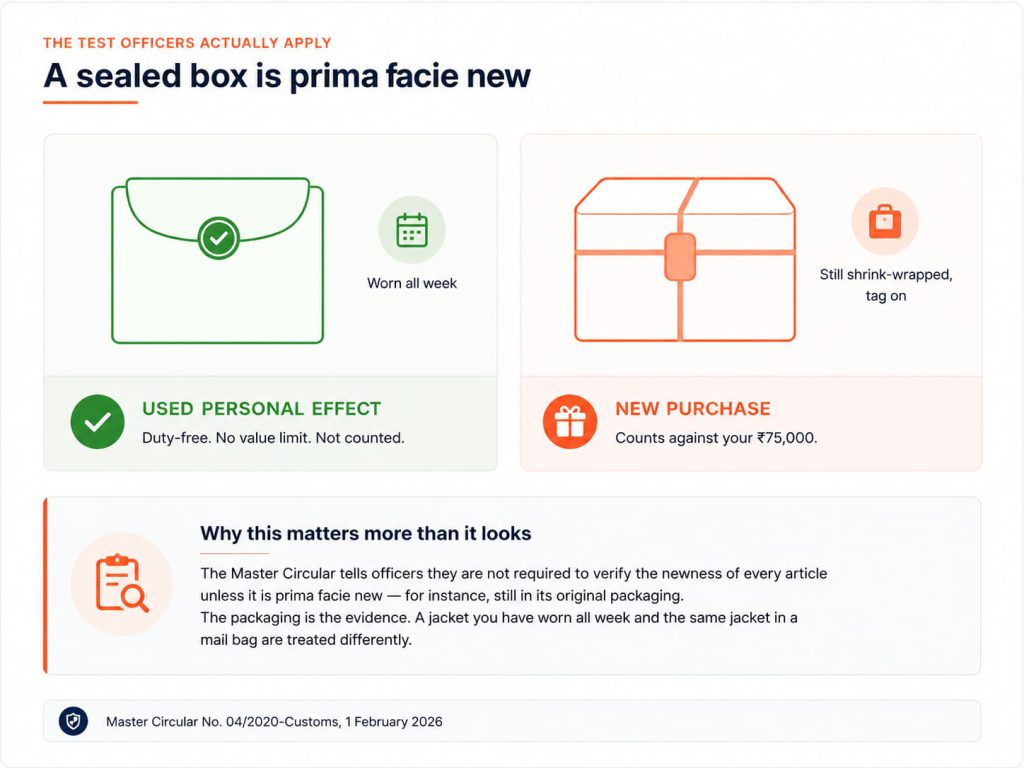
The sealed box is the tell. A jacket you have worn all week is a personal effect. The same jacket in a Dubai Mall bag with the tag on is a new purchase counting against your ₹75,000.
Who Gets What
| Class of passenger | General free allowance | Mode |
|---|---|---|
| Resident (Indian passport, ordinarily resident in India) | ₹75,000 | Any mode other than land |
| Tourist of Indian origin (NRI, OCI cardholder) | ₹75,000 | Any mode other than land |
| Foreigner on a valid non-tourist visa, staying over 6 months | ₹75,000 | Any mode other than land |
| Tourist of foreign origin | ₹25,000 | Any mode other than land |
| Crew member (not final pay-off) | ₹2,500 | — |
| Infant (two years or under) | Nil | Used personal effects only |
| Any passenger arriving by land | Nil | Used personal effects only |
| Caption: General free allowance by class of passenger and mode of arrival. | ||
For a family flying back from Dubai, the practical reading is simple: everyone on the passport list who is over two years old carries their own ₹75,000.
If You Are Moving Back, Not Visiting
Everything above assumes a trip. If you are relocating to India after a posting in the Gulf, a much larger entitlement applies — Transfer of Residence, under Rule 7 of the same rules.
| Time spent abroad | Duty-free value, personal and household articles |
|---|---|
| 3–12 months | ₹1,50,000 |
| 1–2 years | ₹3,00,000 |
| More than 2 years | ₹7,50,000 |
| Caption: Transfer of Residence duty-free value limits by length of stay abroad. | |
Two points make this worth knowing. Transfer of Residence sits over and above the personal-effects and general free allowances, not instead of them. And the 2026 rules raised every band — the ceiling for a two-year stay was previously ₹5,00,000.
It carries conditions this guide does not cover: one unit each from a fixed list of household articles, restrictions on how often you can claim, and short-visit limits. If you are shifting residence rather than returning from a holiday, treat it as a separate exercise.
Value and Quantity Are Two Separate Tests
You can fail either one independently, and this catches people who are only watching the rupee figure.
The value test is the ₹75,000. Straightforward.
The quantity test is the definition of personal effects itself, which excludes goods imported for commercial purposes. Goods in commercial quantity cannot be cleared as bona fide baggage even on payment of duty — a different and more serious outcome than owing money. Thirty identical phone cases worth ₹9,000 in total sits under the value threshold and still fails.
The same paragraph carries a reassuring counterweight. A marginal excess of ordinary, freely importable goods is not treated as prohibited simply because it arrived as baggage, and may be cleared on payment of duty. Crucially, the presence of some commercial goods does not make your entire baggage non-bona fide — the rest still gets its allowances.
Why Customs Can Open Your Bag
Because putting something inside a suitcase does not change what it is.
Customs clearance in India now runs on risk-based verification. Officers are told to avoid routine or indiscriminate examination of genuine baggage, and to identify passengers for examination based on risk profiling or specific intelligence. If you are selected, you may be asked to report to the Red Channel even if you walked toward the green one.
Selecting the Green Channel is not a neutral act of walking. It is a legal declaration that you have nothing dutiable, restricted or prohibited. If that turns out to be untrue, the problem is no longer the duty you owe. It is the declaration you made.
Gold: How Much Gold Can You Bring From Dubai to India?

There is no single gold customs limit from Dubai to India. Indian law splits gold into three separate tracks, and which track you are on is decided before anyone weighs anything.
The single most common mistake is to search for one number. Indian law splits gold into three separate tracks, and which track you are on is decided before anyone weighs anything.
Track 1 — Gold You Already Own and Wear
Used personal jewellery that you reasonably require for personal use during the journey is treated as personal effects under the Baggage Rules, 2026. It is cleared duty-free, subject to risk-based verification. There is no gram limit and no value cap on this track.
This is the track most family travellers are actually on, and it is the change that Indian communities in the Gulf had been asking for over many years.
Two practical notes. First, “used” does the work here — this is jewellery that left India with you, not jewellery bought in Deira on Thursday. Second, if you are travelling with substantially more jewellery than a person would normally wear, the sensible move is the one the rules themselves offer: take an export certificate before you leave India.
Carrying Jewellery for a Wedding
This is the most common Indian version of the question, and the rules answer it directly.
Jewellery being carried temporarily to attend an event, and to be taken back out again, may be permitted on the basis of a Temporary Baggage Import Certificate (Form CBD-IV), obtained from Customs on arrival.
Which route applies depends on which direction you live in, and this distinction matters:
If you live in the UAE and are visiting India, you are a tourist of Indian origin and the Temporary Baggage Import Certificate is your route: declare on arrival and ask for it. It stays valid until your first departure from India or six months, whichever is earlier, cannot be extended, and must be produced with the articles when you leave.
If you live in India and are carrying jewellery out and back, the certificate you want is the Export Certificate (Form CBD-III), taken before you depart rather than on your return.
Note that Form CBD-IV is drafted in the regulations for arriving tourists. If you are an Indian resident and think the temporary-import route fits your situation, ask at the counter rather than assuming.
| Export Certificate (CBD-III) | Temporary Baggage Import Certificate (CBD-IV) | |
|---|---|---|
| For | Valuables leaving India that will come back | Valuables arriving in India that will go back out |
| When you get it | Before you depart India | On arrival in India |
| Who | Residents, tourists of Indian origin, non-tourist-visa foreigners | Drafted for arriving tourists |
| Valid until | Your first return to India, or 6 months | Your first departure from India, or 6 months |
| Extendable | No | No |
| Caption: Export Certificate compared with Temporary Baggage Import Certificate. | ||
Track 2 — The Gold Allowance From Dubai to India: 20g and 40g
| Passenger | Duty-free jewellery | Condition |
|---|---|---|
| Female passenger | 40 grams | Resident or tourist of Indian origin who has been residing abroad for more than one year |
| Passenger other than female | 20 grams | Same condition |
| Caption: Special duty-free jewellery allowance by passenger type and eligibility condition. | ||
The value caps that used to sit alongside these weights — ₹1,00,000 and ₹50,000 — were removed on 2 February 2026. The allowance is now purely by weight.
Read the condition column again, because it is the whole point. This allowance is not for people returning from a holiday. It requires having lived abroad for more than a year. A family that spent nine days in Dubai does not qualify for it, no matter how the weight works out. Neither does a Gulf-based NRI who makes frequent short trips home, because the test attaches to residence abroad, not to the flight.
Track 3 — The Eligible Passenger Concession (up to 1 kg)
This is a separate scheme entirely, sitting outside the Baggage Rules, under Notification No. 45/2025-Customs dated 24 October 2025.
An eligible passenger — a person of Indian origin, or a passenger holding a valid Indian passport — may import gold, including ornaments, on three conditions: they are returning after a stay abroad of not less than six months, the duty is paid in convertible foreign currency, and the quantity does not exceed one kilogram of gold per eligible passenger. The equivalent silver limit is ten kilograms. Import remains subject to the import policy issued by DGFT.
Note the shape of this: it is not an exemption but permission to import a larger quantity at a concessional rate, on payment. Six months abroad is the gate, and a holiday does not open it.
Dubai Gold Customs in India: Why Form Matters More Than Weight
Here is where Dubai buyers most often go wrong, and it is a rule you can state in one line.
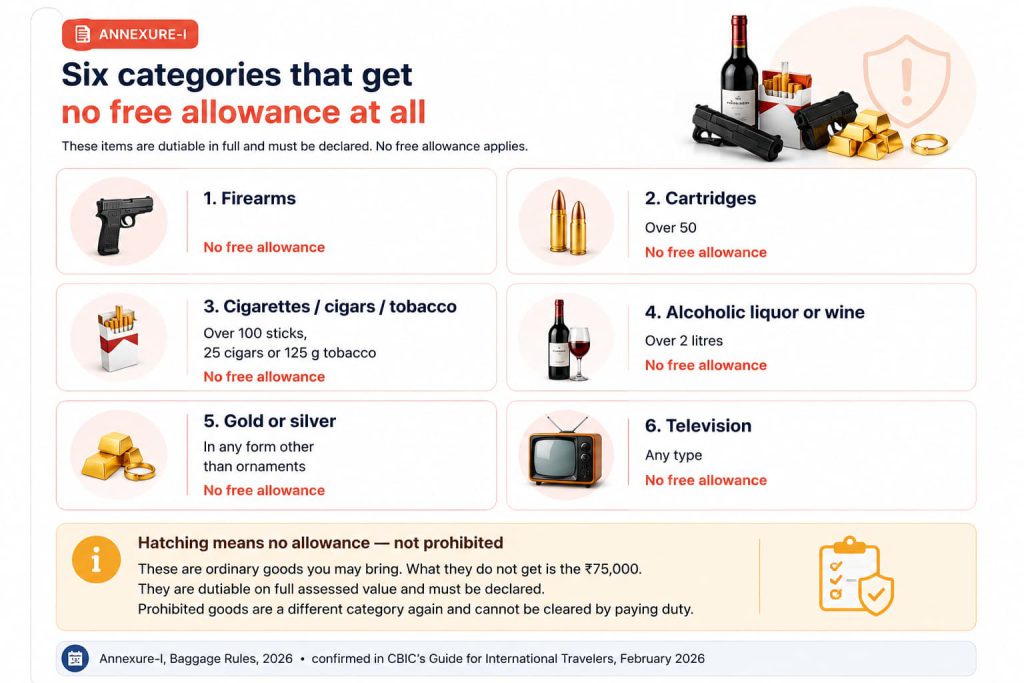
Annexure-I to the Baggage Rules, 2026 lists “gold or silver in any form other than ornaments.” Anything on Annexure-I is excluded from every free allowance.
| Form of gold | Inside your ₹75,000 allowance? | Notes |
|---|---|---|
| Gold jewellery / ornaments | Yes, as ordinary dutiable goods | Also eligible for Tracks 1 and 2 if you qualify |
| Gold bars | No | Annexure-I. Dutiable from the first gram |
| Gold coins | No | Annexure-I |
| Gold biscuits, bullion | No | Annexure-I |
| Caption: How each physical form of gold is treated against the general free allowance. | ||
So the honest answer to “can I buy a small gold bar in Dubai for my daughter’s wedding fund?” is: you can, India will tax it from the first gram, and it must be declared. Gold bullion is a Red Channel item in its own right on the declaration form, and its import is separately governed by DGFT policy.
The Duty Question — and Why This Guide Won’t Print One Percentage
Grams are only half of it. Two numbers decide what you pay: how much gold, and at what rate.
For a family returning from a Dubai holiday — under six months abroad, so no concession — gold beyond the ₹75,000 allowance is assessed at the ordinary baggage rate of 38.5%. That is the figure that applies to most readers here, and it is high enough to erase Dubai’s price advantage on anything substantial.
For genuinely eligible passengers under Notification 45/2025, a concessional rate applies instead. This guide deliberately does not print that percentage. The reasoning, so you can judge it:
In July 2024 India cut the import duty on gold from 15% to about 6%. Then on 13 May 2026 it raised the effective import duty on gold and silver back to 15% — 10% basic customs duty plus a 5% Agriculture Infrastructure and Development Cess (AIDC) — reported at the time by Reuters and CNBC, alongside changes to the India–UAE CEPA tariff-quota concessions.
A rate that has moved twice in under two years is not something to memorise from an article. Read the current text of Notification 45/2025-Customs, as amended, linked at the end of this guide, or ask at the customs counter. Any page confidently quoting a single fixed gold percentage for passengers should be checked against the notification date.
Documentation
Gold is the one category where paperwork changes outcomes, because valuation is the whole argument.
Keep three things accessible rather than buried in a checked bag: the original invoice showing weight, purity, making charges and date; the purity or hallmark certificate from the Dubai retailer; and the card statement corroborating the invoice. Add an export certificate if the jewellery left India with you, and your passport stamps if you are claiming any concession that depends on months abroad.
Declaration
Declare gold when it is dutiable, when it is in a form excluded from your free allowance, or when it exceeds an allowance you are claiming.
| What you are carrying | What to do |
|---|---|
| Gold bars, coins or biscuits | Always declare, regardless of quantity |
| New gold jewellery pushing purchases past ₹75,000 | Declare |
| Jewellery claimed under the 20g/40g allowance | Declare, and be ready to evidence the year abroad |
| Jewellery you have owned and worn for years | Ordinarily personal effects — no declaration needed, though an export certificate makes the conversation shorter |
| Caption: When gold must be declared at Indian Customs, by what you are carrying. | |
A Worked Example (Hypothetical)
The following is illustrative only. It is not advice on any real transaction, and the figures are for explanation, not assessment.
A married couple, both Indian residents, spend eight days in Dubai. She buys a gold chain weighing 18 grams. He buys a 10-gram gold coin as an investment.
- Her chain: It is new gold jewellery. She has not lived abroad for over a year, so the 40-gram allowance is not open to her. But jewellery is not on Annexure-I, so its value counts against her ₹75,000 general allowance like any other purchase. If the chain plus her other buys stay under ₹75,000, nothing is payable. If they exceed it, the excess is assessed.
- His coin: A coin is gold in a form other than ornaments. It sits on Annexure-I. His ₹75,000 does not touch it. It is dutiable from the first gram, it must be declared, and its import is subject to DGFT policy.
Same trip, same metal, two completely different outcomes — decided by the shape it was cast in. That is the lesson worth carrying into the Gold Souk.
Electronics: Phones, Laptops, Watches, Cameras and Gadgets
Electronics generate more airport conversations than gold, because the amounts feel small and the categories feel obvious. They are not obvious. There is no single India customs duty on electronics that applies to a returning passenger — every device is measured against the same ₹75,000, with one concession that applies to exactly one device type.
Apply two questions to every device separately. Is this a used personal effect I need for the journey, or a new purchase? And if it is new, does its value fit inside my ₹75,000, and does the quantity look personal?
Smartphones
There is no rule that says “one phone is always duty-free.” Anyone who tells you there is has not read the rules. What actually applies:
- Your own phone, the one you travelled out with, is a used personal effect — duty-free, no value limit, not counted against anything.
- A new phone bought in Dubai is a new article, counting against your ₹75,000. If your total new purchases stay under that, no duty arises — because of the allowance, not because phones are special.
- A second or third new phone is where questions start, and they are not about value. A family of four might legitimately buy two. Six identical sealed handsets of one model stops looking like personal use and starts looking like a consignment.
Laptops
This is the one clear, generous concession in the 2026 rules, and it is worth quoting properly.
A passenger of eighteen years of age or above, other than a crew member, is allowed clearance of one new laptop including notepad free of duty in bona fide baggage.
Three things follow. It is per adult, not per family. Two adults travelling together have two laptop concessions between them.
It is separate from the ₹75,000. The laptop does not eat into your general allowance — it sits on top of it. A ₹90,000 MacBook bought in Dubai by an adult passenger can be duty-free while that passenger’s ₹75,000 remains available for everything else.
Under-18s do not have it. A laptop bought for a fifteen-year-old is an ordinary purchase counting against that child’s ₹75,000 general allowance.
A second new laptop in the same person’s bag is not covered by the concession. It falls back into the general allowance, and if it pushes you over, it is assessed.
Tablets — the Distinction Almost Nobody Gets Right
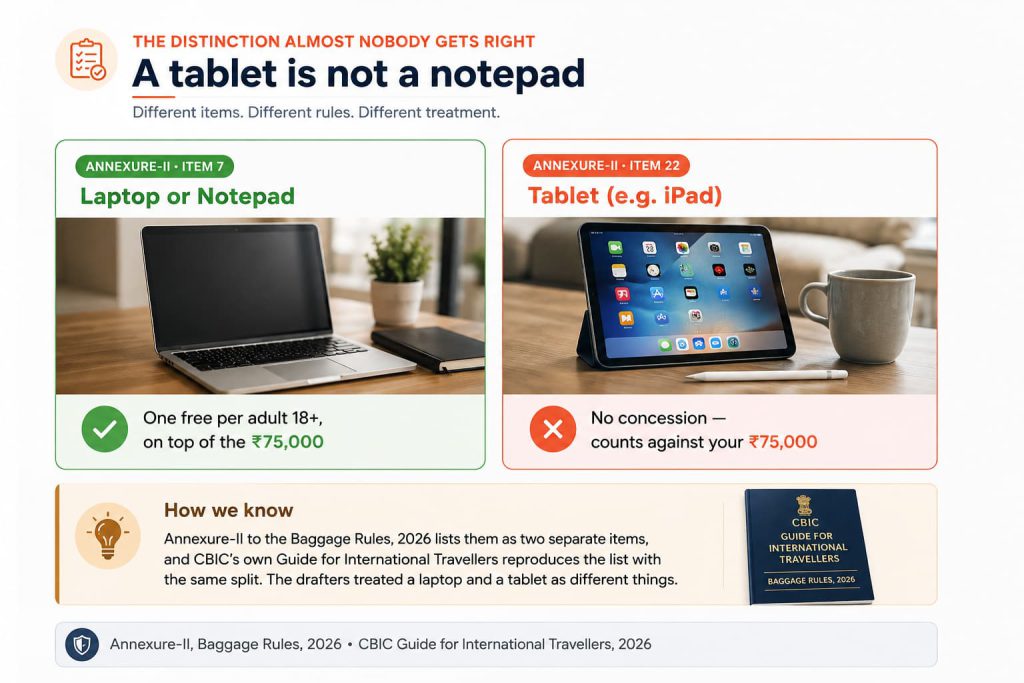
Does an iPad count as a “notepad” for the laptop concession?
No. And the rules themselves prove it. Annexure-II to the Baggage Rules, 2026 lists “Laptop or Notepad” at item 7 and “Tablet (e.g. iPad)” separately at item 22 — and CBIC’s own Guide for International Travellers reproduces that list with the same split. The drafters treated them as two different things. A tablet is an ordinary dutiable article, counting against your ₹75,000 like a perfume or a handbag.
If you are choosing what to buy in Dubai and duty treatment matters to you, this distinction is worth more than most price comparisons.
Smartwatches, Cameras and Wearables
All ordinary goods. No special concession exists for any of them.
Your existing watch or camera — used personal effect, duty-free.
A new smartwatch or camera bought in Dubai — counts against ₹75,000.
Cameras deserve one extra note for families who travel with real equipment. If you are carrying a DSLR or mirrorless body and lenses out of India and back, take an export certificate (Form CBD-III) before departure via the Atithi app. It is free, it takes minutes at the departure terminal, and it removes any argument about whether the kit was bought abroad. The certificate stays valid until your first return to India or six months, whichever is earlier, and it cannot be extended.
Gaming Consoles and Other Devices
A PlayStation, an Xbox, a projector, a Bluetooth speaker — all ordinary articles within the ₹75,000. Consoles are the ones that most often tip a family over the threshold on their own, so price them in rupees before you buy, not after.
Televisions — the Trap in the New Rules
Annexure-I to the Baggage Rules, 2026 lists “Television.” Not “flat panel television,” not “LCD/LED/plasma” as the old 2016 list said. Any television.
Anything on Annexure-I is excluded from the general free allowance completely. So a television bought in Dubai gets no free allowance at all and is dutiable on its full assessed value. If you were planning a TV purchase around the higher ₹75,000 limit, the higher limit does not help you.
Multiple Electronics: What Actually Raises Questions
Quantity, repetition and packaging — in that order.
Quantity — more devices than people travelling. Repetition — several identical models rather than a mix. Packaging — everything sealed, nothing set up.
None is a problem alone. All three together is what moves an officer from “family holiday” to “let us have a look.” If your purchases genuinely are personal — a phone for you, a tablet for your mother, a console for your son — say so plainly and the conversation is short.
Electronics Customs Duty From Dubai to India: Summary
| Item | Treatment | Counts against ₹75,000? |
|---|---|---|
| Phone you already use | Used personal effect | No |
| New phone bought in Dubai | Ordinary article | Yes |
| One new laptop, passenger 18+ | Separate duty-free concession | No |
| Second new laptop | Ordinary article | Yes |
| New laptop for a minor | Ordinary article | Yes |
| Tablet / iPad | Ordinary article (not a “notepad”) | Yes |
| Smartwatch, camera, console | Ordinary article | Yes |
| Your existing camera taken from India | Used personal effect (export certificate advised) | No |
| Television, any type | Annexure-I — no free allowance | Excluded |
| Drone | Restricted — prior authorisation, Red Channel | Declare |
| Caption: Customs treatment of each electronic device and whether it counts against the allowance. | ||
Chocolates and Food Items From Dubai
There is no published limit on how many chocolates you can bring from Dubai to India. No gram figure, no box count, no per-person quota exists in the Baggage Rules, 2026 or in the Master Circular. Anyone quoting one is inventing it.
What exists instead is two tests, and chocolate has to pass both.
Test One: Value
Chocolate is a good like any other, and its value counts toward your ₹75,000. In practice this almost never binds on its own. Where it matters is cumulatively — the chocolate plus the perfume plus the watch is what crosses the line.
Test Two: Whether It Looks Personal or Commercial
This is the test that actually decides chocolate cases, and it is a judgement about proportion, not a number.
Personal effects, by definition, exclude goods imported for commercial purposes. Twelve assorted boxes of Patchi and Bateel for a large family reads as gifts. Sixty identical boxes of the same product in shipping cartons reads as stock, and goods in commercial quantity cannot be cleared as bona fide baggage even on payment of duty.
The honest guidance is: buy the way a family buys. Variety across a reasonable number of recipients is what personal purchasing looks like. Bulk uniformity is what wholesale looks like.
Packaged Food
Commercially packaged, sealed, labelled, shelf-stable food in personal quantities is the least troublesome thing you can carry. Dates, camel-milk chocolate, packaged baklava, sealed spice blends, tinned goods — these travel routinely on the Dubai–India route.
Keep four things true and you remove almost all friction:
Sealed and unopened; labelled with an ingredient list an officer can read; in date; and proportionate — enough for your family, not enough for a shop.
Chocolates From Dubai to India Customs: What Is Actually Restricted
This is separate from customs duty and it is where real confiscations happen. Indian customs guidance lists the following among prohibited or restricted imports for passengers:
Meat and meat products, fish, dairy products, poultry products, and seeds, plants, fruits, flowers or other planting material.
These are biosecurity restrictions, enforced by quarantine authorities, and they do not care about your intent. Calling something a gift does not change its quarantine status, and you cannot pay duty to fix it.
For a Dubai trip the practical implications are narrow but real: fresh fruit from the souk, unpackaged dates in loose form, plant cuttings, and anything containing fresh dairy or meat are the categories to leave behind. Factory-sealed chocolate made with milk powder is an ordinary processed food and is not what these restrictions are aimed at. Homemade or unlabelled preparations sit in a grey zone precisely because nothing on the container tells the officer what is inside.
The Example Worth Remembering
Reads as personal: a family of four with fourteen boxes of assorted chocolates and dates, several brands, various sizes, bought across the trip.
Reads as commercial: the same family with fifty identical boxes of one product, still in the retailer’s outer carton, on one bulk invoice.
Same goods, same country, entirely different outcome — and the second is not solved by offering to pay duty.
Gifts From Dubai: How Much Can You Bring?
Start with the sentence that saves the most trouble:
Indian baggage law contains no gift exemption for arriving passengers.
There is no “gift allowance.” There is no threshold under which something is exempt because it is going to a relative. The Baggage Rules, 2026 do not use the word in the passenger allowance provisions at all. The only gift-specific figure anywhere in the rules is a ₹2,500 limit for crew members — and you are not crew.
So when you buy perfume for your sister-in-law, that perfume is a new article you are importing, valued at what you paid, counting against your ₹75,000 exactly like something you bought for yourself.
You may be thinking of the AED 3,000 gift allowance you read about for Dubai. That is a UAE rule for goods entering the UAE. It has no application whatsoever to what India charges you on arrival. Two countries, two rulebooks, opposite directions of travel.
The Four Things That Decide a Gift’s Treatment
- Total value: Add up everything new in your bag, gifts included, and compare to ₹75,000. There is no separate Dubai gifts customs limit in India — the general allowance is the limit.
- Quantity: Twenty of the same perfume raises the commercial-quantity question no matter what you paid. The definition of personal effects excludes goods imported for commercial purposes, and it does not carve out an exception for generosity.
- Repetition: Multiple identical items is the single strongest visual signal of commercial intent. A mix of different things for different people is what family gift-shopping actually looks like, and it looks like it in an X-ray too.
- Category: A gift on Annexure-I gets no free allowance whatever its value. Calling a gold coin or a television a present does not change what it is.
Common Dubai Gift Categories
| Gift | Treatment | Watch out for |
|---|---|---|
| Perfumes | Ordinary article, counts to ₹75,000 | Multiples of the same fragrance |
| Watches | Ordinary article | One premium watch can use most of an allowance on its own |
| Cosmetics | Ordinary article | Bulk identical SKUs |
| Clothing (new, tags on) | Ordinary article | Prima facie new — the tag is the tell |
| Toys | Ordinary article | Quantity relative to number of children |
| Souvenirs | Often low value; travel souvenirs may be duty-free | Do not stretch the word to cover a handbag |
| Chocolates and dates | Ordinary article | Bulk uniformity |
| Electronics as gifts | Ordinary article | Several identical devices |
| Gold jewellery as a gift | Ordinary article, but see the gold section | Not covered by the 20g/40g allowance unless you qualify |
| Gold coins as a gift | Annexure-I — no allowance | Dutiable from gram one |
| Caption: Common Dubai gift categories, their customs treatment and what raises questions. | ||
One Genuinely Useful Piece of Advice
Keep the gift receipts separate from your own. There is no form requiring it. But if you are asked to account for a bag holding eleven boxed items, being able to say “these six are for my wife’s family, total AED 1,900, here are the invoices” turns a vague situation into a specific one in about a minute.
Can Families Combine Their Customs Allowances?
Short answer: no — and the rules say so in one sentence, deliberately.
The Explanation to Rule 5 of the Baggage Rules, 2026 reads: the free allowance of a passenger shall not be allowed to pool with the free allowance of any other passenger. The official FAQ puts the same point as a direct question and answers it flatly: two passengers cannot pool their allowances to clear one expensive article.
That sentence has survived every rewrite of India’s baggage law for decades. It is not an oversight and it will not be waived at the counter.
But Every Family Member Does Have Their Own Allowance
This is the part that genuinely improved in 2026, and it is worth understanding properly because it changes family arithmetic.
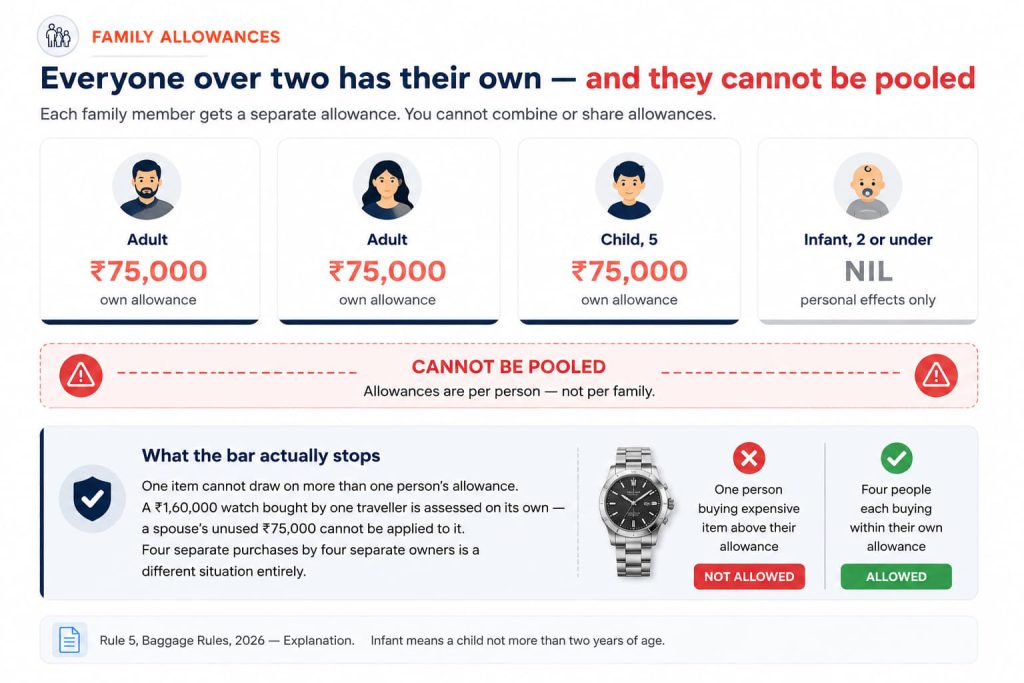
Under the Baggage Rules, 2026, the general free allowance goes to every passenger who is not an infant. An infant is defined as a child not more than two years of age. There is no other age slab. The old structure that gave reduced allowances to children under ten is gone.
| Family member | General free allowance |
|---|---|
| Adult | ₹75,000 |
| Teenager | ₹75,000 |
| Child aged 5 | ₹75,000 |
| Child aged 3 | ₹75,000 |
| Child aged 2 or under (infant) | Nil — used personal effects only |
| Caption: General free allowance by family member, showing the infant exclusion. | |
A family of two adults and two school-age children therefore travels with four separate ₹75,000 allowances. That is real headroom and it is a genuine improvement on the old rules.
So What Does “Cannot Pool” Actually Prevent?
It prevents one item from drawing on more than one person’s allowance.
Take a ₹1,60,000 watch bought by the father. His allowance is ₹75,000. The excess of ₹85,000 is assessed. His wife’s unused ₹75,000 cannot be applied to his watch. Neither can the children’s. The allowance follows the person, and it covers that person’s own goods.
Compare that with the same family buying a ₹70,000 laptop, a ₹40,000 phone, a ₹30,000 handbag and ₹20,000 of gifts, each item genuinely belonging to a different family member. Each item sits inside its owner’s allowance. Nothing is payable.
Same total spend. Completely different outcome — decided by whether the value is concentrated in one object or distributed across genuinely different owners.
Husband and Wife (Hypothetical)
Illustrative only.
A couple returns from Dubai. She has bought a handbag at ₹55,000 and perfume at ₹9,000 — ₹64,000 of new goods, inside her ₹75,000. He has bought a camera at ₹1,10,000 — ₹35,000 over his allowance.
Her remaining ₹11,000 of headroom cannot be transferred to cover his camera. His excess is assessed on its own.
Children
Children over two carry a full allowance, with two practical caveats.
The goods should genuinely be the child’s. An allowance is not a coupon that travels independently of ownership. If the entire family’s shopping is placed in a seven-year-old’s suitcase and presented as hers, the mismatch is obvious and it is the kind of thing the commercial-quantity and bona fide tests exist to catch.
A minor cannot file their own declaration. Under the 2026 declaration regulations, if a passenger has not attained the age of eighteen, the customs baggage declaration may be filed only by a family member or a legal guardian on the minor’s behalf. If your family has anything to declare and a child is carrying part of it, a parent files.
One Suitcase, Shared Goods, and What This Guide Will Not Do
Putting everyone’s purchases into one bag does not merge four allowances into one. The allowance attaches to the passenger, not to the luggage. Genuinely shared household items — an appliance, a family camera — have no special provision either; they are assessed against whoever imports them.
This guide will not tell you how to distribute purchases to reduce duty, for two reasons. Arranging goods to create an appearance that does not match reality is a mis-declaration, which engages Section 111 of the Customs Act and carries consequences worse than duty. And it works less well than people imagine — the pooling bar and the commercial-quantity test exist precisely to catch it.
The legitimate version is simpler: know what each person actually bought, and be able to say it plainly.
What Should You Declare at Indian Customs?
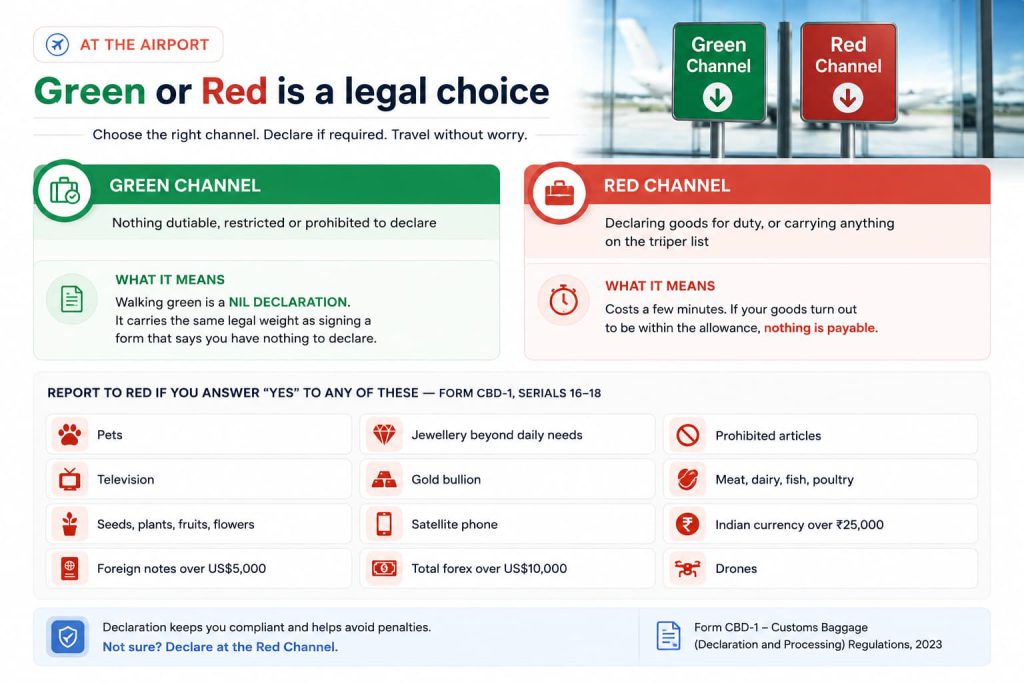
India runs a two-channel system, and choosing a channel is a legal act, not a navigation decision.
Green or Red
| Green Channel | Red Channel | |
|---|---|---|
| Who | Passengers not carrying dutiable or prohibited goods | Passengers declaring goods for duty, or carrying anything listed in Form CBD-I |
| What it means legally | A nil declaration — you are stating you carry nothing dutiable, restricted or prohibited | A declaration of what you are carrying |
| If you get it wrong | Section 111 of the Customs Act, 1962 is engaged; goods become liable to confiscation | Duty is assessed and paid |
| Cost of choosing it unnecessarily | — | A few minutes |
| Caption: Green Channel compared with Red Channel, including the legal effect of each. | ||
Walking green is not a navigation decision. It has the same legal weight as writing “nothing to declare” and signing it.
The Actual Red Channel Trigger List
Form CBD-I is specific rather than vague, which makes self-assessment easier than most travellers expect. You must report to the Red Channel if you answer “yes” to anything at serial numbers 16 to 18:
| Sl. | You are carrying… |
|---|---|
| 16 | Pets |
| 17 | Jewellery beyond daily necessities of life, or beyond the special jewellery allowance — the form asks for the weight |
| 18 (i) | Prohibited articles |
| 18 (ii) | Television |
| 18 (iii) | Gold bullion |
| 18 (iv) | Meat, dairy, fish or poultry products |
| 18 (v) | Seeds, plants, fruits, flowers or other planting material |
| 18 (vi) | Satellite phone |
| 18 (vii) | Indian currency exceeding ₹25,000 |
| 18 (viii) | Foreign currency notes exceeding US$5,000 or equivalent |
| 18 (ix) | Aggregate foreign exchange exceeding US$10,000 or equivalent |
| 18 (x) | Drones |
| Caption: The articles at serial numbers 16 to 18 of Form CBD-I that require the Red Channel. | |
Note serial 15, which is not a yes/no: the form asks for the value of goods other than used personal effects subject to duty assessment. That single line is the whole ₹75,000 question in the government’s own words.
What Requires Declaration
Beyond that list, three categories need naming.
- Dutiable goods — new purchases whose total value exceeds your ₹75,000.
- Restricted goods — drones, which require a licence from the WPC wing of the Ministry of Communications, and satellite phones, which require prior Department of Telecommunications authorisation.
- Prohibited goods — narcotics, wildlife products, counterfeit currency, and material showing incorrect Indian boundaries. Also e-cigarettes, vapes, ENDS devices, heat-not-burn products and e-hookahs, whose import into India is prohibited outright. These cannot be legalised by declaring them or paying duty; they are surrendered.
Currency above thresholds:
| Currency situation | Requirement |
|---|---|
| Foreign currency notes over US$5,000 or equivalent | Declare on a Currency Declaration Form |
| Total foreign exchange (notes + travellers cheques) over US$10,000 or equivalent | Declare on a Currency Declaration Form |
| Indian currency, resident returning from abroad | May bring in up to ₹25,000 |
| Indian currency, NRI or foreign national | Check before you carry any — see the note below |
| Caption: Currency declaration thresholds for Indian and foreign currency on arrival. | |
A note for NRI readers, because sources genuinely disagree here.
The RBI’s Export and Import of Currency Regulations permit a person resident outside India — excluding citizens of Pakistan and Bangladesh — to bring in Indian currency notes up to ₹25,000, with some sources adding that this applies only when arriving by air. Several widely-read guides state flatly that non-residents may not carry Indian rupee notes across the border at all. This guide is not going to pick a winner between them. If you hold an NRI or OCI status and plan to carry rupees, confirm your position with your bank or with Customs rather than relying on any article.
Keep the Currency Declaration Form. It is what authorises you to take the same amount back out.
Alcohol and tobacco above the permitted quantities.
These deserve their own line because they behave differently from everything else. Each passenger may bring in two litres of alcoholic liquor or wine, and 100 cigarettes or 25 cigars or 125 grams of tobacco, duty-free. Beyond those quantities the goods sit on Annexure-I, receive no general free allowance, and are charged at the rates applicable to their commercial import rather than the baggage rate. Buying a third litre at Dubai Duty Free because it was on offer is the classic version of this mistake.
Unaccompanied baggage. If you ship purchases home rather than carrying them, the rules still apply — but the general free allowance does not. That surprises people, and it is worth knowing before you decide to send a box.
Commercial quantities — whatever the value.
Filing the Declaration
Since 2 February 2026, the declaration is electronic.
The form for accompanied baggage is Form CBD-I, filed through the Atithi web or mobile application or through the ICEGATE portal at https://www.icegate.gov.in. You can file it on arrival, or up to three days before you land, and update the details right up to your actual arrival time. If electronic filing is not feasible, the proper officer may permit declaration in another manner on arrival.
There are five forms in the 2026 system, and it helps to know which is which:
| Form | What it is | When |
|---|---|---|
| CBD-I | Indian Customs Declaration Form | Mandatory if carrying dutiable or prohibited goods, or pets |
| CBD-II | Unaccompanied baggage declaration | When baggage follows you separately and has dutiable effects. Filed on ICEGATE |
| CBD-III | Export Certificate | Optional, recommended — taken before you leave India |
| CBD-IV | Temporary Baggage Import Certificate | Optional, recommended — for valuables coming in that will go back out |
| CBD-V | Detention Receipt | Not filed by you; issued by the officer if goods are detained |
| Caption: The five CBD forms under the 2026 declaration regulations and when each applies. | ||
Filing early is the single easiest thing on this list. You are on a four-hour flight from Dubai with nothing to do. Do it before you board.
If You Are Not Sure
Work through these in order, and stop at the first “yes”.
| # | Ask yourself | If the answer is… |
|---|---|---|
| 1 | Is it on Annexure-I? | Yes → declare |
| 2 | Is it restricted or prohibited? | Yes → declare, or for prohibited items, do not carry it at all |
| 3 | Do my new purchases exceed ₹75,000? | Yes → declare |
| 4 | Would a stranger think this quantity is personal? | No → declare |
| 5 | Still unsure? | Verify the current rule, or declare and let the officer assess |
| Caption: A five-step test for deciding whether an item needs to be declared. | ||
Declaring something that turns out to be within your allowance costs you a few minutes and nothing else. The reverse error is not symmetrical.
None of this replaces the instructions given at your arrival airport, which take precedence over any article, including this one.
Customs Duty on Dubai Shopping: How It Is Calculated
Three concepts, in order. Get these and the arithmetic is easy.
1. Baggage Has Its Own Tariff Heading
This is the piece that explains everything else, and almost no consumer guide mentions it.
Goods brought in by a passenger are classified under Chapter 98, Heading 9803 of the Customs Tariff — “all dutiable articles imported by a passenger or a member of a crew in his baggage” — regardless of what the goods actually are. A handbag, a camera and a coffee machine all land in the same heading. As summarised in standard customs commentary, the Supreme Court has confirmed this approach — goods brought as baggage are classified under Chapter 9803 and charged at the baggage rate, even where the item’s own tariff rate would be lower.
This is why you cannot look up “customs duty on smartwatches in India” and apply it to your suitcase. That rate is for commercial imports. Yours is not one.
2. Assessable Value
Duty is charged on the value customs assesses, not on the sticker price you feel is fair.
Your invoice is the starting point and the best evidence you have. This is the practical reason to keep receipts: without them, valuation is an estimate made by someone who did not see the shop. Section 78 of the Customs Act fixes the rate and valuation as those in force on the date you make your declaration — so it is the day you land that matters, not the day you bought.
3. The Rate
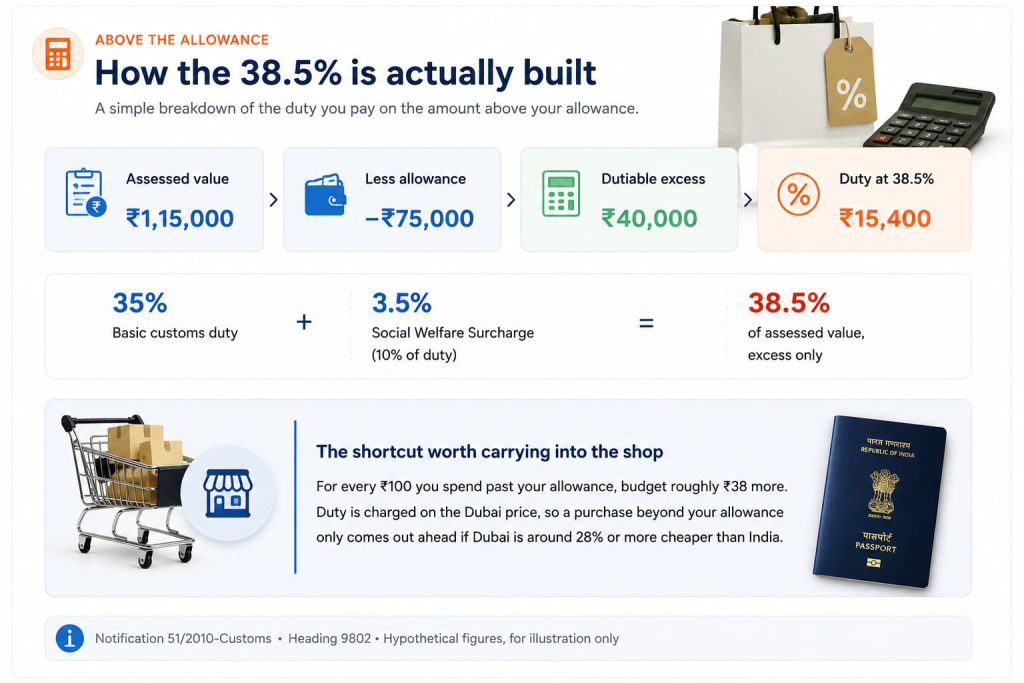
For baggage in excess of the free allowance, the effective rate is:
| Component | Rate |
|---|---|
| Basic customs duty (Notification No. 26/2016-Customs) | 35% |
| Social Welfare Surcharge (10% of the basic duty) | 3.5% |
| Effective total | 38.5% |
| Caption: Components of the effective customs duty rate on baggage above the free allowance. | |
Baggage is exempt from countervailing duty.
Notification No. 04/2026-Customs, issued alongside the new rules, was purely consequential — it substituted the words “Baggage Rules, 2016” with “Baggage Rules, 2026” in the rate notification and changed nothing else.
Important: The “10% Baggage Duty” You May Have Read About
A number of 2026 travel articles report that customs duty on baggage dropped to a flat 10%. That is a misreading, and it is worth understanding so you can price your trip correctly.
Budget 2026 did cut a personal-import duty from 20% to 10%. That cut applies to Heading 9804 — dutiable articles intended for personal use imported by post or air, which is to say parcels and courier consignments. Social Welfare Surcharge was applied to that heading from 1 April 2026, making the net rate roughly 11%. It is a real and significant change for people ordering goods online from abroad, and nothing to do with a suitcase.
Accompanied passenger baggage sits under Heading 9803, which was not part of that change.
| Heading 9803 | Heading 9804 | |
|---|---|---|
| Covers | Dutiable articles imported by a passenger or crew member in their baggage | Dutiable articles for personal use imported by post or air — parcels and courier |
| Rate | 35% + 3.5% SWS = 38.5% | Cut from 20% to 10% in Budget 2026; with SWS from 1 April 2026, net ~11% |
| Applies to your Dubai suitcase? | Yes | No |
| Caption: Tariff Heading 9803 compared with Heading 9804 and which applies to passenger baggage. | ||
If you see a 10% figure quoted for what you carry through an airport, check which heading the source is describing. Professional summaries of Budget 2026 name Heading 9804 explicitly.
Duty Is Charged on the Excess Only
If your new goods total ₹95,000 and your allowance is ₹75,000, duty applies to ₹20,000 — not to ₹95,000.
A Hypothetical Calculation
Illustrative only. Actual assessment depends on customs valuation and the rules in force on your date of declaration.
An Indian resident returns from Dubai with new purchases assessed at ₹1,15,000, none of them on Annexure-I, and no laptop involved.
| Step | Amount |
|---|---|
| Assessed value of new goods | ₹1,15,000 |
| Less general free allowance | (₹75,000) |
| Dutiable excess | ₹40,000 |
| Basic customs duty at 35% | ₹14,000 |
| Social Welfare Surcharge at 10% of duty | ₹1,400 |
| Indicative duty payable | ₹15,400 |
| Caption: Hypothetical duty calculation on new goods assessed above the free allowance. | |
That is 38.5% of the excess, which is a useful shortcut to carry in your head while shopping: for every ₹100 you spend past your allowance, budget roughly ₹38 more.
Is It Actually Cheaper to Buy in Dubai?
This is the question behind most of the searching, and it has a clean answer once you have the rate.
Inside your ₹75,000, Dubai wins on anything genuinely cheaper there, because no duty arises at all. That headroom is the saving, and it is worth planning your largest purchase around.
Past your allowance, the maths turns. Duty is charged on the Dubai price, so a purchase beyond your allowance only comes out ahead if the Dubai price is roughly 28% or more below the Indian price.
| If Dubai is… | Inside your ₹75,000 | Past your ₹75,000 |
|---|---|---|
| Same price | Neutral | Costs ~38% more |
| 10% cheaper | Saves 10% | Costs ~25% more |
| 25% cheaper | Saves 25% | Costs ~4% more |
| ~28% cheaper | Saves 28% | Break-even |
| 40% cheaper | Saves 40% | Saves ~17% |
| Caption: Whether buying in Dubai saves money, inside and beyond the free allowance. | ||
Indicative only. Assumes assessment at invoice value and ignores card and conversion charges.
The conclusion most families need: the allowance is the saving, not the shop. Past ₹75,000, only large price gaps survive the duty — the kind you sometimes see on perfume and premium spirits, and rarely on mainstream electronics.
Two Things That Do Not Follow This Formula
Alcohol and tobacco beyond the permitted quantities are charged at commercial import rates under the Customs Tariff Act, 1975, not at the baggage rate.
Gold under the eligible-passenger concession is charged at the rate in the relevant notification, and must be paid in convertible foreign currency — so if you are on that route, carry acceptable foreign currency, because rupees may not be accepted for that payment.
There is no single universal percentage that applies to everything from Dubai. Anyone offering one is simplifying past the point of usefulness.
Dubai Departure vs India Arrival
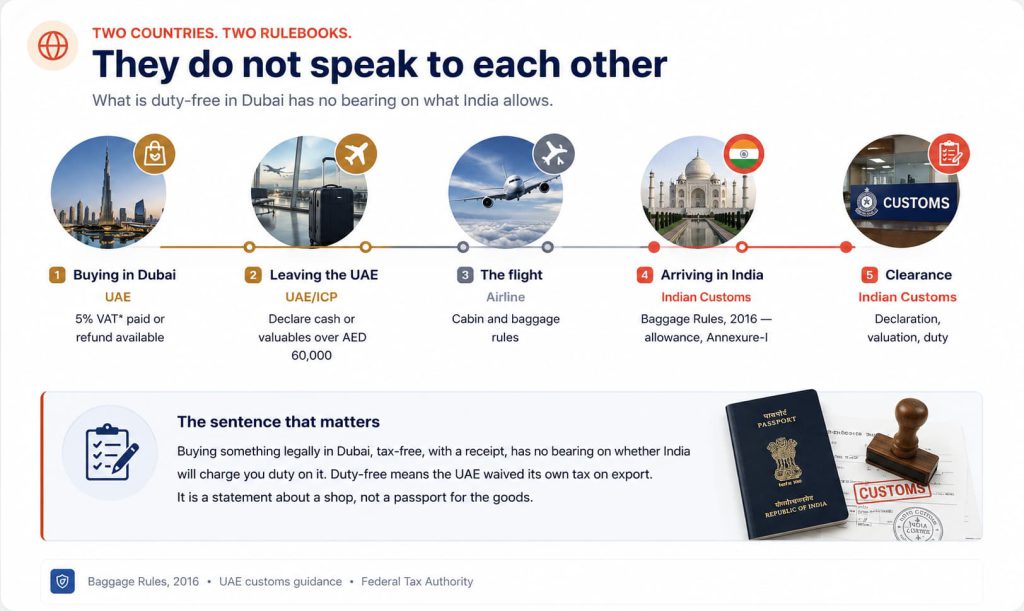
Two countries, two rulebooks, and they do not speak to each other.
| Stage | Whose rules apply | What actually matters |
|---|---|---|
| Buying in Dubai | UAE | 5% VAT on most goods; tourist VAT refund available on eligible purchases |
| Leaving the UAE | UAE / ICP | Declare cash, financial instruments, precious metals or precious stones over AED 60,000; validate VAT refund before check-in |
| The flight | Airline + aviation rules | Your carrier’s own limits — Emirates, IndiGo, Air India Express and flydubai each publish their own cabin and battery rules |
| Arriving in India | Indian Customs | Baggage Rules, 2026 — allowances, Annexure-I, declaration |
| Customs inspection | Indian Customs | Risk-based selection, valuation, duty assessment |
| Clearance | Indian Customs | Payment, detention receipt, or release |
| Caption: Which authority’s rules apply at each stage of a Dubai to India journey. | ||
The Sentence That Matters
Buying something legally in Dubai, tax-free, with a receipt, has no bearing on whether India will charge you duty on it. “Duty-free” means the UAE waived its own tax on export. It is a statement about a shop, not a passport for the goods.
Two Dubai-Side Things Worth Doing
Declare over AED 60,000 on the way out.
Passengers entering or leaving the UAE with more than AED 60,000 — or the equivalent in other currencies, financial instruments, precious metals or precious stones — must declare it to the Federal Authority for Identity, Citizenship, Customs and Ports Security, with Dubai Customs publishing its own airport procedure for the declaration. The threshold applies to travellers aged 18 and above; amounts carried by under-18s are aggregated with a parent or guardian. Note that this covers gold and jewellery, not just cash.
Claim the VAT refund, and keep the invoice.
Non-resident tourists aged 18 and above can reclaim most of the 5% UAE VAT on eligible purchases through the Federal Tax Authority’s scheme, operated by Planet. The minimum spend is AED 250 with the same retailer, goods must leave the UAE within 90 days, and you validate at a kiosk or desk before checking in your bags. The operator deducts a per-claim fee, which was reduced during 2026 — so the refund percentages quoted in older guides are out of date.
The connection here is not the refund but the paperwork: the tax invoice you need for the UAE refund is the same invoice Indian customs will want for valuation.
What Happens at the Indian Airport
The whole process, in the order you will actually meet it.
Before You Fly
File your declaration on the Atithi app if you have anything dutiable, restricted or prohibited. You can file up to three days before arrival and edit it until you land. This is the step that converts a twenty-minute counter conversation into a five-minute one.
The layout differs a little between terminals — Delhi, Mumbai, Kochi, Bengaluru, Chennai and Hyderabad all handle heavy Gulf traffic and all run the same two-channel system — but the sequence is identical everywhere.
Step 1 — Immigration
Standard passport control. Nothing customs-related happens here.
Step 2 — Collect Your Baggage
If a bag is missing, get your free allowance endorsed at the mishandled baggage counter — it protects your entitlement for when the bag arrives.
Step 3 — Decide Your Channel
Run the five-question test from the declaration section, and decide before you start walking.
Step 4 — Use the Correct Channel
Green if you have nothing to declare, Red if you do. You may also be directed to Red on the basis of risk profiling even if you had chosen green — that is a normal part of the system, not an accusation.
Step 5 — Present Your Declaration
If you filed on Atithi, show it. Being able to produce invoices immediately is the difference between a conversation and a process.
Step 6 — Assessment and Payment
The officer assesses value, applies your allowance, and calculates duty. You pay, and you receive documentation. Keep it — it is your proof the goods were cleared lawfully.
Step 7 — Clearance, or the Alternatives
Most people walk out here. Two other outcomes exist and both are legitimate:
Detention. If you cannot pay the duty, or the goods are restricted, the officer may detain the articles and issue a detention receipt. Detained goods can be released later on payment or returned at departure for re-export, and must generally be cleared within six months, extendable by six more. No charge applies where baggage is found bona fide, though storage charges may.
Re-export. For a single expensive item, leaving it with customs and taking it back out is sometimes the right answer. Asking about it is not an admission of anything.
Documents to Keep in Your Hand Baggage
| Document | When it matters |
|---|---|
| Passport and boarding pass | Always — the stamps evidence time spent abroad |
| Atithi declaration reference | If you filed in advance |
| Purchase invoices for all new goods | Always — this is your valuation evidence |
| Gold invoices and purity certificates | Kept separately accessible, if carrying gold |
| Export certificate (Form CBD-III) | If you took valuables out of India |
| Card statements or payment records | For high-value items, to corroborate invoices |
| Currency Declaration Form | If over the currency thresholds |
| Caption: Documents to keep in hand baggage and when each one matters. | |
The reason for “hand baggage” is practical. Receipts that are in a checked bag which is currently on a trolley behind you are receipts you do not have.
If Something Goes Wrong
There is a Customs Help Desk in the arrival hall at international airports in India, and asking there is a normal thing to do rather than an escalation. If you need to raise a complaint afterwards, feedback forms are available in the arrival hall and grievances can be filed through the government’s CPGRAMS portal. Each airport also has a Commissioner of Customs with published contact details, listed in CBIC’s Guide for International Travellers.
What Happens If You Do Not Declare Dutiable Goods?
This section is deliberately factual. Non-declaration is a real risk, not a catastrophe, and both exaggeration and reassurance would be unhelpful.
The Legal Mechanics
Under the Customs Act, 1962:
| Provision | What it does |
|---|---|
| Section 77 | Requires a passenger to declare the contents of their baggage. Choosing the Green Channel is a declaration that there is nothing to declare |
| Section 111(l) | Makes dutiable or prohibited goods not included, or in excess of those included, in that declaration liable to confiscation |
| Section 111(m) | Does the same where goods do not correspond in value or any other particular with the declaration — the provision covering understated prices |
| Section 112 | Penalties for improper importation. For dutiable goods that are not prohibited, up to the duty sought to be evaded or ₹5,000, whichever is greater. For prohibited goods, up to the value of the goods or ₹5,000, whichever is greater |
| Section 114AA | A separate penalty for knowingly using false or incorrect material in customs proceedings |
| Sections 124 and 125 | A show-cause notice is required before confiscation, and the adjudicating authority may give the option of a redemption fine instead of losing the goods outright |
| Caption: Provisions of the Customs Act, 1962 that apply to non-declaration and mis-declaration. | |
CBIC’s own Guide for International Travellers sets out the consequences without softening them. Depending on the nature and gravity of the offence, the actions that may follow are absolute confiscation of goods or release on payment of a substantial redemption fine where permissible; imposition of penalties; and arrest and prosecution, including preventive detention proceedings in serious cases. The guide names four triggers specifically: walking the Green Channel with prohibited, restricted or dutiable goods on which duty has not been paid; mis-declaring at the Red Channel; attempting to export prohibited or restricted goods; and abetting any of these.
Separately, contravening the 2026 declaration regulations attracts a penalty under Section 158(2)(ii) of the Customs Act, 1962 — a distinct exposure from the duty itself.
What This Means in Plain Terms
The cost of non-declaration is not the duty. It is the duty plus consequences that would not have existed at all.
Declare a ₹40,000 excess and you pay roughly ₹15,400. Do not declare it and get selected, and you may face the same duty, plus a penalty that can reach the duty amount, plus goods liable to confiscation with a redemption fine to get them back.
Outcomes vary with circumstances, and the law does distinguish between them — a family that misjudged the value of a handbag is not in the position of someone concealing bullion. Prosecution exists as a possibility in serious cases; it is not the ordinary outcome for an ordinary shopping error, and it would be misleading to suggest otherwise.
There is no way to know in advance whether you will be selected. What is knowable is the arithmetic: declaring costs the duty and some minutes. Not declaring risks the duty, a penalty, a fine, and your evening.
Common Dubai-to-India Customs Mistakes
Mistake 1 — Assuming “personal use” makes it duty-free
Personal use is necessary but not sufficient. The free allowance is a value exemption; personal use is a quantity and character test. A ₹2,00,000 watch bought for your own wrist is entirely personal and entirely dutiable above ₹75,000.
Mistake 2 — Assuming family allowances can be combined
They cannot. The Explanation to Rule 5 bars pooling outright. Four people have four allowances covering their own goods — not one large shared pot for the family’s most expensive purchase.
Mistake 3 — Carrying several new phones
The problem is rarely value. It is the quantity-and-repetition signal. Several sealed handsets of the same model looks like stock, and goods in commercial quantity cannot be cleared as bona fide baggage even on payment of duty. That is a worse outcome than a duty bill.
Mistake 4 — Assuming gifts are exempt
There is no gift exemption in Indian baggage law for arriving passengers. The AED 3,000 gift figure people remember is a UAE allowance for goods entering the UAE.
Mistake 5 — Not keeping invoices
Without receipts, valuation is somebody’s estimate. With them, it is arithmetic. This costs you nothing and is the highest-value thing on this list.
Mistake 6 — Walking green when you should have walked red
Choosing the Green Channel is a legal nil declaration. If it is untrue, Section 111 is engaged and the goods become liable to confiscation. Red costs minutes. Green, wrongly used, can cost the goods.
Mistake 7 — Trusting old blogs and videos
The rules changed on 2 February 2026 and the gold duty changed on 13 May 2026. A page that says ₹50,000, or that quotes value caps of ₹50,000 and ₹1,00,000 alongside the 20g/40g jewellery limits, is describing law that no longer applies. Check the date, and check which notification the source names.
Mistake 8 — Assuming a tablet gets the laptop concession
It does not. The rules list “Laptop or Notepad” and “Tablet (e.g. iPad)” as separate items. Only the laptop concession exists.
Mistake 9 — Assuming wedding jewellery can just come in and go back out
It can, but through a specific door — and which door depends on whether you live in India or abroad. See the gold section. Walk past the counter without asking and you have foregone the facility rather than used it.
Mistake 10 — Treating a promotional receipt as your valuation
Duty is charged on assessed value. A Dubai Duty Free or mall receipt showing a heavily promotional price is useful evidence, but a price far below the item’s ordinary market value invites a valuation question rather than settling one. Keep the card statement alongside it, and expect to explain an unusually low figure on a high-value item.
Mistake 11 — Buying a television because the allowance went up
Televisions are on Annexure-I and get no general free allowance at all — and the 2026 list says “Television,” not “flat panel television,” so it now covers every type.
Real-Life Scenarios
All scenarios below are hypothetical illustrations of how the rules interact. They are not assessments of any real case, and actual outcomes depend on valuation and the rules in force on the date of declaration.
Scenario 1 — A Couple Carrying Gold Jewellery
Both are Indian residents returning after a ten-day holiday. She wore a gold set out of India and bought a new 15-gram bangle in Deira. He bought nothing in gold.
- Her worn set: Used personal jewellery, personal effects, duty-free with no weight or value limit.
- Her new bangle: The 40-gram allowance does not apply, since that needs more than a year abroad. But jewellery is not on Annexure-I, so its value counts against her ₹75,000 like any other purchase.
- What decides it: Her total new goods against ₹75,000, plus her ability to evidence that the worn set left India with her. An export certificate taken before departure removes that question entirely.
Scenario 2 — A Family Carrying 3 Phones and 2 Laptops
Two adults, two teenagers. Three new phones and two new laptops bought in Dubai.
- The laptops: One each for the two adults, duty-free under the 18+ concession, over and above their allowances. A laptop bought for a teenager is not covered and counts against that teenager’s ₹75,000.
- The phones: Three across four travellers is proportionate; each counts against its owner’s allowance.
- Where it would go wrong: If all five devices were the same model, or all assessed against one person. Three different phones for three people is a family holiday. Three identical phones in one bag is a question.
Scenario 3 — A Family Carrying Chocolates and Gifts
Four travellers returning with fourteen boxes of assorted chocolates and dates, six perfumes and four boxes of cosmetics.
- Value: Well within four allowances, so value is not the issue.
- Quantity: The answer turns on variety. Fourteen different assortments across four people reads as gifts. The six identical bottles of one fragrance is the item that stands out, not the chocolate.
Scenario 4 — One High-Value Watch
A single traveller buys one watch, assessed at ₹2,60,000. Nothing else.
- Value: ₹75,000 allowance, ₹1,85,000 dutiable excess.
- At 38.5%: indicatively around ₹71,000 in duty.
- The lesson: Quantity is fine, personal use is genuine, and it is still a substantial bill, because a single object can exceed the allowance on its own. Nobody else’s allowance can be applied to it. This is the scenario where running the arithmetic in the shop, not at the counter, changes the decision.
Scenario 5 — The Traveller Who Is Not Sure
A traveller has bought a boxed camera, a sealed tablet and assorted gifts, and honestly cannot tell whether the total crosses ₹75,000.
- The right move: File on Atithi before landing and use the Red Channel. If the total turns out to be under the allowance, nothing is payable and the traveller has lost a few minutes.
- The wrong move: Walking green and hoping. Because that is a declaration, and if it is wrong, the consequences run past the duty into Section 111 territory.
When in doubt, verify the current rule or declare, rather than assuming exemption.
Scenario 6 — Jewellery Travelling Both Ways
A family carries substantial jewellery to India for a cousin’s wedding, intending to take it back to Dubai afterwards.
- The wrong assumption: That quantity carried for an event is automatically fine because it is not being sold.
- What actually applies — jewellery beyond daily necessities is a Red Channel item, and serial 17 of the declaration form asks for its weight. But the rules provide the answer: a Temporary Baggage Import Certificate, obtained from Customs on arrival, covers goods coming in that will go back out. It must be produced with the articles at departure and cannot be extended beyond six months.
Dubai-to-India Customs Checklist for Families
Five stages, in the order you will actually meet them.
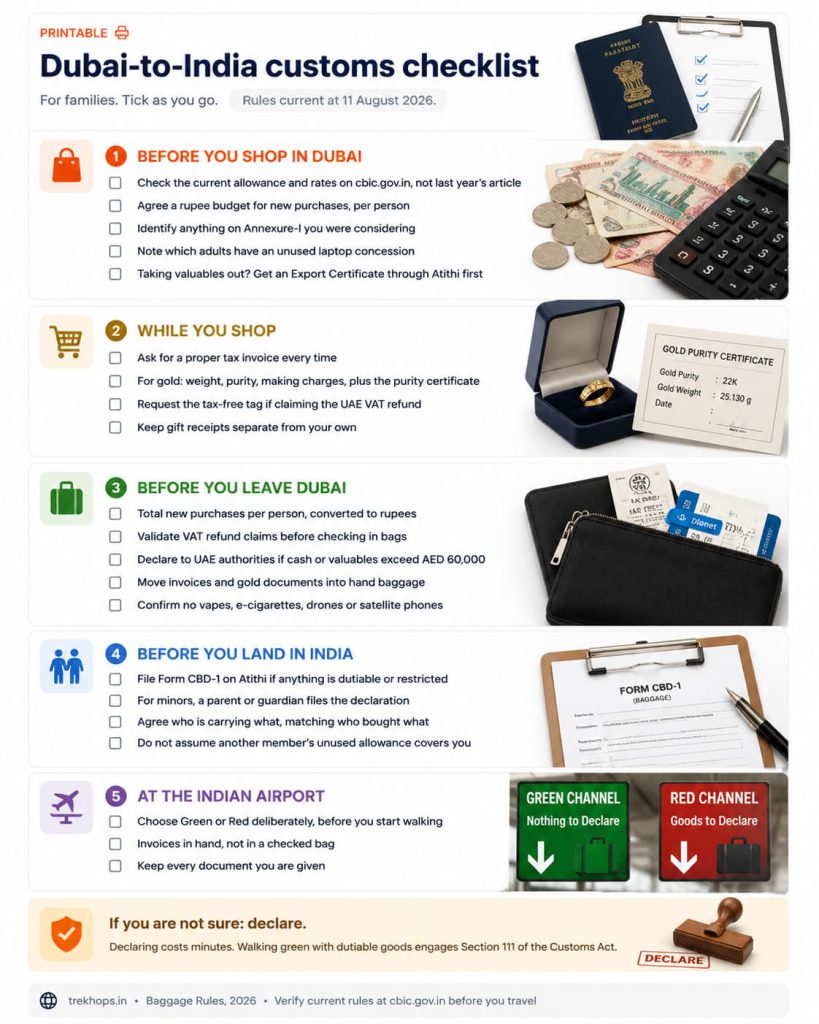
| Stage | What to do |
|---|---|
| Before you shop in Dubai | Check the current allowance and rates on the CBIC site rather than last year’s article |
| Agree a rough rupee budget for new purchases, per person | |
| Identify anything on Annexure-I you were considering — gold bars or coins, a television, extra alcohol or tobacco | |
| Note which adults have an unused laptop concession | |
| If you are taking valuables out of India, get an export certificate through Atithi before you leave | |
| While you shop | Ask for a proper tax invoice every time; for gold, insist on weight, purity and making charges, plus the purity certificate |
| Request the tax-free tag at the till if you plan to claim the UAE VAT refund | |
| Keep gift receipts separate from your own | |
| Watch for repetition — several identical items is the signal that draws attention | |
| Before you leave Dubai | Total up your new purchases per person and convert to rupees |
| Validate VAT refund claims before checking in your bags | |
| Declare to UAE authorities if cash, precious metals or stones exceed AED 60,000 | |
| Move invoices, gold documents and certificates into hand baggage | |
| Confirm nothing prohibited has crept in — vapes, e-cigarettes, drones, satellite phones | |
| Before you land in India | File Form CBD-I on the Atithi app if anything is dutiable, restricted or prohibited |
| For minors carrying declared goods, ensure a parent or guardian files | |
| Separate personal effects from new purchases, so you can explain the difference | |
| Agree who is carrying what, and make sure it matches who bought what | |
| Do not assume another family member’s unused allowance covers your purchases | |
| At the Indian airport | Choose Green or Red deliberately, before you start walking |
| Have invoices in hand, not in a checked bag | |
| Keep every document you are given | |
| Caption: Five-stage customs checklist for families travelling from Dubai to India. | |
Quick Decision Table
| Your situation | What to check |
|---|---|
| Clothes, toiletries, your own phone and worn jewellery | Used personal effects — duty-free, no value limit |
| New purchases under ₹75,000 per person | Inside the general free allowance |
| New purchases over ₹75,000 per person | Declare; duty on the excess at 38.5% |
| One new laptop, passenger aged 18+ | Separately duty-free, on top of the allowance |
| Second laptop, or a laptop for a minor | Counts against the ₹75,000 |
| Tablet, smartwatch, camera, console | Ordinary articles inside the ₹75,000 |
| Gold jewellery, newly bought | Counts against the ₹75,000; 20g/40g allowance only after a year abroad |
| Gold bars, coins or biscuits | Annexure-I — no allowance, dutiable from gram one, declare |
| Television, any type | Annexure-I — no allowance |
| Alcohol over 2 litres, cigarettes over 100 | Annexure-I — charged at commercial import rates |
| Large quantity of identical items | Commercial-quantity test — may not be clearable as baggage at all |
| Chocolates and packaged food | Value counts to ₹75,000; keep it sealed, labelled and proportionate |
| Fresh fruit, dairy, meat, seeds, plants | Restricted on biosecurity grounds — leave behind |
| Vapes, e-cigarettes, ENDS devices | Prohibited — cannot be cleared by paying duty |
| Drone or satellite phone | Restricted — prior authorisation required, Red Channel |
| Cash or valuables over AED 60,000 leaving the UAE | Declare to UAE authorities before departure |
| Foreign currency notes over US$5,000 | Currency Declaration Form on arrival in India |
| Genuinely unsure | Verify the current rule, or declare |
| Caption: Quick decision reference matching each traveller situation to what must be checked. | |
Frequently Asked Questions
1. How much gold can I bring from Dubai to India?
There is no single number, because three separate rules apply depending on who you are and what form the gold is in. Gold you already own and wear travels as personal effects with no weight or value limit.
A duty-free allowance of 40 grams for female passengers and 20 grams for others exists, but only for people who have been residing abroad for more than one year — not for holiday travellers. Separately, an eligible passenger who has been abroad six months or more may import up to one kilogram on payment of concessional duty in foreign currency. Newly bought jewellery outside these routes simply counts against your ₹75,000 general allowance.
2. Can I bring gold jewellery from Dubai without paying customs duty?
Sometimes, and it depends on which route applies. Jewellery you owned and wore out of India is duty-free as personal effects. Newly purchased jewellery has no special exemption for a short-trip traveller, but it is not on Annexure-I, so its value counts inside your ₹75,000 general free allowance like any other purchase. If your total new goods stay under that, no duty arises. Above it, the excess is assessed at the baggage rate. The 20g/40g weight allowance is only open to people who have lived abroad for over a year.
3. Can I bring a new iPhone from Dubai to India?
Yes, and its value counts against your ₹75,000 general free allowance. There is no rule making one phone automatically duty-free — the reason a single phone usually costs nothing is that it fits inside the allowance, not that phones are exempt.
If the phone plus your other new purchases exceed ₹75,000, declare and pay on the excess. One thing worth knowing: a phone still sealed in its box is prima facie new, which is exactly the indicator the Master Circular tells officers to look for when distinguishing new goods from personal effects.
4. Can I bring two mobile phones from Dubai?
There is no numerical limit on phones, so two is not automatically a problem. What matters is whether the quantity looks personal and whether the combined value fits your allowance. Two phones for two travellers is unremarkable. Two identical sealed handsets of the same model carried by one person invites the commercial-quantity question, and goods in commercial quantity cannot be cleared as ordinary baggage even on payment of duty. Phones genuinely bought for family members travelling with you are unremarkable — each counts against its owner’s allowance.
5. Can I bring a laptop from Dubai to India?
Yes, and this is the most generous concession in the 2026 rules. A passenger aged eighteen or above, other than a crew member, is allowed one new laptop including notepad free of duty — and it sits over and above the ₹75,000 general allowance rather than eating into it. Two travelling adults therefore have two laptop concessions.
Note the limits carefully: it is one laptop, it is only for adults, and a tablet does not qualify. The rules list “Laptop or Notepad” and “Tablet (e.g. iPad)” as separate items, so an iPad is an ordinary article counting against your allowance.
6. How many chocolates can I bring from Dubai to India?
No official limit exists — not a box count, not a weight. Anyone quoting a specific number is inventing it. Two real tests apply instead.
First, the value of the chocolate counts toward your ₹75,000 allowance, which in practice almost never binds on chocolate alone. Second, the quantity must look personal rather than commercial, because goods imported for commercial purposes fall outside the definition of personal effects entirely. Variety across a reasonable number of recipients reads as gifts; dozens of identical boxes in retail cartons reads as stock. Keep everything factory-sealed, labelled and in date.
7. How much gift value can I bring from Dubai to India?
There is no separate gift allowance in Indian baggage law for arriving passengers. Gifts are simply goods. Their value is added to everything else new in your bag and measured against your ₹75,000 general free allowance.
The AED 3,000 gift figure people often recall is a UAE allowance governing goods entering the UAE — it has no bearing on what India charges on arrival. Quantity matters as much as value: multiple identical items raise commercial-quantity questions regardless of price. Keeping gift receipts separate from your own makes the conversation far shorter if you are asked.
8. Can a family combine their customs allowances?
No. The Baggage Rules, 2026 state expressly that the free allowance of a passenger shall not be pooled with the free allowance of any other passenger, and the official FAQ repeats the point directly.
Each allowance covers that person’s own goods. This matters most for a single expensive item: a ₹2,00,000 necklace bought by one traveller cannot draw on a spouse’s or a child’s unused allowance. What the rules do allow is four separate allowances covering four people’s separate purchases — which is a real benefit, just not a shared pot.
9. Do children get a separate customs allowance?
Yes, and the threshold is lower than parents expect: the only excluded group is infants, defined as children not more than two years old. A three-year-old carries the same ₹75,000 as an adult, and the old reduced slab for under-tens is gone.
Two things follow that people miss. A passenger under eighteen cannot file their own declaration — a family member or legal guardian must file it for them. And the under-18 exclusion from the laptop concession is separate, so a laptop bought for a fifteen-year-old counts against that child’s general allowance rather than being free.
10. Do I need to declare gold at the Indian airport?
The declaration form answers this more precisely than most guides do. Serial 17 asks whether you are carrying jewellery beyond daily necessities or beyond the special allowance, and asks you to state its weight — so weight, not value, is the figure to have ready.
Serial 18(iii) treats gold bullion as its own Red Channel trigger, which is why bars and coins are always declared regardless of quantity. Jewellery you have owned and worn for years is ordinarily personal effects and needs no declaration; an export certificate taken before you left India makes any question about it very short.
11. Should I use the Green Channel if I have expensive gifts?
Expense alone does not decide the channel — the questions are whether your total new purchases exceed ₹75,000, and whether anything is on the Red Channel trigger list. Expensive gifts that are genuinely within your allowance and not on that list are a Green Channel matter.
What makes this worth taking seriously is that walking green is a legal nil declaration under Section 77, with the same weight as signing a form. If you cannot tell, file on Atithi and use Red; being under the allowance costs you nothing but a few minutes.
12. What happens if I exceed the customs allowance?
Nothing dramatic, provided you declare it. You report to the Red Channel, the officer assesses the value of your goods, subtracts your free allowance, and charges duty on the excess only — not on the full value. You pay and you leave with documentation.
The exception is Annexure-I goods, which receive no allowance at all and are assessed on their full value, and commercial quantities, which may not be clearable as baggage at all. Exceeding the allowance is an ordinary, routine transaction. It becomes a problem only when it is not declared.
13. How is customs duty calculated in India?
The number people miss is the break-even, not the rate. Duty is 38.5% of assessed value, charged only on the excess above your allowance — but it is calculated on the Dubai price, not the Indian one. So a purchase past your allowance only comes out ahead if Dubai is roughly 28% or more cheaper than India.
Inside your allowance, any saving is a real saving. Past it, mid-sized discounts on electronics usually disappear. Note also that baggage sits under its own tariff heading, so the commercial duty rate for a product category is not what you pay.
14. Can I carry perfume from Dubai to India?
Yes. Perfume is an ordinary article with no special limit, and its value counts toward your ₹75,000 general free allowance.
The issue with perfume is almost never value and almost always repetition — six identical bottles of one fragrance is the classic pattern that raises the commercial-quantity question, while six different fragrances for six different people reads as gift shopping. Do check your airline’s rules on liquids and aerosols separately, since aviation limits are a different regime from customs limits and apply to your cabin bag regardless of what customs allows.
15. What documents should I keep for Dubai purchases?
Original tax invoices for everything new, kept in your hand baggage rather than a checked bag. For gold, add the purity or hallmark certificate and make sure the invoice shows weight, purity and making charges.
Keep card statements or exchange receipts that corroborate the invoices, your passport and boarding pass, and any export certificate you obtained before leaving India. If you claimed the UAE tourist VAT refund, keep that invoice copy — it is the same document Indian customs will want. Without receipts, valuation becomes an estimate made by someone who did not see the shop.
16. Can I bring multiple electronic items as gifts?
Yes, within limits that are about proportion rather than count. Each item’s value counts against the allowance of the passenger importing it, and there is no gift exemption to change that. The risk with multiple electronics is the pattern: several identical devices, all sealed, carried by one person, is what commercial importing looks like. A mix of different devices for different named recipients, with invoices, is what family gift-buying looks like. If the total pushes you past ₹75,000, declare and pay on the excess — that part is straightforward.
17. What happens if Customs stops me at the airport?
Usually a short conversation. Clearance runs on risk-based selection, and officers are expressly instructed to avoid routine or indiscriminate examination of genuine baggage — so being asked to step aside is a selection outcome, not an accusation. You may be asked to open bags and produce invoices.
If goods are dutiable, they are assessed and you pay. If you cannot pay, or the goods are restricted, the officer may detain the articles and issue a detention receipt, and they can be released later on payment or returned at departure for re-export. Having receipts to hand is what keeps this brief.
18. My spouse is an NRI and I am an Indian resident — do we get different allowances?
Your general free allowance is identical: ₹75,000 each, since residents and tourists of Indian origin sit in the same row. Where you diverge is everything built on time spent abroad. A UAE-based NRI who has lived abroad more than a year can claim the 20g or 40g duty-free jewellery allowance; an India-based spouse cannot, however the gold is shared. The same split governs the six-month gold concession and Transfer of Residence. It also decides which jewellery certificate applies — the resident takes an Export Certificate before departing India, the visitor asks for a Temporary Baggage Import Certificate on arrival.
19. Are Dubai shopping receipts useful at Indian Customs?
They are the single most useful thing you can carry. Duty is charged on assessed value, and your invoice is the primary evidence of what that value is. Without it, an officer must estimate, and estimates are rarely generous.
Receipts also establish when and where an item was bought, which is what separates a new purchase from a personal effect. For gold they do more still, evidencing weight and purity. The practical rule is simple: ask for a proper tax invoice at every till, and keep the whole set in your hand baggage.
Final Takeaway
If you remember one thing from this guide, make it this: there is no single “Dubai to India customs limit.”
There is a general free allowance of ₹75,000 per passenger over the age of two. There is a separate laptop concession for adults. There is a list of goods — Annexure-I — that receives no allowance at all, including gold in any form other than ornaments and any television. There are jewellery and gold routes that open only after a year or six months abroad. And running underneath all of it is a quantity test that asks whether your bag looks like a family holiday or a consignment.
Which of those applies to you is decided by five things: the item, its form, its value, its quantity, and your own travel history. Change any one of them and the answer changes.
So the practical version is short. Know your ₹75,000, and know it is per person and cannot be pooled. Keep every invoice, in your hand baggage. Understand that a sealed box is a new purchase and a worn item is a personal effect.
Treat gold bars and coins as a different category from gold jewellery, because the law does. File your declaration on Atithi before you land if anything is dutiable. And when you genuinely cannot tell, verify the current rule or declare — because declaring costs minutes, while a wrong green-channel walk engages a different part of the Customs Act entirely.
One last word on freshness, since this is a topic where being out of date is the main way to be wrong. India replaced its baggage law in February 2026 and changed gold duty in May 2026.
Both happened inside twelve months. Before you fly, spend two minutes on the CBIC site confirming the allowance and the rate, and check what your arrival airport’s customs page says. Any article — including this one — is a guide to how the system works, not a substitute for the rule in force on the day you land.
Planning the trip that generates all this shopping? Our other guides cover the practical side of a Dubai family holiday, and if you would rather have the logistics handled, look at our Dubai tour packages from India.
How We Verified This
Every regulatory statement in this guide is traced to a named instrument issued by the Central Board of Indirect Taxes and Customs under the Ministry of Finance. Where sources disagreed, we say so in the text rather than picking the convenient answer.
| Claim | Source |
|---|---|
| Baggage Rules, 2026; allowances, Annexure-I, jewellery, laptop, pooling bar | Notification No. 14/2026-Customs (N.T.), 1 Feb 2026 — CBIC |
| Declaration procedure, Forms CBD-I to CBD-V, Red Channel trigger list, TR bands, penal provisions | Notification No. 15/2026-Customs (N.T.), 1 Feb 2026; CBIC, Guide for International Travellers, updated February 2026 |
| Transfer of Residence bands (₹1,50,000 / ₹3,00,000 / ₹7,50,000) | Rule 7, Baggage Rules, 2026; CBIC Guide for International Travellers Q13 |
| Temporary Baggage Import Certificate for event jewellery | CBIC Guide for International Travellers Q8, Q22–Q24 |
| Personal effects, packaging test, commercial quantity, jewellery treatment, risk-based verification, detention | Master Circular No. 04/2026-Customs, 1 Feb 2026 |
| Baggage duty rate unchanged by the 2026 rules | Notification No. 04/2026-Customs, 1 Feb 2026 (consequential amendment to Notification No. 26/2016-Customs) — see Bangalore Customs Public Notice 03/2026 |
| Baggage rate of 35% + 3.5% SWS = 38.5% | Notification No. 26/2016-Customs; Mumbai Customs Zone III FAQ |
| Heading 9804 cut from 20% to 10% applies to post/air personal imports, not accompanied baggage | Union Budget 2026 customs summaries naming Heading 9804 |
| Gold and silver, eligible passenger, 1 kg / 10 kg, six months, foreign currency | Notification No. 45/2025-Customs, 24 Oct 2025 — CBIC; Mumbai Customs Zone III gold guidance |
| Gold and silver import duty raised to 15% from 13 May 2026 | Notifications 15–18/2026-Customs dated 12 May 2026; reported by Reuters and CNBC |
| Government summary of the 2026 baggage reforms | PIB press release |
| Official Baggage Rules 2026 FAQs (allowance table, Red Channel triggers, minors, Atithi) | Delhi Customs — Customs Reforms FAQs |
| Restricted and prohibited categories for passengers | Chennai Customs — Passenger Clearance FAQ |
| Export certificate and departure guidance | Mumbai Customs Zone III — Departure Passenger Guidelines |
| Confiscation, penalty and redemption provisions | Customs Act, 1962 — Sections 77, 78, 111(l), 111(m), 112, 114AA, 124, 125 |
| UAE declaration threshold of AED 60,000 | u.ae — Customs clearance; Dubai Customs |
| UAE tourist VAT refund conditions | Federal Tax Authority; u.ae |
| Caption: Every regulatory claim in this guide mapped to its official source. | |
Why official sources, and not the well-known travel sites
On a regulatory topic the usual quality signals invert. A long-established page with strong authority is often more dangerous than an obscure one, because age is exactly what makes it wrong here — the rules changed in February 2026 and the gold duty in May 2026, so the pages with the most accumulated trust are the ones most likely to still be quoting ₹50,000. Every entitlement below therefore comes from a notification or from CBIC’s own guidance, and where a secondary source was the only thing available, we have said so in the risk column rather than letting it pass as settled.
How we handled disagreement
Where official sources and secondary sources conflicted, we followed the official one and said so. Where two official sources conflicted, or where only secondary sources existed, we reported the disagreement instead of choosing — as with the NRI currency position. Note that CBIC’s traveller guide states on its own first page that it carries no legal authority, and that only notifications published in the Official Gazette are binding; we have used it for procedure and forms, and the notifications for entitlements.
Declared gaps
Three things we deliberately did not state as fact. First, the exact concessional gold duty percentage for eligible passengers — it is fixed by notification and has changed twice since July 2024, so we point to the notification instead. Second, any per-item quantity limit for chocolates or food — no such figure exists in the rules, so we explain the two tests that actually apply. Third, how officers weigh “commercial quantity” in a specific case — the rules set the principle, not a threshold, so we describe the signals rather than inventing a number.
Verify Before You Fly
| What to check | Where |
|---|---|
| Current allowances and rules | CBIC — https://www.cbic.gov.in |
| CBIC’s own traveller guide (allowances, forms, FAQs) | https://www.cbic.gov.in/resources/htdocs-cbec/travellerguide_atithi.pdf |
| Baggage Rules, 2026, full text | https://taxinformation.cbic.gov.in/view-pdf/1010571/ENG/Notifications |
| Gold and silver conditions for eligible passengers | https://taxinformation.cbic.gov.in/view-pdf/1010489/ENG/Notifications |
| File your arrival declaration | Atithi app, or https://www.icegate.gov.in |
| Official Baggage Rules 2026 FAQs | https://delhicustoms.gov.in/files/Customs%20Reforms%20-%20FAQs.pdf |
| Prohibited and restricted items for passengers | https://chennaicustoms.gov.in/passenger-clearance-faq/ |
| Drone or satellite phone authorisation | Saral Sanchar portal, Department of Telecommunications |
| UAE cash and valuables declaration | https://u.ae/en/information-and-services/finance-and-investment/clearing-the-customs-and-paying-customs-duty |
| UAE tourist VAT refund | https://tax.gov.ae/en/services/tourist.vat.refunds.aspx |
| Caption: Official sources to check before travelling from Dubai to India. | |
Medicines travel under an entirely separate regime in both directions, with its own permits and controlled-substance lists — see our guide to UAE Banned and Restricted Medicines before you pack a family medical kit.
Reviewed: 11 August 2026. Rules stated as in force on that date. Customs rates and allowances change by notification, sometimes with immediate effect; confirm the current position before you travel.
Planning a Trip to Dubai?
If you’re an Indian traveller based in one of the cities listed below — or nearby — check out our Dubai Tour packages from India by clicking the link for your city.
- Dubai Tour Packages from Rajkot
- Dubai Tour Packages from Visakhapatnam
- Dubai Tour Packages from Vijayawada
- Dubai Tour Packages from Vadodara
- Dubai Tour Packages from Trivandrum
- Dubai Tour Packages from Trichy
- Dubai Tour Packages from Surat
- Dubai Tour Packages from Pune
- Dubai Tour Packages from Nagpur
- Dubai Tour Packages from Mumbai
- Dubai Tour Packages from Lucknow
- Dubai Tour Packages from Kolkata
- Dubai Tour Packages from Kochi
- Dubai Tour Packages from Kerala
- Dubai Tour Packages from Kannur
- Dubai Tour Packages from Jalandhar
- Dubai Tour Packages from Indore
- Dubai Tour Packages from Hyderabad
- Dubai Tour Packages from Guwahati
- Dubai Tour Packages from Goa
- Dubai Tour Packages from Delhi
- Dubai Tour Packages from Coimbatore
- Dubai Tour Packages from Chennai
- Dubai Tour Packages from Calicut
- Dubai Tour Packages from Bhopal
- Dubai Tour Packages from Bangalore
- Dubai Tour Packages from Amritsar
- Dubai Tour Packages from Ahmedabad
- Dubai Tour Packages from Jaipur
- Dubai Tour Packages from Chandigarh