Jump to: The 60-Second Answer · Why the Two Countries Classify Differently · Rules at a Glance · Six-Step Check · Categories Needing Attention · Documentation · How Much You Can Carry · The MOHAP Permit · Packing · At the Airport · Pack-or-Check List · FAQs
The 60-Second Answer
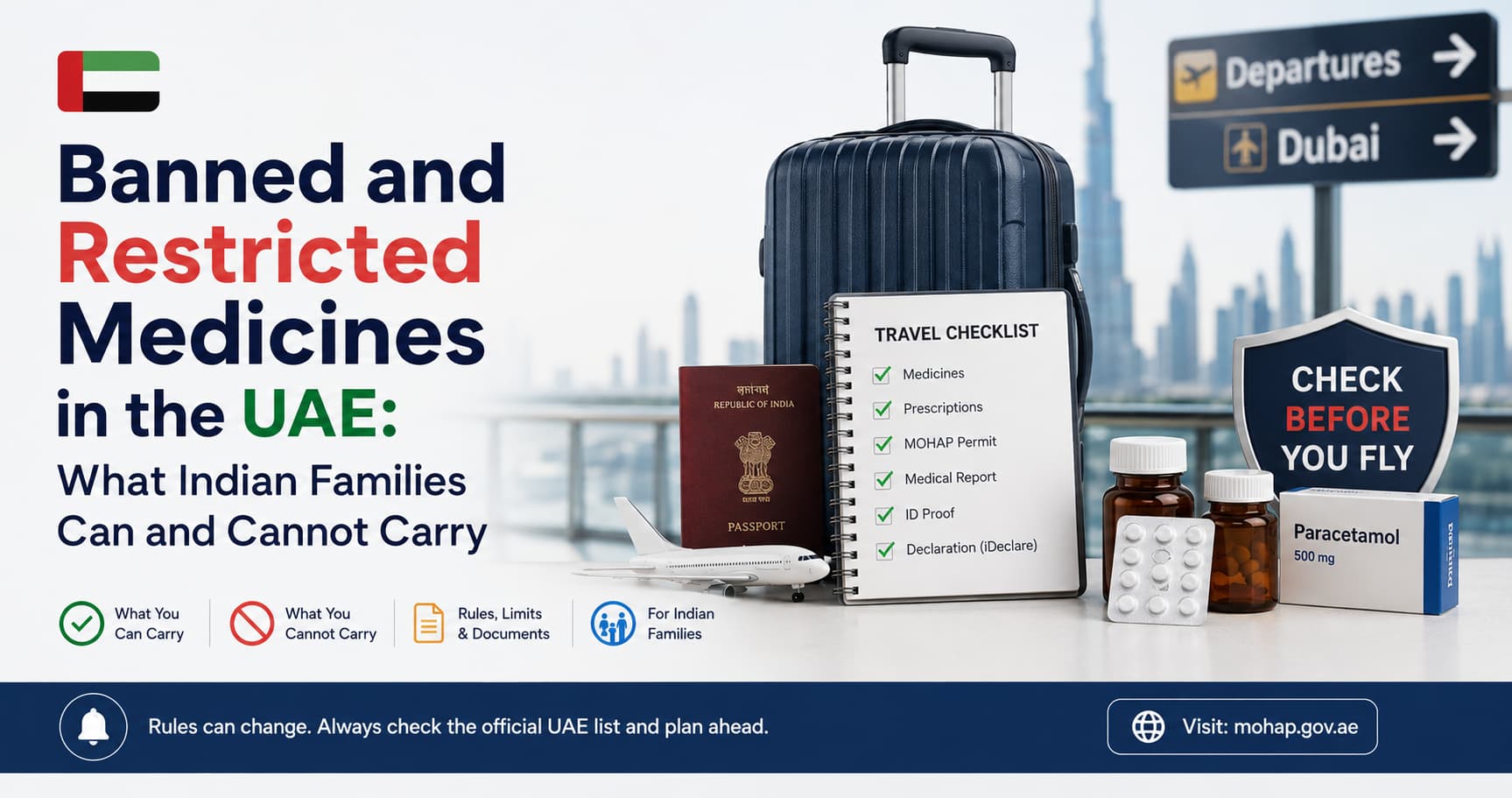
If you are flying from India to the UAE with medicines in your bag, here is the short version of the rules on banned and restricted medicines in the UAE.
- Most ordinary medicines Indian families carry — paracetamol, antacids, most blood pressure and diabetes tablets, most antibiotics, most inhalers — are not on the UAE’s controlled list. You can carry them for personal use.
- A specific group is controlled. These are legal to carry for genuine medical use, with documentation and within quantity limits. Tramadol, codeine, pregabalin, gabapentin, alprazolam, diazepam, clonazepam, zolpidem and ADHD medicines all sit here.
- A much smaller group is prohibited outright, with no personal-use route at all. Cannabis and CBD products catch travellers most often.
- Two prohibitions turn on labelling rather than contents: UAE law bars any medicine whose active ingredients are not identified in Arabic or English, and any medicine that is expired. This applies to herbal and Ayurvedic preparations too.
- The MOHAP import permit is free and, for visiting travellers, optional — but it requires a UAE PASS login that most Indian visitors do not have. If you cannot get one, declaring on arrival with your prescription is a legitimate alternative route, not a failure.
- Do you need to declare ordinary paracetamol? No. Declaration applies to controlled medicines and certain medical items, not to everyday over-the-counter tablets.
The single most useful thing you can do before you fly is turn your medicine box over, read the active ingredient, and check that ingredient — not the brand name — against the UAE’s published list.
Why This Matters More Than Most Travel Checklists
Indian families almost never travel light on medicines. A typical suitcase heading to Dubai carries a fever syrup, a strip of painkillers, something for acidity, something for loose motions, a month of a parent’s blood pressure tablets, and often a pouch of Ayurvedic powders somebody at home swears by.
Nearly all of that is fine. But a handful of those items sit in a category the UAE treats very differently — and the paperwork and packaging have to be right before you reach the airport, because neither can be fixed at a customs desk.
Key message: Do not assume that a medicine freely available in India is automatically unrestricted in the UAE. The legal question is what the active ingredient is, how the UAE classifies that ingredient, and whether your documentation connects you to it.
Why India and the UAE Classify Medicines Differently
Most guides tell you which medicines cause problems. Understanding why takes ten minutes and makes the rest of this guide obvious.
Two systems, two different axes
India controls medicines through the Drugs and Cosmetics Rules, 1945 — Schedules H, H1 and X — with the Narcotic Drugs and Psychotropic Substances Act, 1985 operating as a separate, harsher regime on top. Schedule H covers the broad majority of prescription medicines. Schedule H1, introduced in 2013, adds tighter record-keeping for a narrower set including higher-generation antibiotics, anti-TB drugs and some psychotropics. Schedule X is the most restrictive tier, and it contains just sixteen substances.
The UAE controls medicines through the narcotic and psychotropic schedules annexed to Federal Decree-Law No. 30 of 2021, aligned to the Single Convention on Narcotic Drugs 1961 and the Convention on Psychotropic Substances 1971, with MOHAP maintaining the Controlled Drug Class A (CDa) and Class B (CDb) classifications on top.
The consequence is arithmetic. India’s most restrictive tier holds sixteen substances. The UAE’s traveller-facing controlled list runs to 268 entries. The UAE is not stricter about the same medicines — it draws a wider circle. That single fact explains almost every unpleasant surprise Indian travellers report.
The red symbol on your Indian pack — a flag, not a clearance
Here is something you can act on immediately, and it costs nothing.
Indian labelling rules require a red symbol in the top-left corner of the pack for controlled categories:
| Symbol on the pack | What it means in India | What it should mean to you |
|---|---|---|
| Rx in red, with a red-bordered warning box | Schedule H1 — tighter control, pharmacist retains the prescription | Check this ingredient against the UAE list |
| NRx in red | A Schedule H medicine that also falls under the NDPS Act | Treat as very likely controlled in the UAE |
| XRx in red | Schedule X — India’s most restrictive tier | Assume controlled in the UAE and prepare full documentation |
| No red symbol | Ordinary prescription or over-the-counter medicine | Not a clearance. Check anyway |
That last row is the important one. Pregabalin and gabapentin are ordinary prescription medicines in India with no special red marking, and both appear on the UAE controlled list. The symbol tells you what India worries about. It does not tell you what the UAE worries about.
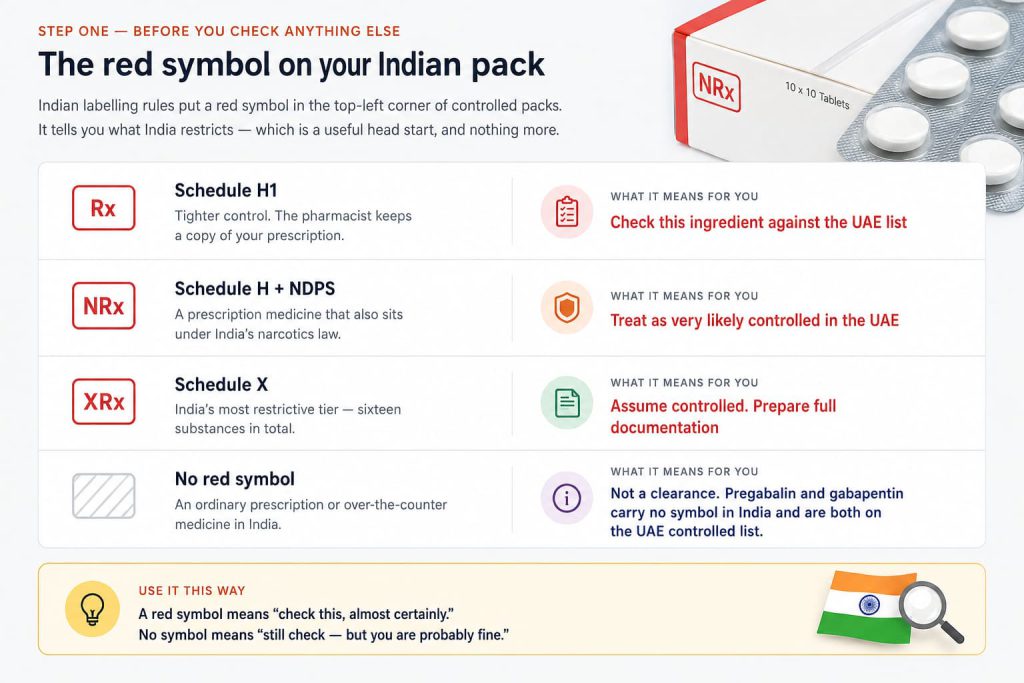
Use it this way: a red symbol on your Indian pack is a near-certain “check this.” No symbol means “still check, but you are probably fine.”
How We Verified the Information in This Guide
Medicine rules are the kind of topic where a confident-sounding article can do real damage. Much of what circulates online is a decade old, copied from another blog, or a WhatsApp forward that hardened into “fact” through repetition.
Every regulatory statement here is tied to a named, current, official source. Where sources disagree, we say so rather than picking whichever reads better.
| Source | What it establishes | Where to find it |
|---|---|---|
| UAE Government Portal, Drugs and controlled medicines | The CDa / CDb system and official framing of controlled medicines | u.ae |
| MOHAP, Issue of Permit to Import Medicines for Personal Use | Who needs a permit, required documents, that it is free and optional for travellers | mohap.gov.ae |
| Alphabetical list of INCB and MOHAP controlled substances | The named substances and their control level | Controlled medicines list (PDF) |
| Federal Decree-Law No. 30 of 2021 | The governing criminal law, the medical-treatment exception, penalties | uaelegislation.gov.ae |
| Cabinet Resolution No. 90 of 2021, Annex No. 1 | The operative detail on bringing medicines in for personal use — quantities, documents, packaging, prohibitions | uaelegislation.gov.ae |
| Dubai Airports and Zayed International Airport | What must be declared on arrival and how declaration works | dubaiairports.ae · zayedinternationalairport.ae |
Three caveats about the sources themselves
The consolidated list carries a September 2022 update date
A great deal in this guide rests on it, and it is the most current consolidated version published on the UAE Government Portal. MOHAP separately hosts a controlled and semi-controlled medicines document in the resources section of its permit service page. If the two differ for your specific medicine, the MOHAP page is the one attached to the permit you would actually apply for. Check both close to your travel date.
The list limits itself
Its closing statement covers preparations containing any listed material and any other material with the same dispensing status in the UAE, and records that non-inclusion of a similar substance does not place it outside the law. Absence from the list is strong reassurance. It is not a legal guarantee.
The rulebook is layered and it moves
Cabinet Resolution No. 90 of 2021 sits under Federal Law No. 8 of 2019, which Federal Decree-Law No. 38 of 2024 replaced from January 2025 — but regulations made under the old law still apply where they do not conflict with the new one, which is why Annex No. 1 remains operative. The narcotics framework has been amended more than once, and medicines regulation is consolidating under the Emirates Drug Establishment (EDE), with enforcement under the National Drug Enforcement Authority and supply tracked through Tatmeen.
Editorial note: This is a travel-compliance guide, not medical or legal advice. It does not tell you what to take, what to stop, or how to treat any condition. Decisions about your medicines belong to you and your doctor.
UAE Medicine Rules at a Glance
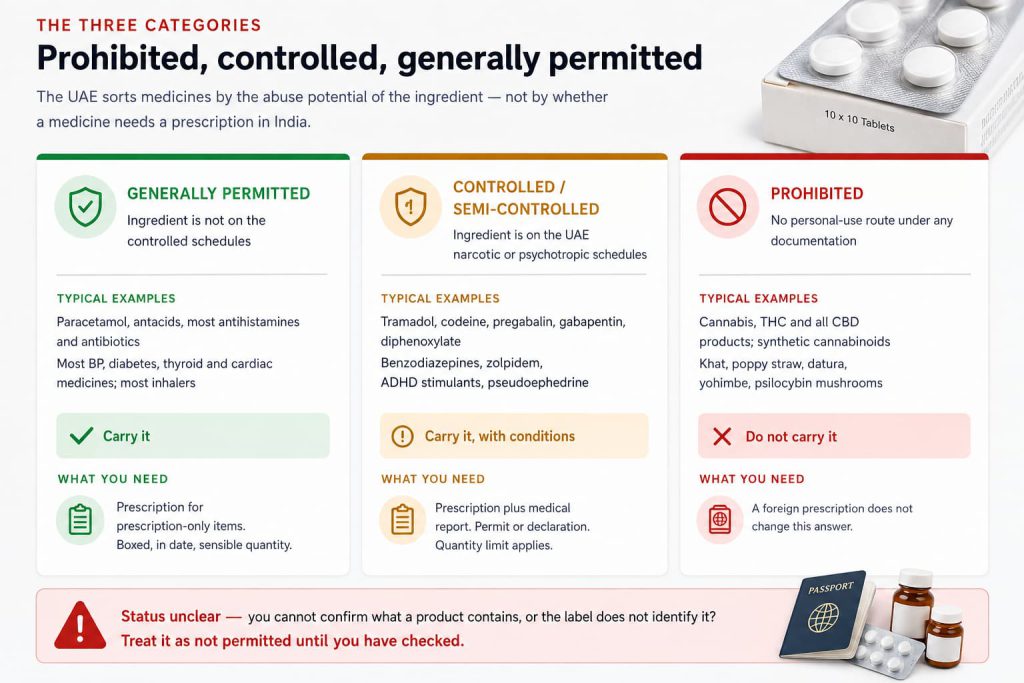
The UAE sorts medicines by the abuse potential of the active ingredient — not by whether a medicine needs a prescription in your home country.
| Category | What it means | Can you carry it? | Documentation |
|---|---|---|---|
| Generally permitted | Over-the-counter and prescription medicines whose active ingredients are not on the controlled schedules | Yes, for personal use | Prescription or medical report for prescription-only medicines; not required for genuine OTC items |
| Semi-controlled (CDb) | Real but lower abuse potential; more commonly dispensed to outpatients | Yes, subject to the applicable rules | Prescription or attested medical report expected |
| Controlled (CDa) | Ingredients on the UAE’s narcotic and psychotropic schedules and the INCB conventions | Yes, for genuine medical use, within quantity limits | Prescription or attested medical report; MOHAP permit available and advisable |
| Prohibited | No personal-use route under any documentation | No | A foreign prescription does not change this |
| Status unclear | You cannot confirm the contents, or the label does not identify them | Treat as not permitted until confirmed | Verify before you fly |
Two points are where most travellers go wrong.
- “Restricted” is not a soft version of “banned.”: The controlled category exists precisely so patients who need these medicines can travel with them. The UAE Government’s own framing is that controlled medicines are given to patients with acute and chronic conditions in line with modern medical practice.
- “Prescription-only in India” tells you nothing: Many Indian prescription medicines are entirely uncontrolled in the UAE. Some Indian over-the-counter and Ayurvedic products contain ingredients the UAE controls or prohibits.
Banned, Restricted and Generally Permitted: The Real Difference
Prohibited medicines and substances
Prohibited means no lawful route as a traveller. No prescription, doctor’s letter or permit changes the answer. On the published list these entries are marked as prohibited rather than given a quantity allowance.
The entries most relevant to travellers include cannabis in all forms — plant, resin, cannabis sativa, tetrahydrocannabinol (THC) and synthetic cannabinoids — along with heroin, cocaine, coca leaf, LSD, MDMA, khat (Catha edulis), psilocybin mushrooms and concentrate of poppy straw.
Several prohibited entries are botanical, and these quietly matter to Indian travellers because they can appear in traditional preparations rather than in anything anyone would call a drug. Datura (Datura stramonium), yohimbe bark, henbane, morning glory seeds, peyote and ergot are all listed. So is a catch-all covering any other plant containing narcotic ingredients or capable of harming the mind.
CBD deserves its own line. Cannabis-derived products — oils, drops, gummies, topicals, vape cartridges — are prohibited regardless of what the label claims about THC content or where they were legally bought. Residue in a previously used vape device has been enough to create a problem. The UAE’s licensed industrial hemp framework covers regulated commercial activity and creates no allowance for visitors.
Two India-specific items belong here even though they are not medicines. Poppy seeds (khus khus) are treated as a narcotic-related item and should not be carried in any form, including inside bakery products and spice mixes — Dubai’s courts have convicted travellers who brought them for cooking. Paan and betel leaves are listed among prohibited items by Dubai Airports. Neither is worth testing.
Controlled and semi-controlled medicines
These are legal for genuine medical use. What they carry is conditions: documentation proving the medicine belongs to you, a quantity limit, and a declaration or permit.
The UAE splits them into Controlled Drug Class A (CDa) — narcotics and stronger psychotropics — and Class B (CDb), described as semi-controlled. Neither is freely available in UAE pharmacies and neither can be freely imported. “Not freely imported” describes a process, not a prohibition.
The practical difference is intensity rather than kind: CDa attracts the strictest prescribing controls inside the UAE, CDb sits closer to ordinary prescription medicines. For a traveller both mean the same thing — bring documentation and observe the limit.
Generally permitted medicines
Everything else, which is most of what a family packs: paracetamol, most anti-inflammatories, most antihistamines, antacids, most antibiotics, most cardiac, thyroid, cholesterol and diabetes medicines, most asthma inhalers.
General conditions still apply — original packaging, readable ingredients, in date, sensible quantities, and a prescription for prescription-only items. But there is no permit and no controlled-substance process.
Why the distinction decides your whole trip
Restricted does not mean illegal. It means conditional. Meet the conditions and you travel normally.
Prescription medicine does not mean banned medicine. The UAE asks what the active ingredient is, not whether an Indian pharmacist asked to see a prescription.
Getting these backwards produces the two classic mistakes: leaving necessary medication at home out of unfounded fear, or carrying controlled medicines with no documents because “I have a prescription.”
How to Check Whether Your Medicine Is Allowed: Six Steps
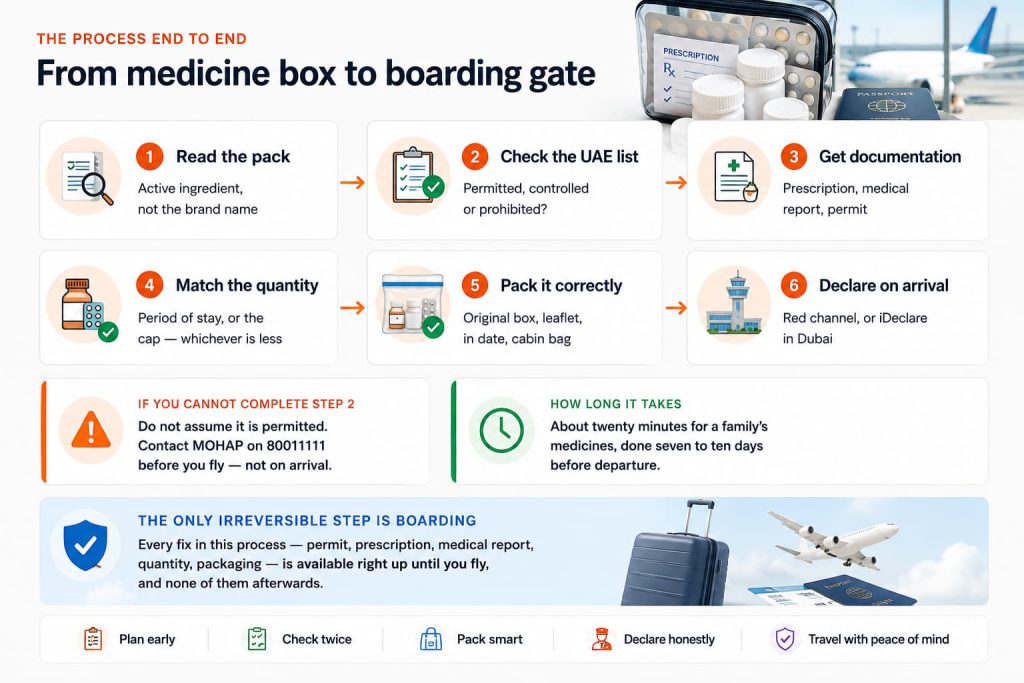
Work through this with your medicine boxes in front of you. It takes about twenty minutes for a family’s worth of medicines.
Step 1 — Find the active ingredient, not the brand name
Every Indian medicine pack prints its composition, usually in smaller type under the brand name. That composition line is the only thing the UAE is looking at.
Brand names are national. The same molecule sells under a dozen names in India and completely different ones in the UAE, and one Indian brand can cover several formulations across tablet, syrup and SR versions. Searching a brand name against a UAE list usually returns nothing, which feels reassuring and proves nothing.
Write down the ingredient exactly as printed. If a pack contains several actives, list all of them. Combination products are where most surprises live — the problem ingredient is frequently the second or third one rather than the headline one.
Step 2 — Note the strength and the form
Record the strength per dose and the form.
The UAE list distinguishes between them. Codeine appears in its own right, and separately as codeine above 30 mg per unit dose in combination products, classified differently. Dihydrocodeine appears both alone and in combination. Same molecule, different treatment depending on dose and what it is mixed with.
Patches, injections and modified-release preparations deserve extra care, since they often carry substantially more active ingredient per unit than the equivalent tablet.
Step 3 — Check the ingredient against the UAE’s published list
Open the UAE’s alphabetical list of INCB and MOHAP controlled substances, published on the UAE Government Portal, and search it for each ingredient.
You will get one of three results:
- Not on the list. Very likely permitted — sufficient for an everyday medicine. For an unusual or new molecule, remember the list’s own statement that non-inclusion is not a guarantee, and ask MOHAP.
- Listed with a quantity allowance. Controlled or semi-controlled: it travels with you, with documentation, inside the limit.
- Listed as prohibited. No personal-use route. Do not pack it, and speak to your doctor.
Step 4 — Work out what documentation the medicine needs
- Controlled or semi-controlled: a prescription in the patient’s name, ideally a medical report, and a permit if you can obtain one.
- Prescription-only but not controlled: a prescription or medical report showing the medicine belongs to the person carrying it.
- Genuine over-the-counter: no prescription needed, but the packaging rules below still apply.
Step 5 — Check the quantity against your actual trip
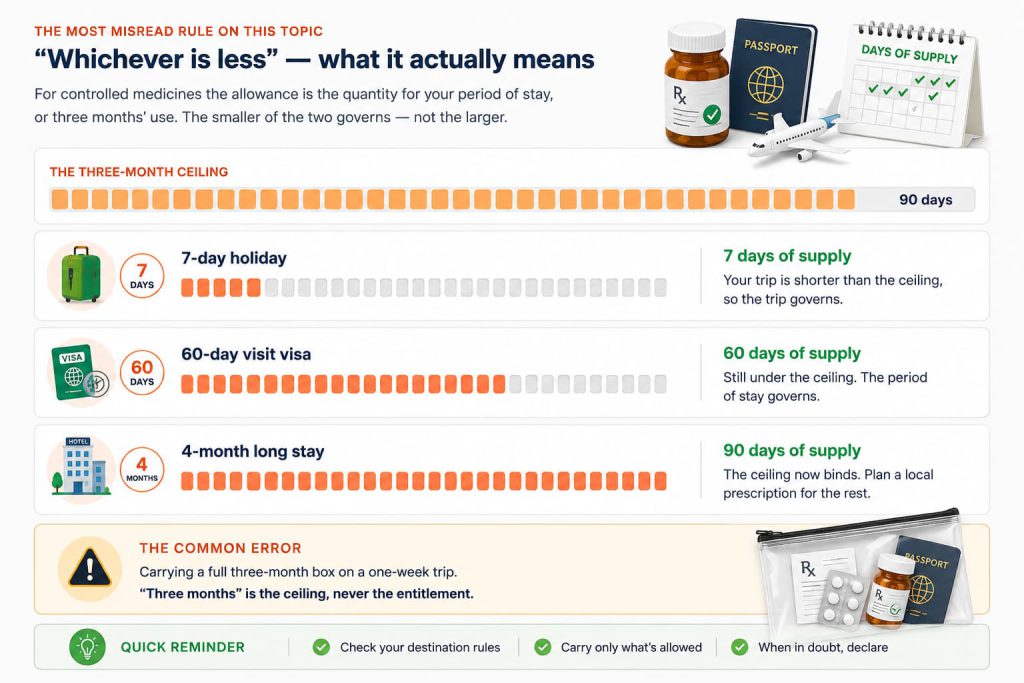
For controlled medicines the allowance is the quantity for your period of stay or a maximum of three months’ use, whichever is less. For a two-week holiday, three months’ supply is not your allowance. Two weeks is.
Step 6 — Verify before departure, not on arrival
If anything is unresolved, resolve it while you are still in India. MOHAP operates a call centre on 80011111 and publishes contact channels on its service page.
There is no equivalent conversation available at a UAE arrivals hall.
Medicine Categories That Need Extra Attention
Being in one of these categories does not mean a medicine is banned. These are the therapeutic areas where controlled ingredients cluster, so they are where checking pays. Many medicines in every category below are completely uncontrolled.
| Category | Why it needs checking | What to do |
|---|---|---|
| Strong painkillers | Opioids are heavily represented — morphine, oxycodone, fentanyl, pethidine, methadone, codeine, dihydrocodeine, buprenorphine, pentazocine, nalbuphine. Tramadol, routine in Indian practice, is listed as a controlled drug. | Assume controlled. Prescription, medical report, permit, quantity limit. |
| Nerve-pain medicines | Pregabalin and gabapentin both appear on the UAE controlled list. Prescribed very widely in India for neuropathy, sciatica and diabetic nerve pain, and routinely assumed to be ordinary tablets. | Treat exactly like a controlled painkiller. The most commonly missed item on Indian routes. |
| Sleeping medicines | Zolpidem, zopiclone and zaleplon are listed, as are nitrazepam, temazepam, triazolam, estazolam and flurazepam. | Never pack a few loose “for the flight.” Prescription and original box. |
| Anti-anxiety medicines | The benzodiazepine family is comprehensively listed — alprazolam, diazepam, clonazepam, lorazepam, bromazepam, chlordiazepoxide, clobazam, clorazepate, oxazepam, prazepam, midazolam. | Assume controlled. Documentation naming the patient. |
| Antidepressants | The popular claim is mostly wrong. Commonly prescribed SSRIs and SNRIs do not appear on the published list. Some older and atypical agents do — amineptine is listed as a Schedule II psychotropic. | Check your specific molecule rather than accepting “all are banned” or “none are.” Carry the prescription regardless. |
| ADHD medicines | Methylphenidate, dexamfetamine, lisdexamfetamine and amfetamine are all listed as Schedule II psychotropics. | Full documentation, permit strongly advised, strict quantity discipline. Applies to children as well as adults. |
| Cough and cold medicines | The sleeper category. Pseudoephedrine and ephedrine are controlled under the 1988 UN Convention as reflected on the UAE list, and both appear constantly in Indian combination cold remedies. Codeine and pholcodine cough preparations are listed as narcotics. | Read the full composition of every cold and cough product, including anything bought off the shelf. The decongestant is usually the issue. |
| Anti-diarrhoeal medicines | Diphenoxylate is listed as a Schedule I narcotic. It is the active ingredient in a very familiar anti-motility preparation Indian families pack automatically for travel. | Check the composition. Loperamide is a different molecule and is not on the list. |
| Anti-epileptic and neurological | Mixed. Phenobarbital, clonazepam and clobazam are listed; many other anticonvulsants are not. Anti-parkinsonian agents including trihexyphenidyl (benzhexol) and procyclidine appear as controlled drugs. | Check each molecule separately. Never generalise across a multi-medicine prescription. |
| Weight-loss medicines | Phentermine, amfepramone, mazindol and phendimetrazine are listed as psychotropics. | Check before packing. Often bought with minimal documentation, which makes them harder to justify. |
| Hormonal and other prescription | Most are not on the controlled list. Avoid blanket assumptions in either direction. | Standard prescription-only handling. |
The pattern behind this table
The medicines that catch Indian travellers are not exotic — a leftover tramadol strip, a pregabalin course, a decongestant for the flight, an anti-diarrhoeal kept for travel. None of them feel like controlled substances, which is exactly why they get packed without a second thought. Every one travels legally with a prescription, the box, and a quantity that matches the trip.
Common Medicines Indian Families Usually Carry
The wording here is deliberately careful. The honest answer is rarely “always allowed,” because it depends on the composition of the specific product in your hand.
| Medicine type | General consideration | What to check on your pack |
|---|---|---|
| Fever and pain (paracetamol) | Plain paracetamol is not on the controlled list. | That it is genuinely plain — paracetamol is frequently combined with codeine or a decongestant. |
| Anti-inflammatories | Ibuprofen, diclofenac and naproxen are not on the controlled list. | Combination packs, which sometimes add other actives. |
| Antacids and acid reducers | Not on the controlled list. Routine. | Nothing beyond normal packaging and quantity. |
| Antihistamines | Common antihistamines are not on the controlled list. | Whether the product is a combination with a decongestant. |
| Cold and flu combinations | The category needing most care. Pseudoephedrine and ephedrine are controlled, and many Indian cold remedies contain one. | The full composition line. If a decongestant is present, treat as controlled. |
| Cough syrups | Depends entirely on the active. Codeine and pholcodine preparations are narcotics. | The active ingredient, and whether it is a combination. |
| Motion sickness | Common agents are not on the controlled list. | Standard packaging and quantity. |
| Anti-diarrhoeal | Split. Loperamide is not listed; diphenoxylate is a Schedule I narcotic. | Which molecule your pack contains — they are sold for the same purpose. |
| Children’s syrups and drops | Same actives as adult products, so the same logic applies. | Paediatric cold combinations, for the decongestant. |
| Ongoing prescriptions (BP, diabetes, thyroid, cholesterol, cardiac) | The great majority are not controlled. | Carry the prescription — these are prescription-only even though not controlled. |
| Inhalers | Standard asthma and COPD inhalers are not on the controlled list. | Original packaging, prescription, cabin baggage. |
| Insulin and injectables | Not controlled, but they are medical supplies with cold-chain and sharps considerations — see the medical devices section below. | Prescription, original packaging, cabin baggage, airline notification for needles. |
The one habit worth building
All of this reduces to a single behaviour: read the composition line, not the front of the box.
Indian pharmaceutical branding is dense with combination products, and the difference between an unremarkable pack and a controlled one is often one extra ingredient in small type. A family that reads composition lines will catch every issue in this table in ten minutes. A family that reads brand names will catch none of them.
Prescription Medicines: What Documentation Should You Carry?
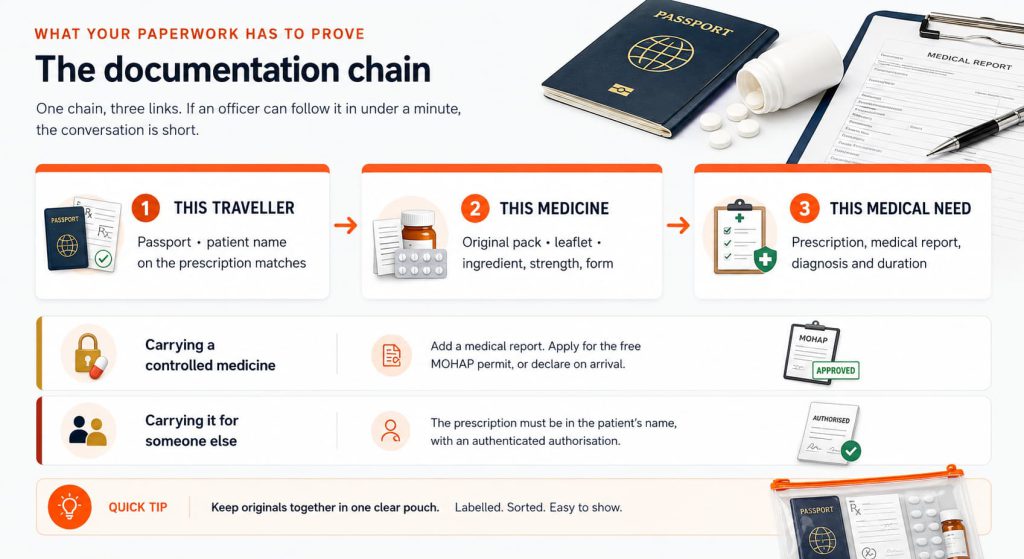
Your paperwork exists to establish one chain quickly:
This traveller → this medicine → this medical need.
If an officer can follow that chain in under a minute, the conversation is short. If a link is missing — the name does not match the passport, the dose does not explain the quantity — it becomes longer.
The pattern worth noticing: across the published guidance and the cases that get reported, the failure point is almost never the medicine itself. It is the documentation, or the absence of it.
The documentation checklist
| Document | Status | What it must show |
|---|---|---|
| Original prescription | Essential for controlled medicines; expected for prescription-only medicines | Patient’s full name, medicine name, dose, dosage form, duration of treatment, date of issue, prescribing doctor’s name |
| Prescription recency | Required for the MOHAP permit route | Issued within the last three months, stamped or recognised by the treating healthcare facility |
| Medical report | Optional for the permit application, but the strongest single document you can carry | Patient’s full name, diagnosis, treatment plan including medicine, dose, form and duration, date, doctor’s name, facility stamp |
| Medical report recency | Where carried | Issued within the last year |
| MOHAP permit | Free; optional for visiting travellers, advisable for controlled medicines | Generated through the MOHAP portal or app |
| Passport copy | Required for the permit application | Standard identity document |
| Power of attorney | Required where a representative carries a patient’s controlled medicine | Authorisation from the patient, authenticated, plus a copy of the patient’s ID |
A documented inconsistency worth knowing about
There is a real difference in stringency between two official sources, and you deserve to know rather than be told a tidy story.
Cabinet Resolution No. 90 of 2021 describes documents authenticated by the health authority of the country of treatment, by that country’s embassy, or by an accrediting body. MOHAP’s current online service page asks for a prescription issued within the last three months and stamped or recognised by the treating healthcare facility — a noticeably lighter requirement, and the one the live e-service operates on.
How to handle the gap sensibly: for ordinary prescription medicines, a properly stamped prescription from your Indian doctor or hospital is what the live MOHAP process asks for. For a long stay, a strong opioid, a stimulant or an unusual medicine, having the documents attested as well removes the question entirely.
Attestation of Indian documents for use in the UAE runs through a sequence — notarisation, then verification by the relevant state authority, then the Ministry of External Affairs, then UAE attestation, which is now issued as a digital certificate covering the Embassy and the UAE Ministry of Foreign Affairs together. Requirements, fees and processing times change, so confirm the current position and the lead time with the attesting authority rather than working to a figure from any article. Start early. Where an official process and an official regulation differ, meeting the stricter one is never wrong.
Carrying Medicine for Someone Else
This is the most common real-world Indian scenario and the one most guides skip entirely. Four situations, four different answers.
| Situation | Position | What to do |
|---|---|---|
| Your own medicine | Simplest case | Prescription in your name, original packaging, quantity matched to your trip |
| A travelling companion’s medicine in your bag | The regulation contemplates a representative carrying a patient’s controlled medicine, and calls for an authenticated power of attorney plus a copy of the patient’s ID | Easiest fix costs nothing: each patient carries their own medicines in their own bag with their own prescription |
| Medicine for a relative living in the UAE | You are the person bringing it in, so the rules apply to you — but the prescription must be in the patient’s name, and quantity is measured against that patient’s documented need | Carry their prescription and medical report. For controlled medicines, treat the authorisation requirement as applying. Consider whether the medicine is simply available in the UAE instead |
| A sealed package someone asked you to carry | You cannot verify the contents, and the identifiability rules described below apply to you as the carrier | Do not carry it. Indian missions in the UAE have specifically warned nationals against accepting packages from others |
The consolidation trap. Families routinely gather everyone’s medicines into one bag to save space — usually the fittest traveller carrying an elderly parent’s prescriptions. It is the single easiest way to turn four straightforward positions into one complicated one. Distribute the medicines, not the risk.
Why the package rule has no exceptions
A passenger arriving at Sharjah International Airport was found carrying a packet he had agreed to bring for a relative’s sick sister. It contained prohibited drugs. Police accepted he had not known what was inside and charged him anyway — unfamiliarity with the law exempts nobody. Sharjah’s airport security administration has since repeated the advice publicly: do not accept packets from other travellers.
Indian officials say the same. A serving Indian Ambassador to the UAE has warned that Indians still land on the wrong side of the law by carrying parcels from strangers, and the Indian Workers Resource Centre notes that such packages come from well-meaning family members as often as from agents.
The rule: if you did not buy it and cannot read its composition, it does not go in your bag. Your relationship to the sender changes nothing.
How Much Medicine Can You Carry?
Short answer: three months’ supply for controlled medicines, six months for everything else — but never more than your trip actually needs.
The published limits
| Medicine type | Maximum quantity | Condition |
|---|---|---|
| Controlled — narcotics and psychotropics | Quantity for the period of stay, or three months’ use — whichever is less | Prescription or attested medical report required. Visitors and residents face the same cap; they differ only in what happens to excess |
| Non-controlled prescription-only | Proportional to the period of stay, not exceeding six months’ personal use | Medical report or prescription copy showing the patient’s details |
| Over-the-counter | Proportional to the period of stay, not exceeding six months’ personal use | Personal use only |
| Preventive medicines | Proportional to stay, not exceeding six months | Medical report or document showing the condition and treatment, or a prescription copy |
The two phrases that change the answer
“Whichever is less.” For controlled medicines the ceiling is not three months in the abstract — it is whichever is smaller, your trip length or three months’ supply. A family on a seven-day holiday carrying a full three-month box is outside the allowance even though “three months” is the number everyone quotes.
“Proportional to the period of stay.” The same logic governs the six-month tiers. Six months is a ceiling, not an entitlement.
The underlying principle is consistency: your quantity should be explainable by your prescription and your itinerary.
What happens to excess
The rules distinguish between situations. For a transit traveller, excess is retained and returned on departure. For a traveller entering the country, quantities beyond the permitted threshold or beyond what the prescription supports may be seized and destroyed. If your permitted supply runs out during your stay, the route is to see a licensed physician at a UAE health facility — regulated by the Dubai Health Authority in Dubai and the Department of Health in Abu Dhabi — who can assess whether to continue the same medicine or prescribe an equivalent registered in the UAE.
One number this guide will not invent
You may find articles quoting precise numbers of tablets or millilitres. Those numbers are not in the official sources, which express limits in months of supply and proportionality to length of stay. Anyone converting that into a tablet count is doing arithmetic on your behalf without a source, and getting it wrong costs you far more than it costs them.
The MOHAP Permit: How It Actually Works
Short answer: it is free, it is optional for visiting travellers, and it requires a UAE PASS account that most Indian visitors do not have. That last point is the one almost no guide mentions, and it is where readers following generic advice get stuck.
What to expect
- Cost: free. There is no fee for the permit.
- Where: the MOHAP website or smart app, under the personal-use medicine import service.
- Login: UAE PASS, the UAE’s national digital identity. Visitors without a UAE PASS account will not be able to submit the form directly.
- If you cannot register: MOHAP publishes a smart services support channel for travellers who face difficulty registering or submitting. Contact them before you fly rather than at the airport.
- If you still cannot submit: MOHAP’s own guidance is that a traveller unable to complete the application may carry the medicine with the prescription and medical report, provided the quantity stays within the three-month limit.
- Timing: MOHAP lists the service completion duration as instant. Some reputable reporting describes processing within about three working days. Treat it as up to three working days and apply at least a week before you fly.
- Documents: prescription no older than three months, stamped by the treating facility; passport copy; medical report optional but recommended.
Permit or declare on arrival? Both are legitimate
| Apply for the permit | Declare on arrival | |
|---|---|---|
| Legal standing | Prior approval | Expressly provided for by MOHAP where prior approval was not obtained |
| Requires UAE PASS | Yes | No |
| Best for | Controlled medicines, long stays, unusual molecules, anyone who wants certainty | Travellers without UAE PASS, late bookings, ordinary prescription medicines |
| At the airport | Usually a formality | Inspection and document check; can take longer |
| Main risk | Leaving the application too late | Officer discretion where documentation is incomplete or classification is ambiguous |
| Still need documents? | Yes | Yes — the prescription and medical report do the work |
Our view: if you are carrying a controlled medicine and can obtain a permit, do. If you cannot, that is not a reason to leave a prescribed medicine behind — it is a reason to make your prescription and medical report immaculate.
Posting or couriering medicines is a different process
Everything above concerns medicines you carry personally. Posting them falls under the UAE medicine import rules instead, and that is where MOHAP approval stops being optional and becomes the mechanism. Do not assume a parcel clears the way a passenger does, and do not send controlled medicines by post at all.
How to Pack Medicines for a UAE Trip
Packing is not just tidiness here. Parts of it are written into the regulation.
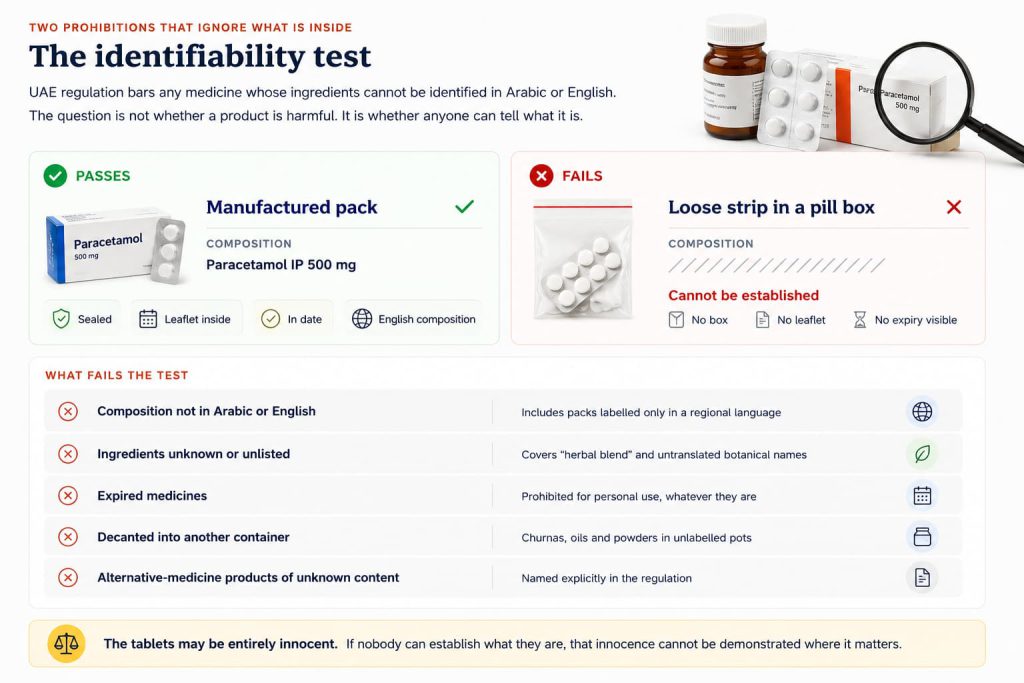
The identifiability test
Two of the UAE’s prohibitions have nothing to do with what a medicine contains. They turn on whether anyone can tell what it contains.
Cabinet Resolution No. 90 of 2021 requires medicines brought in for personal use to be in original, tightly closed packaging — or packaging labelled by a health or pharmaceutical establishment showing the composition, the patient’s name and the storage conditions. Separately, it prohibits bringing in medicines that carry no leaflet identifying the active ingredient in Arabic or English, medicines of unknown ingredients, and expired medicines.
Call it the identifiability test, because that is what it is. A strip of unlabelled tablets in a pill organiser fails it. The tablets may be entirely innocent; if nobody can establish what they are, that innocence cannot be demonstrated where it matters. This single test explains the packing rules below, and it returns again in the section on Ayurvedic and herbal products.
The packing checklist
- Original boxes, leaflet inside. The leaflet is what identifies the contents. Do not discard boxes to save space.
- Check every expiry date. Expired medicines for personal use are specifically prohibited — five minutes clearing old strips removes a whole category of risk.
- Essential medicines in cabin baggage. Anything you cannot manage a day without travels with you.
- Documents with the medicines, reachable at the same moment.
- One medicine bag per patient. For families with several prescriptions, this turns a confusing inspection into a straightforward one.
- No decanting, no pill boxes, no loose strips. If you use a weekly organiser at home, take it empty and fill it after you arrive.
- Liquid medicines: two separate rule sets. Airline and aviation-security liquid limits are cabin-safety rules set by your airline and departure airport. UAE medicine regulation governs what may enter the country. Satisfying one does not satisfy the other.
- Cold-chain items need planning. Insulin and similar products have storage requirements the regulation expects to be respected in transit. Plan the cool bag before departure.
- Digital backups. Photograph every document and keep the images on your phone and in cloud storage — not a substitute for originals, but it has rescued plenty of travellers.
Medical Devices, Supplies and Sharps
Families travelling with elderly parents or a diabetic child usually carry more than tablets, and the rules treat equipment slightly differently from medicines.
- Medical supplies are permitted for personal use. The regulation covers them explicitly.
- Supplies containing a controlled substance follow the controlled rules. A pre-filled pen or cartridge containing a scheduled ingredient is treated as that ingredient, not as a device.
- Nebulisers, CPAP machines, insulin pumps and continuous glucose monitors travel as personal medical equipment. Carry the prescription or a doctor’s letter identifying the device and the patient, and keep it in cabin baggage where possible.
- Syringes, needles and lancets should stay with the medicine they belong to, in original packaging, with the prescription. Notify your airline in advance — this is an airline and security requirement rather than a UAE customs one.
- Oxygen concentrators need airline approval before travel, typically with a medical form completed by your doctor. Start this at least two weeks out.
- Anything unusual or powered is worth a call to your airline’s medical desk before you fly, since aviation rules and UAE entry rules are separate questions.
Ayurvedic Medicines, Herbal Products and Supplements
This section matters disproportionately for Indian travellers, because these are the products most likely to be packed without a thought and least likely to survive close reading of the rules.
“Natural” is not a regulatory category. Nothing about a product being herbal, traditional or plant-based places it outside UAE medicine law.
What the regulation actually says
Cabinet Resolution No. 90 of 2021 covers herbal and supplemental products explicitly, in two ways.
First, travellers are prohibited from bringing in supplements, items or herbal substances that are banned or prohibited inside the UAE according to lists issued by the Minister or identified as prohibited on the Ministry’s website.
Second — and this decides most real cases — it lists among medicines prohibited from being brought in by arriving travellers: drugs of alternative medicine and medical herbs that contain unknown ingredients.
This is the identifiability test again, applied to the category where it bites hardest. The question is not whether the product is harmful. It is whether its contents are known and identifiable. A traditional preparation in an unlabelled pouch, a churna decanted into a plastic container, a bottle of oil with a handwritten label, capsules from a clinic with no printed composition — all fail a test about identifiability rather than a test about safety.
Add the Arabic-or-English requirement and the position is clear. A commercially manufactured Ayurvedic product with a printed composition in English, sealed and in date, is in a completely different position from a homemade or repackaged preparation — even if the second is the more familiar and better-loved of the two.
The ingredient risk
There is a second, narrower issue. Some plants used in traditional preparations appear on the UAE prohibited list by name — datura and yohimbe among them — alongside a catch-all covering other plants containing narcotic ingredients.
A product labelled only “herbal blend,” or listing ingredients with no botanical or English equivalent, cannot be checked against that list at all — exactly the situation the unknown-ingredients prohibition covers.
What to do in practice
- Sealed, commercially packaged products only — printed composition in English, visible expiry date.
- Leave home-prepared, loose or decanted preparations behind. However well they work, they cannot be identified.
- Read supplement labels the way you read medicine labels. Sports supplements, weight-loss aids, “energy” products and herbal sleep aids most often contain something on a control list.
- If the composition is not printed in English or Arabic, do not pack it. Not a judgement call.
What Happens at UAE Ports of Entry
Federal rules, local procedures
This distinction matters and is frequently blurred. What your medicine is classified as, how much you may carry, and what documents you need are federal questions — identical whether you land in Dubai, Abu Dhabi or Sharjah, or arrive by land or sea. Federal Decree-Law No. 30 of 2021, Cabinet Resolution No. 90 of 2021 and the MOHAP lists apply nationwide, with the Federal Authority for Identity, Citizenship, Customs and Port Security (ICP) overseeing customs at federal level.
How you declare is administered locally, by each emirate’s customs authority.
| Port of entry | Declaration mechanics |
|---|---|
| Dubai (DXB and DWC) | Dubai Customs operates the green and red channel system; passing through either channel is itself treated as a declaration. Dubai Customs also offers the iDeclare app for declaring in advance. Dubai Airports lists medicines, controlled drugs and certain medical items among items that must be declared, with MOHAP named as the controlling authority for pharmaceutical products. |
| Abu Dhabi (Zayed International) | Abu Dhabi customs guidance is that medications may be subject to specific restrictions or require a permit, and that any item you are unsure about should be declared to a customs officer. There is no Dubai-style app; declaration is made in person. |
| Sharjah, Ras Al Khaimah and other emirates | Each emirate’s customs department publishes its own prohibited and restricted goods list. The federal medicine rules are the same; the declaration procedure is local. |
| Land borders and seaports | The same federal rules apply. Cabinet Resolution No. 90 of 2021 is written around entering the State, not around airports specifically. |
| Transit without leaving the airport | MOHAP’s guidance is that prior approval is not required for transit. But UAE customs jurisdiction reaches checked baggage during transit, and screening is automated — so carry the prescription with the medicine even if you never clear immigration. |
What the honest picture looks like
Not every passenger is questioned and not every bag is opened. Screening is thorough, but a family carrying boxed everyday medicines is an unremarkable sight and is generally treated as one. If your medicines are looked at, the questions are predictable: what is it, who is it for, what for, how long are you staying.
If you did not get a permit
Arriving without a permit is not itself an offence. MOHAP’s guidance is that where prior approval was not obtained, travellers should declare controlled medicines on arrival, together with the prescription and medical report. Declaration is the alternative route, not a failure state.
What actually creates trouble
Almost always documentation that is missing, a medicine that cannot be identified, a quantity the prescription cannot explain, or a green-channel walk-through while knowingly carrying something declarable. That last one is the avoidable own goal: declaring something that turns out to be fine costs a few minutes.
The legal backdrop, in proportion
The UAE operates a genuinely strict narcotics regime under Federal Decree-Law No. 30 of 2021, enforced through the National Drug Enforcement Authority. That law also contains the exception this entire guide relies on: personal use is prohibited except for treatment, in accordance with a prescription from the treating physician. The medical route is written into the law itself.
The framework for non-resident travellers has also become more proportionate. An amendment provides that a non-resident found at a port of entry in possession of a narcotic or psychotropic substance for personal use faces a monetary penalty — expressly excluding cases authorised for medical purposes — within a statutory range running to AED 1,000,000.
Official: the fine range and the medical carve-out are in the text of the Decree-Law. Commonly reported: legal commentary describes Cabinet Resolution No. 43 of 2024 as setting tiered bands, with a first offence in the region of AED 5,000–20,000 and entry barred until payment, escalating to deportation and entry bans for repeat offences. We have not verified these tiers against the primary text and report them as secondary-sourced.
Two conclusions follow. The medical-use carve-out is explicit rather than a matter of goodwill. And this administrative route applies to personal-use quantities at the border — larger quantities, or anything suggesting supply, remain firmly within the criminal law, where penalties are severe.
If Your Medicine Is Questioned
Rare, but worth knowing in advance rather than improvising.
What to do:
- Stay calm and answer directly. Do not improvise an explanation for a medicine you are unsure about — say so and offer the documentation.
- Produce everything at once — prescription, medical report, permit, passport. The full set is more persuasive than answering one question at a time.
- Do not sign anything you do not understand. Ask for an explanation or translation.
- Ask to contact your consulate. Indian nationals are entitled to consular assistance, and the missions run 24-hour lines for this.
Indian consular contacts in the UAE (verify before travel, as numbers change):
| Situation | Contact |
|---|---|
| Jail, detention or legal matters — Dubai and Northern Emirates | Consulate General of India, Dubai: +971 50 943 3111 (24×7) |
| General emergency assistance, Pravasi Bharatiya Sahayata Kendra | Toll-free within the UAE: 800 46342 · WhatsApp: +971 54 309 0571 |
| [email protected] (Dubai and Northern Emirates) · [email protected] (Abu Dhabi) |
The Consulate General in Dubai covers Dubai and the Northern Emirates; the Embassy in Abu Dhabi covers Abu Dhabi and Al Dhafra.
If a medicine is confiscated: for transit and non-resident travellers, excess quantities may be retained and returned on departure; quantities beyond what is permitted for someone entering the country may be destroyed. Ask what is happening to the medicine and request written confirmation. Then see a UAE-licensed physician about a replacement supply for the rest of your stay.
What If Your Medicine Is Restricted?
A restricted medicine is a task, not a crisis. Work through it in order.
- Do not simply pack it and hope. Every option below stays available until you board. None afterwards.
- Confirm the exact active ingredient, strength and form.
- Check the current UAE classification and note whether it shows a quantity allowance or reads as prohibited.
- Speak to your prescribing doctor. Ask for a prescription and a medical report in the format described earlier, and say it is for international travel documentation so the paperwork is written for that purpose.
- Apply for the MOHAP permit — free, and start at least a week before departure.
- Recalculate the quantity against the whichever-is-less rule.
- Pack it correctly — original packaging, in date, leaflet inside, documents in the same bag.
- Declare it on arrival, pre-declaring through iDeclare if you are flying into Dubai.
If the medicine is prohibited rather than restricted, step 4 changes character. That is a clinical conversation about alternatives for the travel period, and it belongs to you and your doctor. Nobody should stop or change prescribed medication on the strength of a travel article — but you need enough notice to have the conversation, which is the argument for starting two weeks out.
The Pack-or-Check List
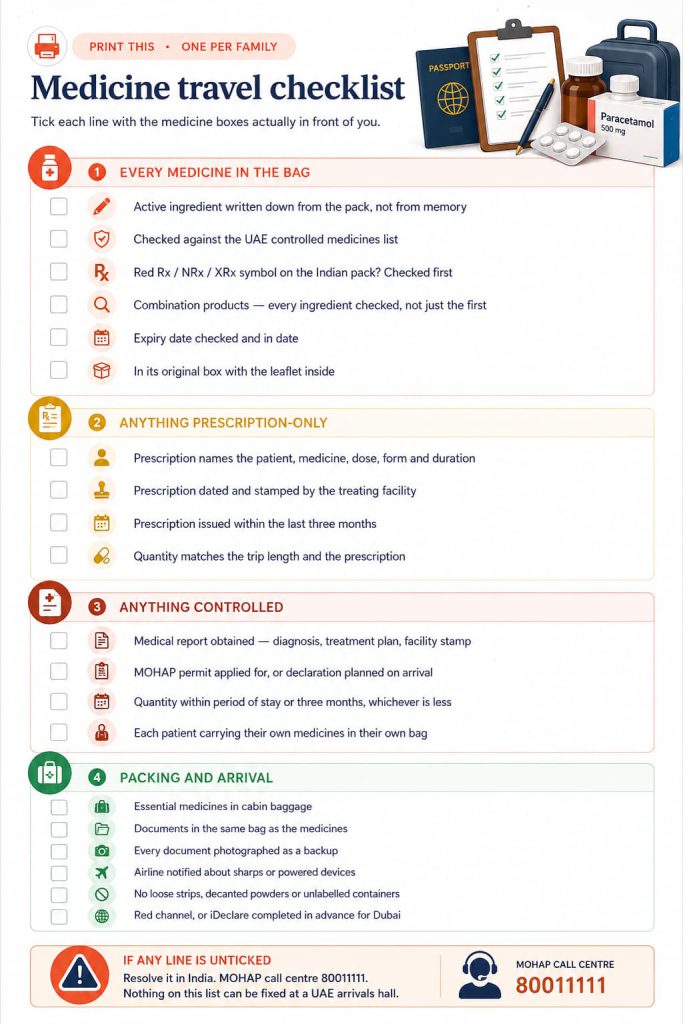
Print this. Read it with your medicine drawer open. If an ingredient below is in your bag, it needs checking — not that it is banned.
Check the ingredient: morphine · oxycodone · fentanyl · pethidine · methadone · codeine · dihydrocodeine · pholcodine · buprenorphine · pentazocine · nalbuphine · tramadol · pregabalin · gabapentin · alprazolam · diazepam · clonazepam · lorazepam · chlordiazepoxide · clobazam · nitrazepam · temazepam · zolpidem · zopiclone · zaleplon · methylphenidate · dexamfetamine · lisdexamfetamine · pseudoephedrine · ephedrine · diphenoxylate · phenobarbital · phentermine · trihexyphenidyl · procyclidine · ketamine · amineptine
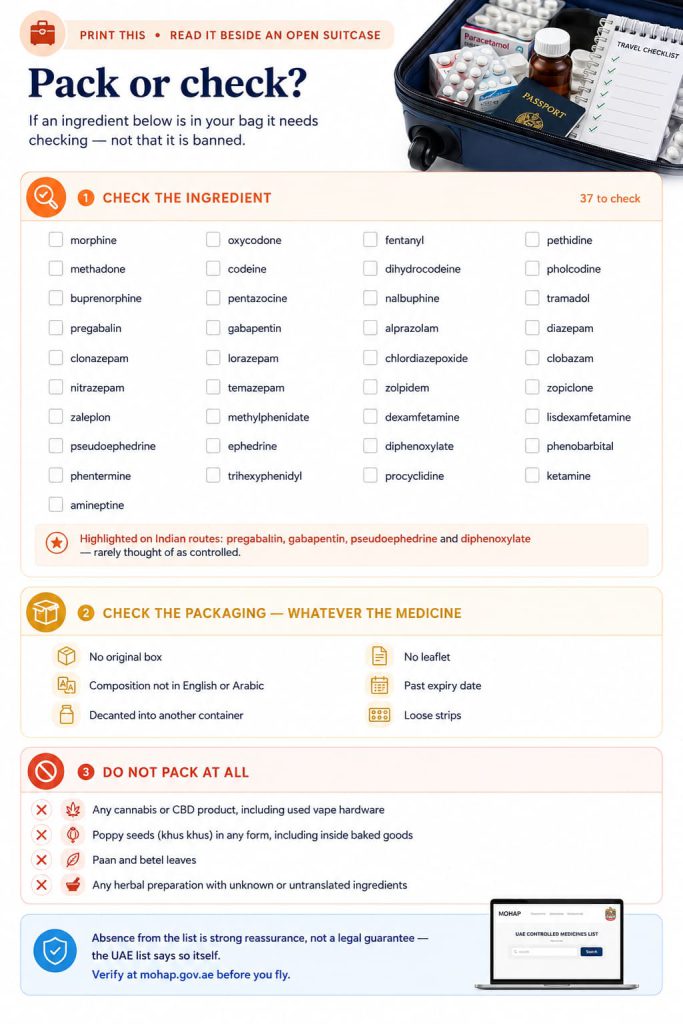
Check the packaging, whatever the medicine: no original box · no leaflet · composition not printed in English or Arabic · past expiry date · decanted into another container · loose strips
Do not pack at all: any cannabis or CBD product, including used vape hardware · poppy seeds (khus khus) in any form · paan and betel leaves · any herbal preparation with unknown or untranslated ingredients
Eight Mistakes Indian Travellers Make
- Assuming an Indian prescription makes a medicine legal in the UAE. It proves medical need. It does not determine UAE classification. Instead: treat it as one required document among several, and check the ingredient separately.
- Checking the brand name instead of the active ingredient. Brand names do not cross borders, so searching one produces a reassuring blank that means nothing. Instead: read the composition line and check each active by its generic name.
- Carrying loose tablets in a pill organiser. The most common self-inflicted problem, and a direct failure of the identifiability test. Instead: original boxes, leaflets inside, organiser packed empty.
- Carrying controlled medicines with no supporting documents. Common with leftovers — tramadol from an old injury, sleeping tablets kept “just in case,” with no prescription because the course finished months ago. Instead: get current documentation or leave it behind.
- Carrying quantities the trip cannot explain. Buying six months in India because it is cheaper, then carrying all of it on a one-week visit. Instead: match quantity to trip and prescription.
- Assuming Ayurvedic and herbal products are exempt. They are not, and they carry an extra risk because their contents are often unclear. Instead: sealed commercial packaging with an English composition, or leave it at home.
- Trusting a forwarded list of banned medicines. These circulate for years after they stop being accurate, and the most alarming claims attached to them rarely survive checking. Instead: use the official list, close to your travel date.
- Leaving the check until arrival. Every solution in this guide exists only before departure. Instead: start seven to ten days out. It takes one evening.
Pre-Travel Medicine Checklist for Indian Families
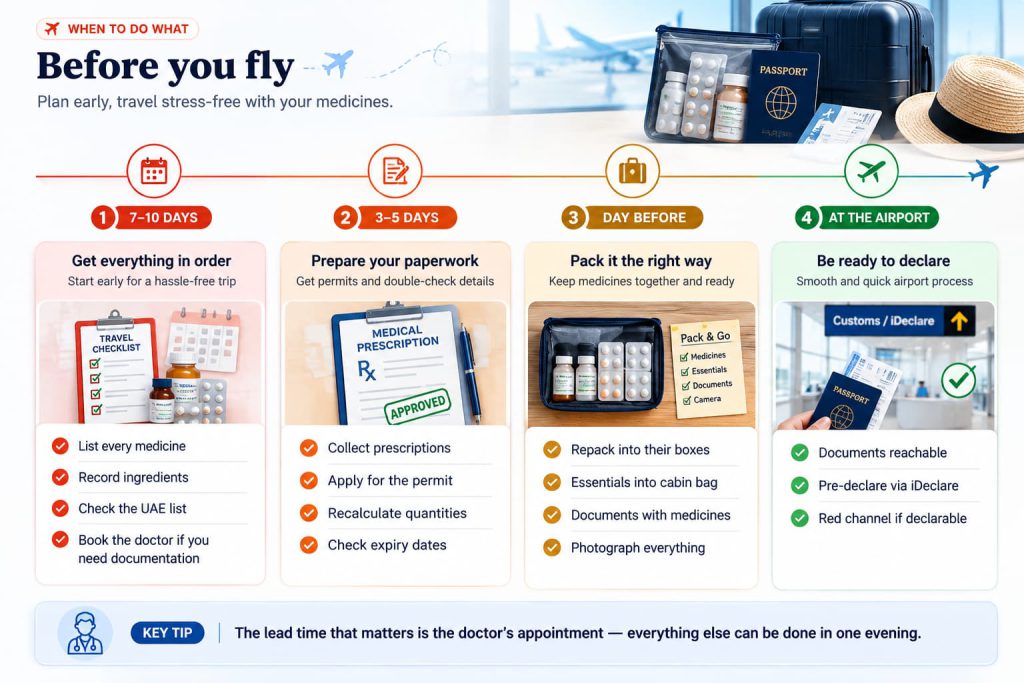
7–10 days before departure
- Gather every medicine the family will carry, including OTC items and supplements.
- Write down the active ingredient, strength and form for each — from the pack, not from memory.
- Look for a red Rx, NRx or XRx symbol on Indian packs and flag those first.
- Check each ingredient against the official UAE controlled medicines list.
- Flag anything controlled, anything prohibited, anything unconfirmed.
- Book a doctor’s appointment if you need a prescription or medical report — this is the step with a lead time.
- Start the MOHAP permit application, or contact MOHAP support if you have no UAE PASS.
- Discuss alternatives with your doctor for anything prohibited.
3–5 days before departure
- Collect prescriptions and reports; check each is dated, names the patient, and is stamped by the facility.
- Confirm the prescription is within three months if using the permit route.
- Recalculate quantities against your actual trip length.
- Check expiry dates and discard what has expired.
- Notify your airline about sharps, powered devices or oxygen if relevant.
- Re-check the official page for any change since you first looked.
The day before
- Repack all medicines into their boxes with leaflets.
- Separate essential medicines into cabin baggage.
- Put prescriptions, reports and permit in the same bag as the medicines.
- Photograph every document as a backup.
- Confirm each patient is carrying their own medicines.
- Final sweep for loose strips, decanted powders and unlabelled containers.
At the airport
- Keep documents reachable, not buried.
- Pre-declare through iDeclare if flying into Dubai.
- Use the red channel if carrying anything declarable.
- Answer questions simply and produce the documents.
Quick Decision Matrix
| Your situation | What to do |
|---|---|
| Ordinary OTC medicine, single ingredient | Check the composition, keep it boxed, carry a sensible quantity |
| OTC cold or cough combination | Check for pseudoephedrine, ephedrine or codeine before assuming it is ordinary |
| Prescription medicine, not on the controlled list | Prescription, boxed, quantity proportional to the stay |
| Medicine on the controlled list | Prescription plus medical report, MOHAP permit, observe whichever-is-less, declare on arrival |
| Medicine shown as prohibited | Do not carry it. Speak to your doctor about the travel period |
| Ingredient you cannot identify | Treat as not permitted until confirmed. Contact MOHAP before you fly |
| Herbal, Ayurvedic or supplement product | Sealed commercial packaging with English composition only |
| Quantity larger than the trip needs | Reduce it to match the prescription and itinerary |
| Medicine with no packaging or label | Get a fresh labelled pack from your pharmacy, or do not carry it |
| Someone else’s medicine in your bag | Move it to that person’s bag with their own prescription |
| A package someone asked you to carry | Do not carry it |
| Transiting without leaving the airport | No prior approval needed, but carry the prescription — checked bags are screened |
| Long stay of two to three months | Quantity still capped at three months for controlled medicines; plan a local prescription for anything longer |
| Any CBD or cannabis product | Do not pack it, in any form, including used vape hardware |
Frequently Asked Questions
Is medicine from India allowed in the UAE?
Yes, for personal use, subject to the applicable rules. Most ordinary Indian medicines are not on the UAE’s controlled list and travel without difficulty in their original boxes. Medicines whose ingredients appear on the controlled schedules can also be carried, with documentation and within quantity limits. A small number of substances are prohibited outright. The question is never “is Indian medicine allowed” but “how does the UAE classify this particular ingredient.”
Which medicines are banned in the UAE?
The prohibited entries include cannabis and THC in all forms, synthetic cannabinoids, heroin, cocaine, LSD, MDMA, khat, psilocybin mushrooms and concentrate of poppy straw, along with plants including datura, yohimbe, henbane and peyote. The list also prohibits medicines with no ingredient information in Arabic or English, medicines of unknown composition, expired medicines, and alternative-medicine products containing unknown ingredients — prohibitions that turn on labelling rather than on the substance itself.
Do I need to declare ordinary paracetamol or antacids?
No. Declaration applies to controlled medicines and certain medical items, not to everyday over-the-counter medicines carried in sensible quantities for personal use. Keep them in their boxes and there is nothing further to do. If you are carrying a controlled medicine in the same bag, declare that one — doing so does not drag the rest of your medicine pouch into the process.
Can I carry prescription medicine to Dubai?
Yes. Carry it in the manufacturer’s box with the prescription naming the patient. If the ingredient is on the UAE controlled list, add a medical report, keep the quantity within the period-of-stay-or-three-months rule, and either obtain the free MOHAP permit or declare on arrival. Both routes are legitimate.
How long does the MOHAP permit take, and do I need a UAE PASS?
The service is accessed through UAE PASS, the UAE’s national digital identity, which most visitors do not hold — MOHAP publishes a support channel for travellers who cannot register, and its guidance allows a traveller who cannot submit the form to carry the medicine with the prescription and medical report inside the three-month limit. On timing, MOHAP lists completion as instant while some reporting describes about three working days. Apply a week ahead, and treat approval as trip-specific rather than open-ended.
Can I carry medicines for my parents or relatives living in Dubai?
Only with their documentation. The prescription must be in the patient’s name, and quantity is measured against that patient’s documented need rather than your trip length. For controlled medicines the regulation contemplates an authenticated authorisation from the patient. Before going to that trouble, check whether the medicine is simply available in the UAE — for non-controlled medicines it very often is, which is usually the easier answer.
Is an e-prescription or tele-consultation prescription accepted?
The requirement is about content and authentication rather than format. The prescription must name the patient, identify the medicine, dose, form and duration, be dated within three months, and be stamped or recognised by the treating healthcare facility. A digital prescription carrying the facility’s identification generally satisfies that. Carry a clear printout as well as the digital version, and pair it with a medical report for anything controlled.
My prescription is in Hindi or a regional language. Is that a problem?
Potentially. The regulation contemplates documents in Arabic or English, and the same requirement applies to ingredient information on the pack itself. Ask your doctor or hospital to issue the prescription and medical report in English — most Indian hospitals do this routinely. If the pack carries composition only in a regional language, that is a separate and more serious problem, because it fails the identifiability rules regardless of what the medicine is.
Can I carry sleeping pills to Dubai?
Only with documentation, because most prescription sleeping medicines are controlled — zolpidem, zopiclone, zaleplon, nitrazepam and temazepam all appear on the UAE list. The specific trap is the leftover strip: tablets from a course that finished months ago, carried with no current prescription. That is the weakest possible position, because nothing connects you to the medicine. Get a current prescription or leave them behind.
Can I carry painkillers to the UAE?
It depends which painkiller. Paracetamol and common anti-inflammatories are not on the controlled list. Opioids are, and so is tramadol. Pregabalin and gabapentin, prescribed widely in India for nerve pain, are also listed. The overlooked risk is combination packs — a paracetamol product with codeine added is a controlled medicine even though the front of the box reads like an ordinary painkiller.
Can I carry antidepressants to Dubai?
Usually yes, with a prescription. Commonly prescribed SSRIs and SNRIs do not appear on the UAE’s published controlled list, so they are handled as ordinary prescription-only medicines. Some older and atypical antidepressants are listed — amineptine among them — so check your specific molecule rather than relying on the category, and carry the prescription either way.
Can I carry children’s medicines to the UAE?
Yes, and the same logic applies, because children’s products contain the same ingredients as adult ones. Paracetamol-based fever syrups are routine. The item to check is paediatric cold and cough preparations, which often contain a decongestant or a codeine-class ingredient. Keep syrups in their original bottles with the carton and leaflet, and carry the paediatrician’s prescription for anything prescription-only.
Can I carry Ayurvedic medicines to Dubai?
Only if the product is commercially packaged, sealed, in date, and carries a printed composition in English or Arabic. UAE regulation specifically prohibits alternative-medicine products and medical herbs containing unknown ingredients, and separately prohibits medicines whose ingredients are not identified in Arabic or English. Loose churnas, decanted oils and homemade preparations fail that test regardless of how safe they are.
Can I carry medicines in cabin baggage?
Yes, and essential medicines should travel in the cabin so a delayed bag is never a medical problem. Two separate rule sets apply: your airline and departure airport set cabin liquid rules, while UAE regulation governs what may enter the country. Keep prescriptions accessible for both checks, and notify your airline in advance if you are carrying sharps or a powered medical device.
Should medicines remain in their original packaging?
Yes — this is a regulatory requirement rather than a convenience. The rules call for original, tightly closed packs, or packaging labelled by a health or pharmaceutical establishment showing composition, patient name and storage conditions. Keep the leaflet inside the box, since that is what identifies the ingredient. If you have already discarded a box, ask your pharmacy to dispense a fresh labelled pack rather than travelling with loose strips.
How much medicine can I carry to the UAE?
For controlled medicines, the quantity for your period of stay or three months’ use, whichever is less. For non-controlled prescription-only and over-the-counter medicines, a quantity proportional to your stay and not exceeding six months. On a 60-day visit visa the period-of-stay figure governs; for a stay approaching or beyond three months, the controlled-medicine cap becomes binding and you should plan to see a UAE-licensed physician rather than carrying extra. Excess may be retained and returned on departure, or destroyed.
Are the rules different in Abu Dhabi or Sharjah?
The rules are federal and identical everywhere — classification, quantity limits and documentation do not change by emirate. Procedure does. Dubai Customs offers the iDeclare app for advance medicine declaration at Dubai airport; Abu Dhabi’s guidance is to declare in person to a customs officer if you are unsure about an item; other emirates publish their own restricted-goods lists. Prepare identically, then follow local procedure on arrival.
Can I buy the same medicine in Dubai instead?
Often, yes — the UAE Government notes that most medicines used worldwide are available in UAE pharmacies. But controlled medicines are not freely available and would need a consultation with a UAE-licensed physician, and your Indian brand may not exist locally even where the molecule does. Treat local purchase as a backup rather than a plan, and price it before you rely on it.
Final Recommendation
Work out which of these four situations you are in.
- If your medicine is ordinary and clearly permitted — common painkillers, antacids, allergy tablets, most long-term prescriptions — carry it boxed with the leaflet, keep the prescription for anything prescription-only, and match the quantity to your trip.
- If it is prescription-only but not controlled, the prescription is doing real work: it should name the patient, the medicine and the dose, and travel with the medicine.
- If it contains a potentially controlled ingredient — an opioid, a benzodiazepine, a prescription sleeping tablet, a stimulant, pregabalin, gabapentin, tramadol, or a decongestant-containing cold remedy — treat it as a task to complete before you fly. Prescription, medical report, permit if you can get one, quantity within the limit, boxed, declared on arrival.
- If you cannot confirm what a product contains, do not assume it is permitted. This applies with particular force to loose tablets, decanted preparations and herbal products with unclear composition, because the rules treat unidentifiable contents as a reason for prohibition in themselves.
The core message: check the active ingredient and the current UAE requirements before you travel, rather than relying on the Indian brand name or on the fact that a doctor prescribed it.
Almost none of this is difficult. It is a twenty-minute job with your medicine boxes in front of you, done a week before you fly instead of the night before. Families who do it travel with their medicines and never think about the subject again. Families who skip it discover the rules in the one place where nothing can be fixed.
If you are still planning the trip and want the rest of it organised with the same care, our Dubai tour packages from India are built for families travelling with children and elderly parents.
Verify Before You Fly
| What you need | Official source |
|---|---|
| The controlled medicines list | Alphabetical list of INCB and MOHAP controlled substances (PDF) |
| Apply for the import permit | MOHAP — Issue of Permit to Import Medicines for Personal Use |
| The classification system explained | UAE Government Portal — Drugs and controlled medicines |
| What must be declared in Dubai | Dubai Airports — Arrivals prohibited items |
| Abu Dhabi customs guidance | Zayed International Airport — Visa, passports and customs |
| Restricted goods and controlling authorities | UAE Government Portal — Restricted items |
| Pre-declare before arrival (Dubai) | Dubai Customs — iDeclare |
| Ask about a specific medicine | MOHAP call centre: 80011111 |
Related reading: Dubai Travel Guide · UAE Visa Guide · Dubai Airport Guide · Dubai Family Travel Guide · Dubai Packing List · Best Time to Visit Dubai
Planning a Trip to Dubai?
If you’re an Indian traveller based in one of the cities listed below — or nearby — check out our Dubai Tour packages from India by clicking the link for your city.
- Dubai Tour Packages from Rajkot
- Dubai Tour Packages from Visakhapatnam
- Dubai Tour Packages from Vijayawada
- Dubai Tour Packages from Vadodara
- Dubai Tour Packages from Trivandrum
- Dubai Tour Packages from Trichy
- Dubai Tour Packages from Surat
- Dubai Tour Packages from Pune
- Dubai Tour Packages from Nagpur
- Dubai Tour Packages from Mumbai
- Dubai Tour Packages from Lucknow
- Dubai Tour Packages from Kolkata
- Dubai Tour Packages from Kochi
- Dubai Tour Packages from Kerala
- Dubai Tour Packages from Kannur
- Dubai Tour Packages from Jalandhar
- Dubai Tour Packages from Indore
- Dubai Tour Packages from Hyderabad
- Dubai Tour Packages from Guwahati
- Dubai Tour Packages from Goa
- Dubai Tour Packages from Delhi
- Dubai Tour Packages from Coimbatore
- Dubai Tour Packages from Chennai
- Dubai Tour Packages from Calicut
- Dubai Tour Packages from Bhopal
- Dubai Tour Packages from Bangalore
- Dubai Tour Packages from Amritsar
- Dubai Tour Packages from Ahmedabad
- Dubai Tour Packages from Jaipur
- Dubai Tour Packages from Chandigarh