
Researched and reviewed 14th August 2026 · Author: Asfiya · Next review: February 2027
You find a Dubai hotel at ₹10,000 a night. The photos show a big bed, a sofa, a balcony. You are two adults and two children, and the sofa looks like somewhere a child could sleep. So you book it, and you assume ₹10,000 covers the four of you.
That assumption is the most common reason Indian families end up in an awkward conversation at a Dubai reception desk — or receive an email a few days after booking asking them to upgrade to a family room or take a second room.
The problem is not that Dubai hotels are unfriendly to families. Dubai has more genuinely family-sized room categories than most destinations. The problem is that four separate permissions all have to line up before one room works for four people:
- Occupancy — the room is permitted to hold four people at all.
- Age — both children fall inside that hotel’s child age bands.
- Bedding — there is a permitted place for each child to sleep.
- Rate — the specific rate you selected allows all three of the above.
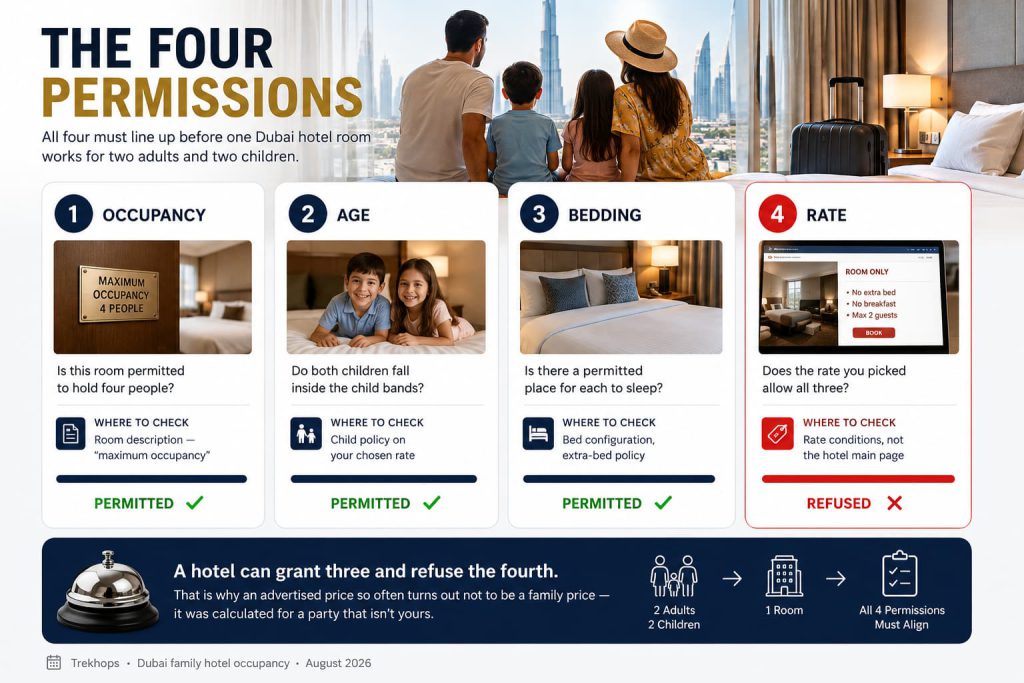
A hotel can grant three of the Four Permissions and refuse the fourth. That is why a property can be openly family-friendly and still turn down your booking — because of your second child’s age, or because you picked the king-bed version of a room instead of the twin.
Short answer: Two adults and two children can share one Dubai hotel room at many properties, but it is never automatic. It depends on the room’s stated occupancy limit, both children’s exact ages, the beds already in that room, and whether the rate you chose permits it. “Kids stay free” almost always means one child, using existing beds, up to a stated age, and it usually does not include breakfast or an extra bed.
Every figure below was read in August 2026 and is labelled Official (the operator’s own site) or Listed (a booking-channel listing). Full sources, with links, are near the end.
Can 2 Adults and 2 Kids Stay in One Dubai Hotel Room?
Often yes. Automatically, no. This is Permission 1 — occupancy — and nothing else overrides it.
There is no Dubai-wide rule that a room may hold two adults and two children. Dubai’s Department of Economy and Tourism (DET) licenses and classifies hotel establishments under Decree No. 17 of 2013, covering ratings, categories (Hotel, Resort, Hotel Apartment, Guest House) and designators. But the number of people permitted in any individual room is set by that property, for that room type, and registered accordingly.
To verify Permission 1 you have to separate three numbers that look like one.
| Concept | What It Means | Why It Matters |
|---|---|---|
| Room capacity | The maximum guests the hotel may register in that room, whatever their age. Shown as “maximum occupancy” or “sleeps up to” | The hard ceiling. Nothing overrides it — not a small child, not a request |
| Sleeping capacity | How many can actually sleep using the beds present, plus any cot or extra bed the room allows | A room can be permitted to hold four people without having four beds |
| Booking occupancy | How the booking system counts your party once you enter ages — some children count as adults, some not at all | Decides whether the room appears in your results, and at what price |
| Caption: The three capacity numbers behind Permission 1, and why they are not interchangeable. | ||
Occupancy is a registered limit, not a judgement about floor area. Conrad Dubai’s 100 sqm Deluxe Suite is described in trade listings as sleeping a maximum of three adults, or two adults and one child, with an infant possibly sharing existing bedding — and that applies to the version fitted with two double beds. Two double beds physically sleep four. The permitted number is still three.
Bed layout matters just as much. At Atlantis, The Palm, the Ocean View Room is one category with two layouts. As listed by booking partners, the king-bed layout takes two adults, one child below 14 and one infant. The twin-bed layout of the same category takes two adults and two children below 14. Same room name, same view, different answer for a family of four.
And brand-level pages are a starting point, not the answer. Rove Hotels’ published FAQ states that a Rover room is designed for a maximum of two adults, with total occupancy limited to two, and that the Rover Family Room takes two adults and one child under 16. Yet property listings show Rover Rooms at Rove Downtown and Rove at The Park sleeping three on a king-plus-sofa-bed or twin-plus-sofa-bed layout, and a Family Interconnecting Rover Room at Rove at The Park sleeping six. The brand page is accurate about the base product. It is not the whole estate.
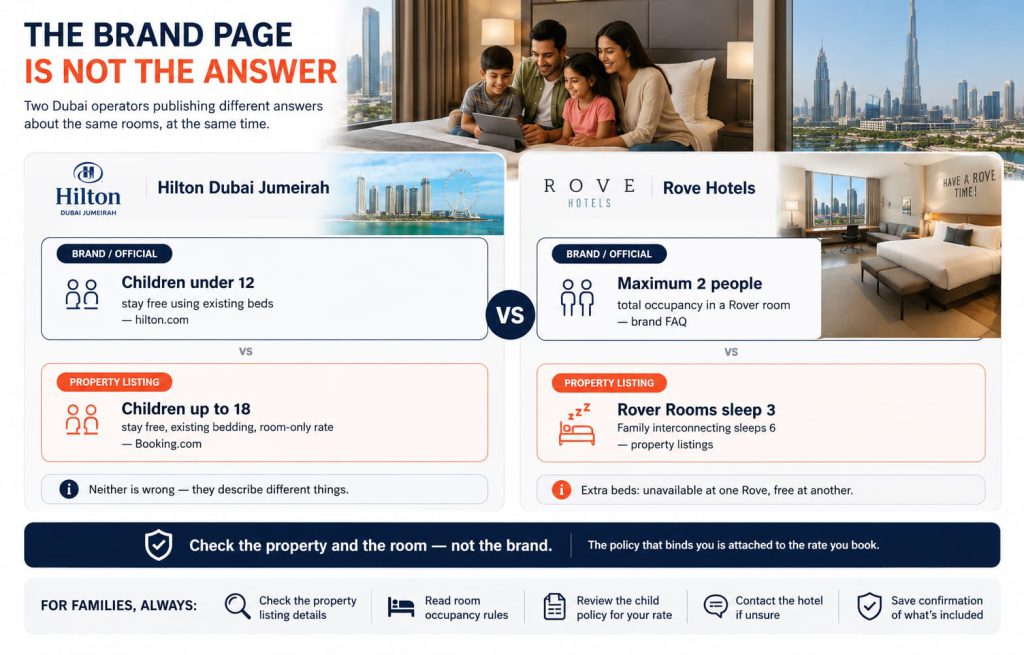
Check the property and the room, not the brand. A chain’s headline policy describes its standard product. The room you are booking may be more generous, or less.
Why Children’s Ages Matter
Permission 2. There is no single Dubai age at which a child becomes an adult for hotel purposes, and the spread between properties is wider than most families expect.
| Property | Child Stays Free Up To | Extra Bed Charge | The Detail That Catches Families Out |
|---|---|---|---|
| Hilton Dubai Jumeirah Official — hilton.com |
Under 12, using existing beds | AED 120 per night for anyone over 12 or an adult | Maximum of two extra beds, depending on the room. Cots free under 2 |
| Hilton Dubai Jumeirah Listed — Booking.com |
Up to 18, existing bedding, room-only rate | Not included in the displayed rate | Same hotel, different published age — the free-child age is attached to the rate, not the building |
| Atlantis, The Palm Official — property terms |
Kids up to 13.99 years | Not stated in the property terms | The “stay and dine free” offer requires bed & breakfast or half board booked for the entire stay |
| Atlantis, The Palm Listed — booking channels |
One child 13 or younger, existing bedding | Rollaway listed at AED 797 per night | The extra bed costs more per night than many complete Dubai hotel rooms |
| Address Hotels & Resorts Official — Emaar Hospitality |
Under 12 — in suites and 1–4 bedroom residences | Applies once a child passes 4 years | Scoped to certain room categories, not every room in the hotel |
| Millennium Plaza Downtown Listed — booking channels |
Up to 12, existing beds, subject to room capacity | AED 150 per night, available from age 4 and over | Children’s breakfast listed separately at AED 63; a 2-year-old cannot take an extra bed at all, only a cot |
| Caption: Four Dubai properties across six published policy statements, read August 2026, showing how widely the age thresholds vary. | |||
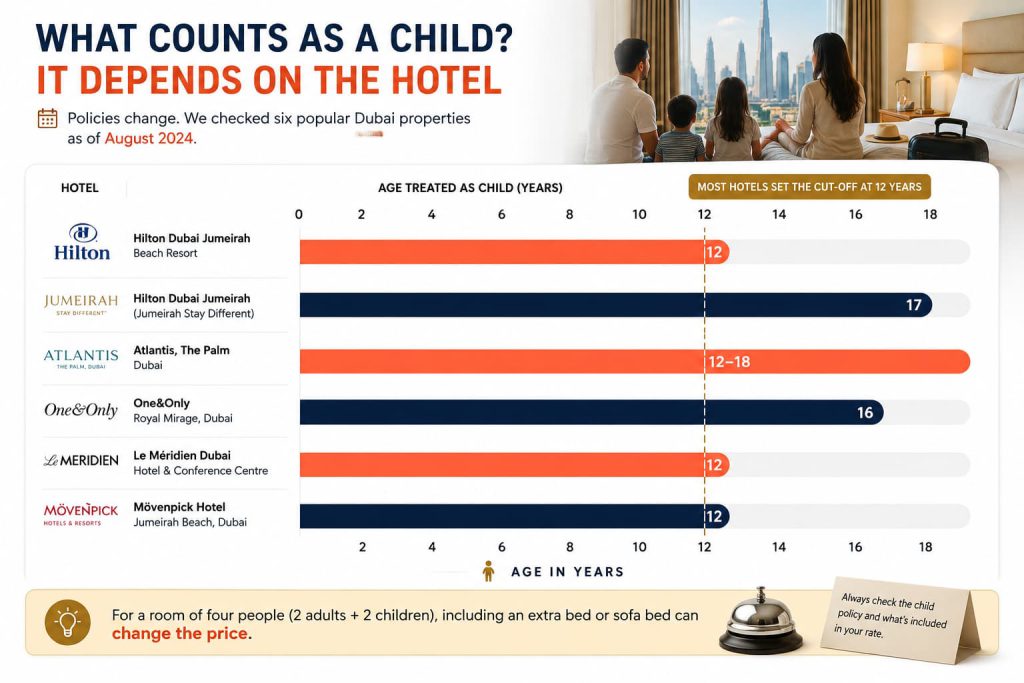
Four things follow.
The free-child age ranges from under 12 to under 18 among these properties alone. A 13-year-old is a full-price adult at one hotel and a free child at another on the same street.
The same hotel can publish two different free-child ages on two channels at once. Hilton Dubai Jumeirah’s own amenities page states children under 12 stay free on existing beds. Its Booking.com listing states children up to 18 stay free with existing bedding on a room-only rate, within the room’s occupancy limit. Both were live in August 2026, and neither is wrong — they describe the hotel’s general extra-bed policy and a rate-linked child allowance respectively.
The policy that binds you is the one attached to the exact rate you book, not the one on the hotel’s main website.
That has a practical consequence for where you book. Because the more generous allowance here sits on the channel listing rather than the hotel’s own page, it is worth checking both and booking wherever the child policy is written most favourably — then getting it confirmed in writing either way.
Age changes the price; it does not create space. A room that accepts two adults and one child will not necessarily accept two adults and two children, even if the second is younger. Once the first child occupies the spare capacity, the second needs capacity of their own.
Ask what happens if a child crosses a threshold mid-stay. There is no standard practice: some properties apply the age at check-in for the whole stay, others reprice from the birthday, a few use the booking date. If your child turns 12 during a stay at a hotel whose adult threshold is exactly 12, the difference can be an extra bed charge for half the trip.
One pattern is worth carrying between hotels: policy style tends to travel with the operator group. Emaar’s Address brand scopes its free-child policy to suites and residences. Hilton splits accommodation ages from dining ages. Rove caps hard at the base room. The group gives you a reasonable first guess; only the rate page gives you the answer.
Can Children Share the Existing Beds?
Permission 3. Many Dubai hotels allow it — that is what “using existing bedding” means: the child sleeps in a bed the room already has, and nothing is brought in.
Permission to share is granted by age band and capped by occupancy, and hotels draw the lines differently. Some allow one child on existing bedding and no more. Some allow any children within the room’s limit. Some require a second child to have a bed of their own.
Two adults and two young children.
Most likely to work in one room, especially where the room has twin beds or a king plus a genuine sofa bed. A hotel permitting children under a stated age on existing bedding, with a limit of four, can normally take this family with no extra bed at all.
Two adults, one child and one infant.
Usually easiest, because a cot is treated separately from an extra bed and is very often free — Hilton Dubai Jumeirah lists cots as free under two. Whether the cot counts towards the occupancy limit varies by property, so ask: at some hotels it does not, which quietly buys you a place.
Two adults and two older children.
Where families are most often refused. Once children pass the adult threshold — commonly 12 or 13 — they occupy adult capacity, so the request becomes four adults in one room.
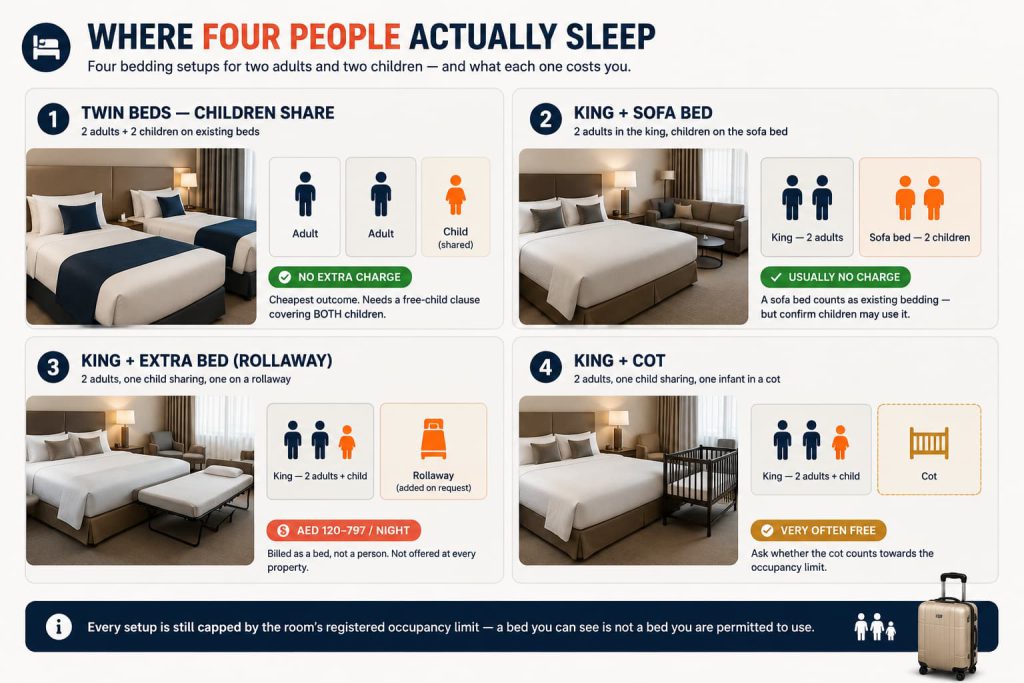
One caution about sofa beds: their presence in a photograph is not permission to use them. A one-bedroom hotel apartment can contain a visible sofa bed and still carry a policy allowing only one child under 12 on existing beds. The furniture and the policy are separate facts, and the policy decides.
Extra Beds, Rollaway Beds and Sofa Beds
If the existing beds are not enough, the hotel may be able to add sleeping space. “May” is carrying real weight in that sentence.
| Bedding Type | What It Is | Typical Charge in Dubai | What To Verify |
|---|---|---|---|
| Existing bed | The bed or beds already in the room. A child sleeping here is “using existing bedding” | No accommodation charge if the child is within the free age band | Which bed layout you booked, and the free-child age on your rate |
| Extra bed (also called a rollaway) |
A movable single bed set up for the stay. The two terms mean the same thing. Often gated by a minimum age — one hotel lists extra beds from age 4 | AED 120–150 per night at the mid-range properties surveyed; AED 797 listed at one luxury resort; free at some properties | Whether the room permits one, how many, the price, and availability on your dates |
| Sofa bed | A sofa or daybed that converts into a sleeping surface. Frequently designated for children only | Usually no separate charge — it counts as existing bedding | Whether it counts towards occupancy, and whether an adult may use it |
| Cot / crib | An infant bed, requested in advance. One Dubai hotel specifies under 2; another lists free cots for under 3s | Very often free | Whether it counts towards occupancy, and that it is reserved rather than assumed |
| Caption: The four bedding types a Dubai family booking involves, and what to confirm about each before paying. | |||
Three points cause most of the surprises.
An extra-bed policy is not an extra-bed guarantee, and it varies between properties of the same brand. Hilton Dubai Jumeirah’s own site states a maximum of two extra beds, depending on the room, by request and subject to availability. Within Rove, listings for Rove Downtown state that rollaway and extra beds are not available at all, while Rove at The Park lists free rollaway beds and free cots. One brand, opposite answers.
The price range is extreme. AED 120 a night at Hilton Dubai Jumeirah is roughly ₹3,100. The AED 797 rollaway listed at Atlantis, The Palm is roughly ₹20,700 a night — across a week, more than many Dubai families spend on the room itself.
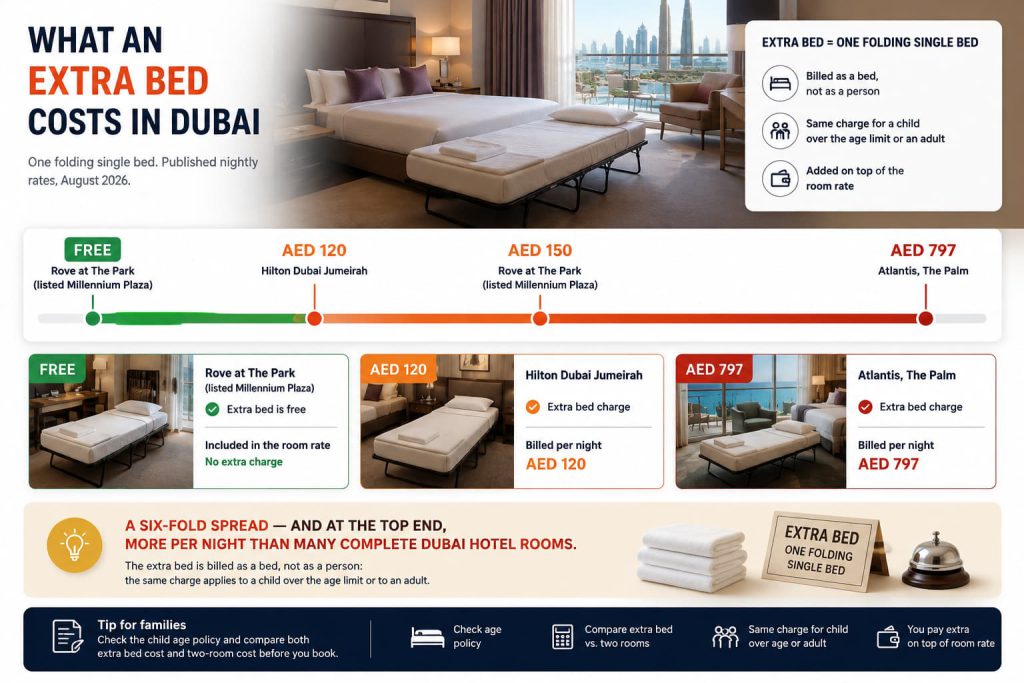
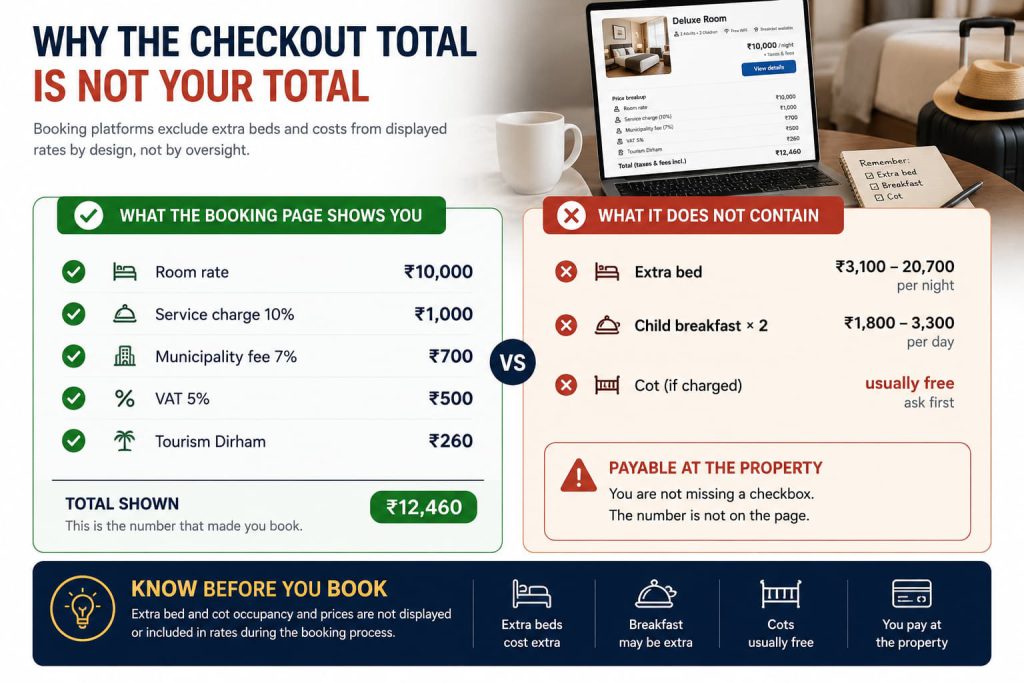
Extra-bed costs are structurally invisible while you book. The platforms document this themselves. Booking.com’s partner guidance tells hotels that the child age-range rates they configure apply only to children in existing beds — not extra beds or cribs — and that extra bed and cot occupancy and prices are not displayed or included in rates during the booking process.
Extra bed and cot charges are excluded from booking-page totals by design, not by oversight. You are not missing a checkbox — the number is not there.
What Does “Kids Stay Free” Actually Mean?
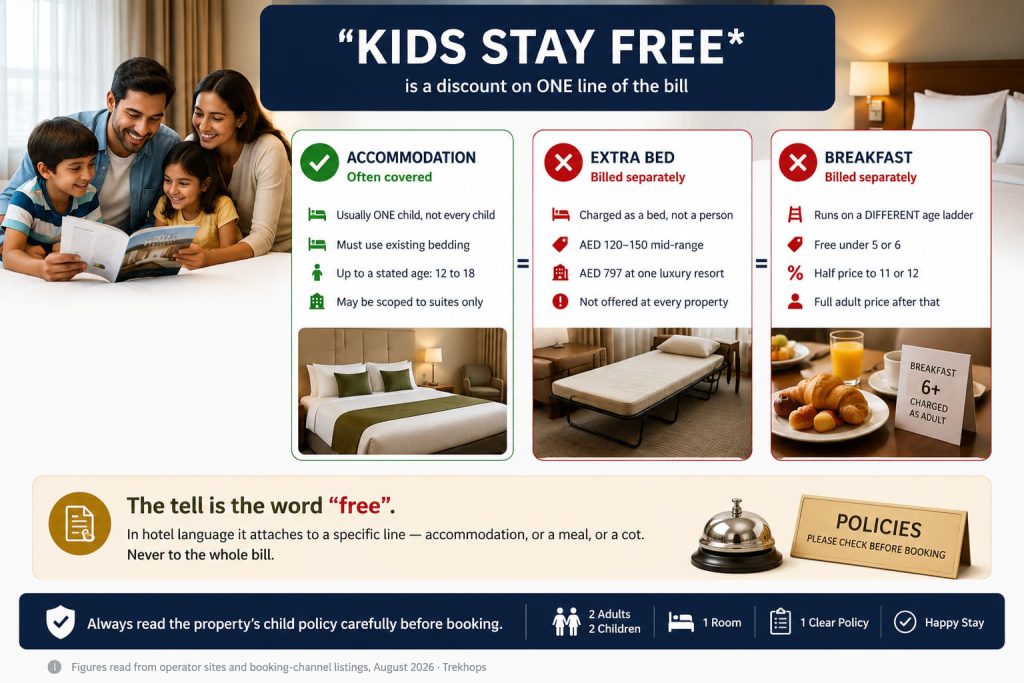
Permission 4 — the rate — mostly lives here. “Kids stay free” is a marketing phrase, not a definition. It promises that under certain conditions one particular cost does not increase, and says nothing about the others.
Accommodation
At its narrowest, the room rate does not rise because a qualifying child is in the room. Worth having, and usually the correct reading.
Existing bedding
Almost every Dubai version carries this condition — Rove: one child 16 or under, using existing bedding; Hilton Dubai Jumeirah: children under 12, using existing beds. If the child needs a bed brought in, the offer stops applying at that point.
Extra bed
Charged separately, usually regardless of age. Hilton Dubai Jumeirah’s wording is explicit: children older than 12 or an adult requiring an extra bed will be charged AED 120 per night. The bed is billed as a bed, not as a person. On booking pages this often appears as an extra person charge.
Breakfast
The component families most often assume is included, and very often priced on a different age ladder. Hilton Dubai Jumeirah frees accommodation under 12, but frees dining only under 6, with 6-to-12s at 50%. Hilton Garden Inn Dubai Jumeirah publishes accommodation free to 18, while dining runs free under 5, half price for 6–11, and full rates from 12. Rove Downtown’s listed breakfast bands run free under 5, AED 34.50 for 6–12, and the full adult price of AED 69 from 13. One hotel, two different age ladders, running at the same time.
Treat the accommodation age and the dining age as two separate questions every time.
Taxes and fees
The one part of a Dubai hotel bill that genuinely does not care how many children you bring. Detail in the next section.
Age restriction
Every version has a ceiling: 13.99 years at Atlantis, under 12 at Hilton Dubai Jumeirah, 16 at Rove, 18 on some rate-linked policies. Read it against your child’s age on the travel dates.
Number of children
A Dubai “kids stay free” offer is usually written in the singular: it covers one child, not every child in the room. Rove says “one child 16 years old or younger stays free.” Atlantis says “one child 13 years old or younger.” The offer covers the first; the second becomes a separate question about capacity and price.
This is the condition that most often breaks a family of four.
Room category
Address Hotels & Resorts states that children under 12 stay free in suites and 1-, 2-, 3- and 4-bedroom residences, within the allowed occupancy — a policy written around its larger units. Booking a standard room on the strength of it is an easy mistake.
“Kids Stay Free” vs “Children’s Accommodation Is Free”
| Booking Statement | What It May Mean | What Parents Must Check |
|---|---|---|
| Kids stay free | Child accommodation may carry no additional charge under stated conditions | The age ceiling, how many children it covers, and whether existing bedding is required |
| One child stays free on existing bedding | No extra accommodation charge for a single child sharing beds already in the room | What happens to your second child, and whether occupancy allows them at all |
| Kids stay and dine free | Accommodation and specified meals may be included, often only on a meal-inclusive rate | Which rate unlocks it, which restaurants are covered, and the separate dining age limit |
| Extra bed available | An additional bed may be possible in some rooms at this property | Whether your room permits one, the price, the minimum age, and availability |
| Children charged as adults from age X | Above that age the child occupies adult capacity and adult pricing | Whether the room can hold that many adults at all — an occupancy question, not just a price one |
| Caption: How to read the standard child-policy phrases used on Dubai hotel booking pages. | ||
The consistent tell is the word “free.” In hotel language it attaches to a specific line — accommodation, or a meal, or a cot — never to the whole bill. Ask which line, and treat every other line as unchanged.
What You Actually Pay for a Family of Four
Dubai hotels use occupancy-based pricing: the advertised rate is calculated for a stated number of guests, and additional guests are priced on top.
| Line Item | Charged Per | Rises With Children | Effect On A ₹10,000 Room |
|---|---|---|---|
| Room rate | Room, per night | Sometimes — if a child or extra person charge applies | ₹10,000, or higher if a child falls outside the free band |
| Service charge (10%) | Percentage of room rate | No — but rises if the rate rises | ₹1,000 |
| Dubai Municipality fee (7%) | Percentage of room rate | No — but rises if the rate rises | ₹700 |
| VAT (5%) | Percentage of room rate, per Federal Tax Authority rules | No — but rises if the rate rises | ₹500 |
| Tourism Dirham Fee | Room or bedroom, per night — AED 7 to 20 by hotel category | No — identical for one guest or four | About ₹180–₹520 per night; doubles if you take two rooms |
| Extra bed | Bed, per night | Yes — this is the big one | Roughly ₹3,100–₹3,900 mid-range; far more at luxury resorts |
| Children’s breakfast | Person, per day | Yes, unless the child is inside the dining-age band | Roughly ₹900–₹1,650 per child per day at the properties surveyed |
| Caption: Illustrative build-up on a hypothetical ₹10,000 room. Not a quotation for any Dubai hotel. | |||
Two conclusions, pointing in opposite directions.
Dubai’s taxes are structurally family-friendly.
The Tourism Dirham Fee, introduced by Dubai Executive Council Resolution No. 2 of 2014, is levied per room per night at AED 7 to 20 by classification, capped at 30 consecutive nights, and is identical whether one person or four occupy the room. Service charge, municipality fee and VAT are percentages of the room rate. None counts heads — a family of four pays exactly the tax a solo traveller pays in the same room. The corollary: the fee doubles the moment you take a second room, and multi-bedroom hotel apartments are commonly charged per bedroom.
The two charges that do scale with children are the hardest to see while booking.
An extra bed and two children’s breakfasts at mid-range Dubai prices can add ₹5,000–₹7,000 per day to a ₹10,000 room — a 50–70% increase on the number that made you book.
One room plus an extra bed, or two rooms?
| Option | Extra Cost Per Night | What You Get | Where It Wins |
|---|---|---|---|
| One room, children on existing beds | Nothing | No additional bed, fee or tax | Always cheapest — if the free-child clause covers both children and occupancy allows four |
| One room plus an extra bed | ₹3,100–₹3,900 mid-range; up to ~₹20,700 at one luxury resort; free at some properties | One folding single bed. Same bathroom, same floor space, less of it | Wins on cost almost every time — a second room duplicates the rate, all three percentage charges and the Tourism Dirham; an extra bed duplicates none of them |
| Family room or one-bedroom hotel apartment | Varies — frequently less than room plus extra bed | Real beds, more space, often a kitchen and separate living area | The most commonly overlooked option. Price it before accepting any extra bed |
| Two rooms or interconnecting rooms | A full second room rate, a second Tourism Dirham, and the percentage charges again | Second bathroom, a bed for everyone, genuine privacy | When children are near or over the adult threshold, or when the extra bed is a large fraction of a second room’s rate |
| Caption: The four ways to accommodate two adults and two children in Dubai, compared on cost above the base room rate. | |||
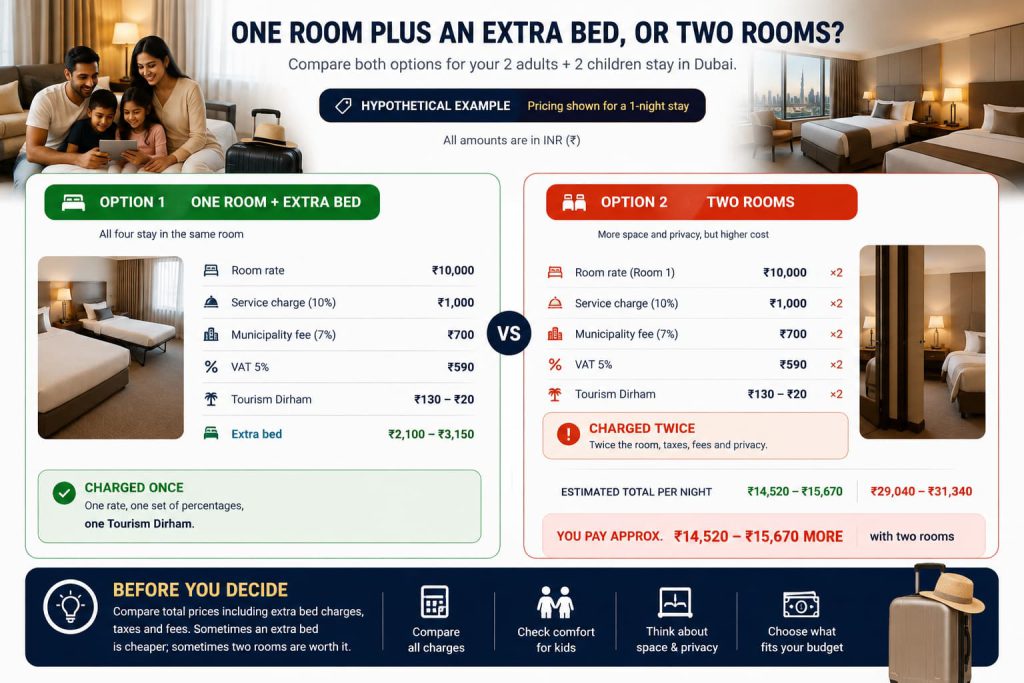
As a rough guide: an extra bed almost always beats a second room on cost, for the structural reason above. But look at what you are buying. At AED 797 a night, the Atlantis rollaway is a substantial fraction of a second room’s rate at that resort — a very expensive folding bed that adds no bathroom and no privacy. Once an extra bed reaches that proportion, price a family room, a suite or an interconnecting pair before choosing either option.
Conversions use roughly ₹26 to the dirham, the rate in August 2026. The dirham is pegged to the US dollar, so the AED–INR rate moves with the rupee.
How to Check Whether One Room Is Suitable Before Booking
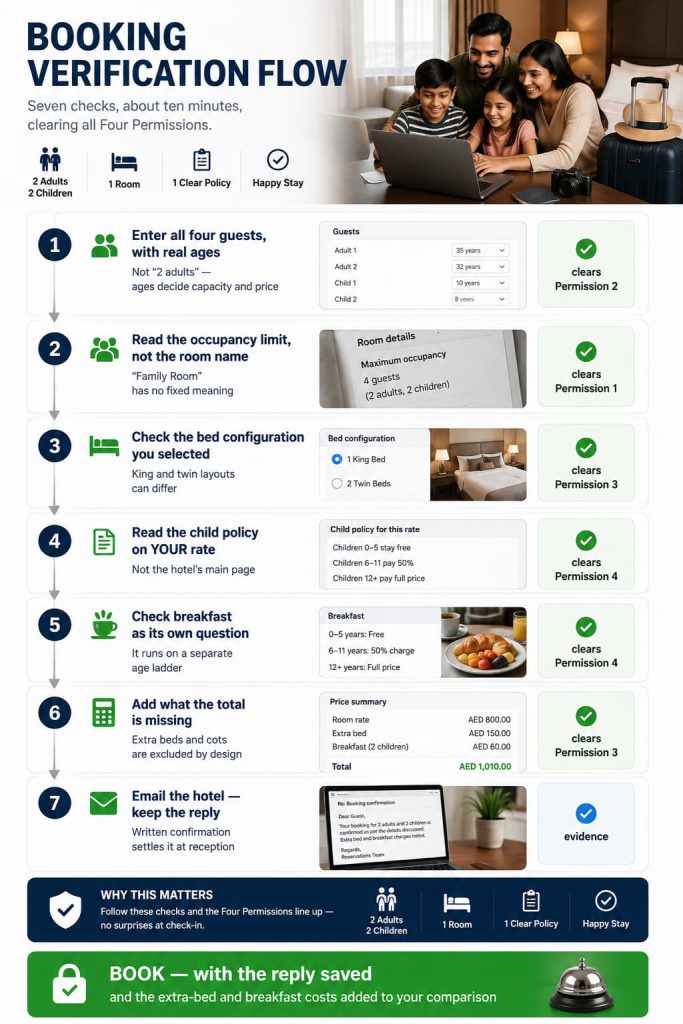
Seven steps, about ten minutes, clearing all Four Permissions.
Step 1 — Enter all four guests, with real ages.
Ages are what the system uses to calculate capacity and price. Entering “2 adults” because it returns more results is the mistake, not the shortcut.
Step 2 — Read the occupancy limit, not the room name.
“Family Room” is a marketing label with no fixed meaning. Find the stated maximum for that exact room and confirm it is at least four.
Step 3 — Check the bedding arrangement you are selecting.
Note whether it is a king, twins, or a king plus sofa bed, and count the sleeping places. Where a room offers both layouts, check whether they carry different limits — at Atlantis, The Palm, they do.
Step 4 — Read the child policy attached to your rate.
Four numbers: the free-child age, how many children it covers, whether existing bedding is required, and the extra-bed cost. If the policy is shown only at hotel level, assume it may differ on your rate and ask.
Step 5 — Check breakfast separately.
Ask for the children’s breakfast price and the dining age bands specifically. Do not infer them from the accommodation policy.
Step 6 — Take the final price, then add what is missing from it.
Extra beds and cots are excluded from booking totals by design. Add them yourself before comparing hotels.
Step 7 — Email the hotel if anything is unclear, and keep the reply.
In our experience email works better than phoning: the answer usually has to be looked up against the room’s registered configuration, and a written reply naming your room type and your children’s ages is what settles any disagreement at reception.
Send:
- Your booking reference and exact arrival and departure dates.
- The exact room type and bed configuration you have booked.
- Both children’s ages on the dates of travel, stated plainly.
- A direct question: can this room accommodate all four of us, and where will each child sleep?
- A request for the total extra-bed or cot charge for the full stay, if any applies.
- A request for the children’s breakfast price per child per day.
What happens if you turn up with an undeclared child
Under Dubai’s e-programme requirements for hotel establishments, introduced by Decree No. 13 of 2011, hotels operate a guest information system linked to Dubai Police, and identification is collected for every guest in the room. Children are registered like everyone else, on their own document — so carry each child’s passport to check-in rather than assuming a parent’s covers them.
Because the occupancy limit is registered, reception staff have no discretion to waive it, however reasonable your request sounds. That is worth understanding before you arrive: the person at the desk is not being unhelpful, they genuinely cannot authorise it. Expect one of four outcomes — the extra person or extra bed charged on the spot at the desk’s rack rate rather than the cheaper rate you would have secured at booking; a move to a larger room at the walk-in differential; a second room at that night’s walk-in rate, with no guarantee it is near the first; or, if the room is already full and nothing suitable is free, a refused stay with your original rate likely non-refundable.
All four are worse than the ten minutes in Steps 1 to 7.
When One Room Is Enough — and When It Is Not
| Family Situation | Likely Accommodation Consideration | First Thing To Check |
|---|---|---|
| 2 adults + 2 children under about 10 | One room may well work if the hotel permits existing-bed sharing and the limit is four | Whether the free-child clause covers one child or two |
| 2 adults + 1 child + 1 infant | Often the easiest configuration, since a cot is treated separately and is frequently free | Whether the cot counts towards the occupancy limit |
| 2 adults + 2 children around 11–13 | The most volatile band — one child may qualify as a child and the other as an adult | The exact adult threshold on your rate, and each child’s age on the travel dates |
| 2 adults + 2 teenagers | Usually becomes a four-adult booking; a larger room, family room or second room is often necessary | Whether any room type at that hotel takes four adults at all |
| Family wanting separate sleeping spaces | A suite, two-bedroom hotel apartment or interconnecting rooms is likely to suit better | Whether interconnecting rooms are guaranteed or merely requested |
| Caption: Which family shapes usually fit one Dubai hotel room, and the single thing to verify first in each case. | ||
The band worth singling out is 11 to 13. Because Dubai hotels place the adult threshold anywhere from 12 to 18, a family with two children in that range can be a straightforward four-person booking at one hotel and a refused booking next door. Verify before you compare prices — you may not be comparing like with like.
Standard Room vs Family Room vs Suite vs Interconnecting Rooms
| Room Type | Typical Occupancy | Sleeping Setup | Cost Implication |
|---|---|---|---|
| Standard room | Two, sometimes three or four | One king or two twins; occasionally a sofa bed | Lowest rate, but may need an extra bed that erases the saving |
| Family room | Varies widely — verify, do not assume | Commonly a king plus a sofa bed, in a larger footprint | Higher rate, but often no extra-bed charge on top — frequently the cheapest all-in option |
| Suite | Three or more — large suites can still cap at three | Separate living area, usually with a sofa bed, plus the bedroom | Significant premium, sometimes with a wider free-child policy attached |
| Interconnecting rooms | Two rooms, each with its own limit | Two full bedrooms joined by an internal door | Two room rates and two Tourism Dirham fees |
| Hotel apartment | Four or more in a one- or two-bedroom unit | Bedroom or bedrooms plus a living room, usually with a kitchen | Often strong value per person; Tourism Dirham commonly charged per bedroom |
| Caption: How the main Dubai accommodation categories compare for a family of four. | |||
Three cautions. “Family room” is not standardised — Mövenpick Hotel & Apartments Bur Dubai (Accor) describes its 40 sqm Family Room, with a king bed and sofa bed, as suiting two adults and two children, while Rove’s Rover Family Room takes two adults and one child under 16.
A suite is not automatically bigger in occupancy terms — as the Conrad example shows, 100 sqm and two double beds can still mean three permitted guests.
Interconnecting rooms are usually a request, not a guarantee, and are routinely subject to availability. If two connected rooms are the reason your trip works, confirm in writing well before arrival.
Hotel apartments deserve a second look from Indian families. They are a licensed category in their own right under DET’s classification scheme, and a one-bedroom unit with a living room and kitchen frequently solves the sleeping-space problem and the fussy-eater problem in one booking.
Booking Mistakes Families Should Avoid
Booking on the headline price. Under occupancy-based pricing the advertised rate is a two-person price in most systems.
Entering only two adults. This returns more rooms and lower prices, which feels like a win and is the root of most check-in disputes. The filter is not malfunctioning — it is removing rooms that cannot take your family.
Reading “kids stay free” as “children cost nothing.” It is a discount on one line, with meals and any extra bed billed separately.
Assuming an extra bed is available. Extra beds are limited by room, capped in number, subject to availability, and at some Dubai properties do not exist at all.
Ignoring the occupancy limit because the room looks big. It is a registered figure, not a judgement about floor area — a 100 sqm suite can still cap at three.
Booking first and asking about the children afterwards. Ages surface at check-in whether or not you raised them.
Comparing a room-only rate with a breakfast-inclusive one. For four people, breakfast is a large recurring cost, and the cheaper room-only rate plus four breakfasts is often more expensive than the inclusive rate you dismissed.
If the hotel contacts you after booking
The booking goes through, then an email arrives saying the room cannot take four and you must upgrade or take a second room. You have more options than the email suggests.
Ask the property to confirm the room’s registered occupancy limit in writing, and raise the discrepancy with whoever sold you the room — if you booked through a platform, the listing is the platform’s product, so open a case there as well as with the hotel. Ask for the differential to a larger room rather than a rebooking at today’s rate; the two numbers are often very different. And ask whether your rate permits a free amendment where the property initiates the change, rather than assuming it does or does not.
Family Hotel Booking Checklist
- Confirm the occupancy limit of the exact room type, not the hotel.
- Enter both children’s actual ages as they will be on the travel dates.
- Confirm whether children may use the existing beds, and how many may do so.
- Check whether an extra bed, sofa bed or cot is permitted in that specific room.
- Get the extra-bed cost per night and the minimum age for using one.
- Ask for the children’s breakfast price and the dining age bands, separately from the room policy.
- Read the child policy attached to your chosen rate, not the general hotel page.
- Price a family room or hotel apartment before accepting an extra bed.
- Add the extra bed and children’s meals to the displayed total before comparing hotels.
- Email the hotel with your room type and children’s ages, and keep the written reply.
If nine of ten are clear and one is not, it is usually the extra bed — the line most likely to change your total and least likely to appear on your confirmation.
Sources
All read August 2026.
| Source | What Was Read | Link |
|---|---|---|
| Hilton Dubai Jumeirah Official |
Extra bed policy, free-child age, cot age, dining bands | hilton.com/en/hotels/dxbjbhi-hilton-dubai-jumeirah/amenities/ |
| Hilton Garden Inn Dubai Jumeirah Official |
Accommodation age to 18, dining bands, Tourism Dirham per bedroom | hilton.com/en/hotels/dxbamgi-hilton-garden-inn-dubai-jumeirah/ |
| Atlantis, The Palm Official |
Tax stack, Tourism Dirham, kids stay and dine free conditions, 13.99 age | atlantis.com/dubai/atlantis-the-palm/terms-property |
| Rove Hotels Official |
Rover room occupancy cap; Rover Family Room configuration | rovehotels.com/en/hotels/rove-jbr/faq-rove-jbr/ |
| Address Hotels & Resorts (Emaar Hospitality) Official |
Free-child policy scoped to suites and residences; infant threshold | addresshotels.com/en/faq/ |
| Mövenpick Hotel & Apartments Bur Dubai (Accor) Official |
Family Room size, bed configuration, stated 2 adults + 2 children fit | movenpick.accor.com/en/middle-east/uae/dubai/hotel-dubai-bur/rooms/family-room.html |
| UAE Government portal Official |
Tourism Dirham Fee range, per-room basis, 30-night cap | u.ae — “Where to stay in the UAE?” |
| Dubai Department of Economy and Tourism Official |
Tourism Dirham Administrative Resolution No. 2 of 2020; Decree No. 17 of 2013; Decree No. 13 of 2011 | dubaitourism.gov.ae/en/legislative-news/ |
| Booking.com Partner Help Centre Official |
How child age-range rates work; extra bed and cot prices excluded from booking totals | partner.booking.com — children policies |
| Booking-channel listings for Atlantis, Rove, Millennium Plaza, Hotel Indigo (IHG) and Conrad Dubai Listed |
Rollaway prices, minimum extra-bed ages, children’s breakfast prices, room and suite occupancy figures, bed layouts | Live availability listings — no stable public URL |
| Caption: Sources for this guide, separated into operator-official statements and booking-channel listings. | ||
Frequently Asked Questions
Can 2 adults and 2 children stay in one Dubai hotel room?
At many hotels, yes — but it is never automatic. It depends on the room’s stated occupancy limit, the beds in that specific room, both children’s ages, and the conditions on your rate. Some Dubai hotels have room types that clearly take two adults and two children; others cap standard rooms at two people and offer no extra beds. Check the occupancy figure for the exact room and bed layout you are booking, rather than assuming the hotel’s family-friendly reputation settles the question.
Do Dubai hotels charge extra for children?
Sometimes. Many Dubai hotels let a child within a stated age band stay at no additional accommodation charge when using existing beds. But that usually covers one child, and covers accommodation only. Children’s meals, an extra bed and any child above the age limit are commonly billed separately. Published extra-bed rates range from around AED 120–150 per night at mid-range properties to considerably more at luxury resorts, and children’s breakfast is frequently a per-child, per-day line item.
What age is considered a child in Dubai hotels?
There is no Dubai-wide answer. Among the properties surveyed in August 2026, the free-child ceiling ranged from under 12 to 18, with one resort using 13.99 years. Dining age bands are often different again at the same hotel — one Dubai property frees children under 6 at meals while freeing children under 12 in the room. Always read the number on the specific rate you are booking, and check your child’s age on the travel dates rather than today.
What does “kids stay free” mean?
It means that under stated conditions, the accommodation charge does not increase for a qualifying child. It does not mean the child costs nothing. Read the offer for four things: the age ceiling, how many children are covered, whether existing bedding is required, and what is excluded. The wording is frequently singular — “one child 13 years old or younger” — which is exactly the condition that catches out families travelling with two children.
Does “kids stay free” include breakfast?
Usually not, unless the offer explicitly says so. Accommodation and dining are typically governed by separate policies with separate age bands. Where a hotel does offer free dining for children, it is often tied to booking a meal-inclusive rate for the whole stay rather than being included with any rate. Ask for the children’s breakfast price per child per day as its own question, and do not infer it from the room policy.
Can children share a bed with their parents?
Many Dubai hotels permit it, and this is what “using existing bedding” in a child policy means. The permission is limited by the child’s age and by the room’s occupancy limit, and some hotels allow only one child on existing bedding regardless of how many beds there are. If both your children fall inside the age band and the room’s limit is at least four, bed-sharing usually works. If either child is above the threshold, expect the hotel to require additional sleeping space.
Is an extra bed always available?
No. Extra beds are limited by room type, capped in number, subject to availability, and at some Dubai properties are not offered at all. This can vary within one chain — listings for one Rove property state that rollaway beds are unavailable, while another Rove property lists them free of charge. Some hotels also apply a minimum age, so a very young child may only be offered a cot. Confirm availability for your exact room and dates.
Do hotels charge for extra beds?
Usually, and typically regardless of the occupant’s age. One Dubai hotel’s own wording is that any child older than 12 or an adult requiring an extra bed will be charged AED 120 per night — the bed is billed as a bed, not as a person. Published mid-range Dubai rates cluster around AED 120–150 per night, one luxury resort lists a rollaway at AED 797, and a few properties provide them free. Cots for infants are very often free.
Can two children stay free in the same room?
Sometimes, but far less often than families assume. Most Dubai “kids stay free” offers are written in the singular and cover one child. Where a hotel’s policy is framed around occupancy instead — children under a stated age staying free within the room’s allowed limit — two children may both qualify. The distinction is in the wording, so check whether the offer names a number of children or refers to occupancy, and confirm it in writing.
Is it cheaper to book one room with an extra bed or two rooms?
One room plus an extra bed is almost always cheaper, because a second room duplicates the room rate, the 10% service charge, the 7% municipality fee, the 5% VAT and the Tourism Dirham, while an extra bed duplicates none of them. The exception is value rather than price: once an extra bed costs a large fraction of a second room’s rate, the second room buys you a bathroom, real beds and privacy for similar money. Before choosing either, price a family room or one-bedroom hotel apartment — that option frequently beats both.
Should I enter children’s ages while booking a Dubai hotel?
Yes, always, and accurately. Ages are how the booking system calculates capacity, eligibility and price — entering “2 adults” instead will show you rooms that cannot legally accommodate your family. It also matters at arrival: hotel establishments in Dubai operate a guest registration system linked to the authorities and collect identification for every guest, so ages are visible at check-in whether or not you declared them at booking.
Is a family room necessary for 2 adults and 2 children?
Not necessarily. Plenty of standard rooms in Dubai take four people when the bed configuration and occupancy allow it, particularly with younger children. A family room becomes the better choice when your children are older, when the standard room caps at three, or when an extra-bed charge would push the standard room above the family room’s rate anyway. Be aware that “family room” is a marketing label with no fixed capacity — some accommodate two adults and only one child.
What happens if I arrive with a child who was not on the booking?
Reception cannot waive a registered occupancy limit, so it is resolved by paying or by moving — most often an extra person charge at the desk’s walk-in price, a move to a larger room at the walk-in differential, or a second room at that night’s rate. If the room is already at its limit and nothing suitable is free, the stay can be refused with your original rate non-refundable. Every guest, including children, is registered on their own identification at check-in.
What should I do if the hotel’s child policy is unclear?
Email the hotel directly and get the answer in writing before you pay, particularly on a non-refundable rate. Give your dates, the exact room type and bed configuration, and both children’s ages on the travel dates. Ask three specific questions: can this room take all four of us, where will each child sleep, and what will the extra bed and children’s breakfast cost in total. Keep the reply — a written confirmation naming your room type and your children’s ages is what resolves any disagreement at reception.
Final Recommendation
For a family of two adults and two children, the question is not whether Dubai hotels allow four people in one room. Many do. The real question is whether the specific hotel and room type grant all Four Permissions at the rate you are looking at — occupancy, age, bedding and rate.
A hotel can grant three and refuse the fourth. That is why the advertised price so often turns out not to be a family price: it was calculated for a party that isn’t yours.
The process is short:
Confirm the occupancy limit → check the bed configuration → read the child policy on your rate → establish what “kids stay free” covers → get extra-bed and children’s breakfast prices → price a family room against them → email the hotel and keep the reply.
Ten minutes of checking replaces the two situations families most want to avoid: an upgrade demand a week after booking, and a conversation at reception at the end of a long travel day. If you are still weighing hotels, area or timing, our guide to the best area to stay in Dubai for first-time visitors covers the location side of the same decision, and our Dubai kids’ ticket and free-entry age guide explains how attraction age cutoffs work once you arrive — they follow a different logic to hotel ones.
For families who would prefer the occupancy, ages and room categories confirmed on their behalf before anything is booked, our Dubai tour packages from India are configured around the family rather than the room.
Policies, prices and age bands were read from operator websites and live booking-channel listings in August 2026 and are published as examples of how much Dubai hotel policies vary — not as quotations. Hotels change child policies, extra-bed pricing and occupancy limits without notice, and policies frequently differ between rates at the same property. Verify with your chosen hotel before booking.
Planning a Trip to Dubai?
If you’re an Indian traveller based in one of the cities listed below — or nearby — check out our Dubai Tour packages from India by clicking the link for your city.
- Dubai Tour Packages from Rajkot
- Dubai Tour Packages from Visakhapatnam
- Dubai Tour Packages from Vijayawada
- Dubai Tour Packages from Vadodara
- Dubai Tour Packages from Trivandrum
- Dubai Tour Packages from Trichy
- Dubai Tour Packages from Surat
- Dubai Tour Packages from Pune
- Dubai Tour Packages from Nagpur
- Dubai Tour Packages from Mumbai
- Dubai Tour Packages from Lucknow
- Dubai Tour Packages from Kolkata
- Dubai Tour Packages from Kochi
- Dubai Tour Packages from Kerala
- Dubai Tour Packages from Kannur
- Dubai Tour Packages from Jalandhar
- Dubai Tour Packages from Indore
- Dubai Tour Packages from Hyderabad
- Dubai Tour Packages from Guwahati
- Dubai Tour Packages from Goa
- Dubai Tour Packages from Delhi
- Dubai Tour Packages from Coimbatore
- Dubai Tour Packages from Chennai
- Dubai Tour Packages from Calicut
- Dubai Tour Packages from Bhopal
- Dubai Tour Packages from Bangalore
- Dubai Tour Packages from Amritsar
- Dubai Tour Packages from Ahmedabad
- Dubai Tour Packages from Jaipur
- Dubai Tour Packages from Chandigarh