
By Trekhops Editorial Team, Dubai Travel Specialist · Published Jan 11, 2026 · 10 min read
Every Dubai itinerary has a desert safari on it, and almost every traveller books one without realising they had three genuinely different products to choose from. Morning, evening, and overnight safaris aren’t just different time slots — they’re different experiences with different price tags, different energy levels, and different people they suit. Book the wrong one and you’ve either paid for a dinner show you were too tired to enjoy or missed the sunset that was the whole point.
This guide breaks down what each format actually contains, what it genuinely costs in 2026, and — the part most guides skip — who should quietly opt out of dune bashing and how to do that without losing the rest of the experience.
Key Takeaways
- Evening safaris (6-7 hours) are the complete package: dune bashing, sunset, camp shows, and BBQ dinner — typically AED 130-210 per person shared
- Morning safaris (3-5 hours) are the budget and low-crowd option, often sold per vehicle rather than per person, but skip the dinner and shows
- Overnight safaris (up to ~18 hours) add stargazing, a Bedouin tent stay, and a desert sunrise — roughly AED 350-716 per person
- Dune bashing is skippable: operators advise against it for pregnant women, young kids, and anyone with back or heart conditions, and will route you straight to camp instead
- Quad biking and dune buggies are almost never included in the base price — budget AED 150+ extra if you want them
- Vegetarian buffet spreads are standard at the camps, not a special request
The Evening Safari: The One Most People Should Book
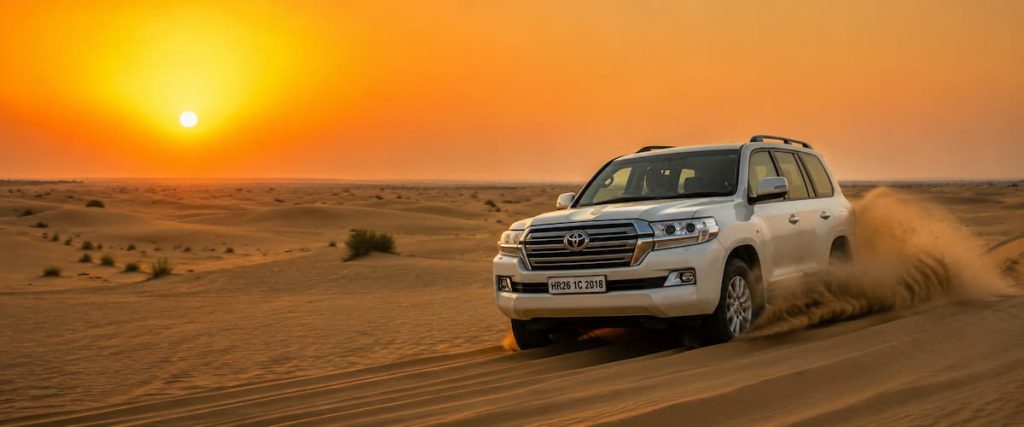
The evening safari is the default for a reason — it packs the full desert experience into a single 6-7 hour window. Pickup from your hotel runs around 2:30-3:30pm, and the sequence from there is remarkably consistent across operators: a drive out to the dunes (usually the Lahbab “red dunes” area, about 45 minutes from the city), 25-35 minutes of dune bashing in a 4×4 Land Cruiser, a photo stop on a high dune timed for the softening afternoon light, then camel rides and sandboarding before you roll into a Bedouin-style camp as the sun goes down.
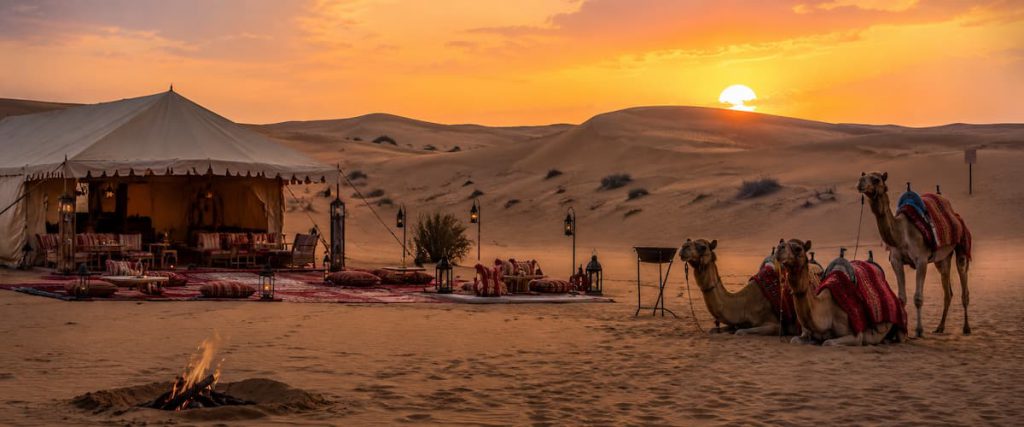
The camp is where the second half of the evening lives: Arabic coffee and dates on arrival, henna painting, shisha corners, falconry photos at some camps, and then a live show rotation — belly dance, the spinning Tanoura performance, and usually a fire show — running alongside a BBQ buffet dinner. The buffet reliably carries both vegetarian and non-vegetarian spreads; camps hosting large numbers of Indian guests treat the veg section as core, not an afterthought. Drop-off back at your hotel lands around 9:30-10pm.
On price: shared evening safaris with dinner realistically run AED 130-210 per person from reputable operators. You’ll see AED 99 headline offers and they’re not necessarily scams, but the difference usually shows up in vehicle age, camp quality, and how many pickup stops your 4×4 makes before actually reaching the desert. VIP tiers — better seating at the camp, table service, sometimes quad biking bundled in — push the price to AED 260-500.
The Morning Safari: Shorter, Cheaper, Cooler — Literally
The morning safari strips the experience down to the adventure core: pickup between 8-10am, dune bashing, camel ride, sandboarding, photo stops, and back at your hotel before the midday heat peaks — roughly 3-5 hours door to door. No dinner, no shows, no camp evening. That makes it both the cheapest format and the one that leaves the rest of your day intact.
A pricing quirk worth knowing: many operators sell morning safaris per vehicle rather than per person — a private 4×4 seating up to six for around AED 650-750. For a family or group of four to six, that works out to AED 110-160 a head with the whole vehicle to yourselves, which quietly beats most shared evening prices. Solo travellers and couples, by contrast, will find per-person shared morning slots from around AED 104-149.
The morning slot suits three groups particularly well: travellers on a tight itinerary who can’t give up an evening, families with young kids whose energy runs out by 7pm, and anyone visiting May-September, when a 9am desert is merely hot rather than dangerous — though even then, summer morning slots start early for a reason.
The Overnight Safari: For the Stars and the Sunrise
The overnight safari is essentially the evening safari with an extension nobody else gets to see. You do everything the evening guests do — dunes, camp, dinner, shows — and then stay behind after the crowds leave, which is when the desert actually becomes the thing people imagine: silent, cool, and under a sky Dubai’s city lights never allow. You sleep in a Bedouin-style tent (beds, pillows, and blankets provided), wake for sunrise over the dunes, take a morning camel trek, have an Arabian breakfast, and get dropped back at your hotel around 8:30am — about 18 hours after pickup.
Prices run roughly AED 350 at the value end to AED 716+ per adult at established camps, with children aged 3-11 typically paying AED 350-500. One honest warning that operators bury in the fine print: winter desert nights get genuinely cold, dropping toward 5°C in December-February. The blankets provided are adequate; an extra warm layer of your own makes the difference between atmospheric and miserable.
The Three Formats, Side by Side
The quick decision logic: evening if it’s your first Dubai trip and you want the full spectacle; morning if you’re short on time, travelling with young kids, or optimising cost per person in a group of 4-6; overnight if the stars and sunrise matter more to you than an extra hotel night — and if you’re travelling as a couple, it’s one of the more memorable splurges Dubai offers.
Dune Bashing: The Fine Print Nobody Reads Until the Car Starts Sliding
Dune bashing is the headline act — a trained driver throwing a Land Cruiser up, along, and down 30-40 metre dunes for around half an hour — and for most people it’s a highlight. But the operators’ own guidance is blunt about who shouldn’t do it: pregnant women, children under roughly 3-5 depending on the operator, and anyone with back, neck, or heart conditions. Motion sickness is the milder, far more common casualty; if you’re prone to it, take your usual remedy before pickup and ask for a front seat, which genuinely helps.
The part many travellers don’t know: you can skip it without skipping the safari. Most operators will drive non-participating guests directly to the camp by the flat route while the rest of the group bashes dunes, and you lose nothing else — camel rides, dinner, and shows all happen at camp. Say so at booking, not at the pickup point, and it’s a painless arrangement. One more practical note: dune bashing pauses during and immediately after rare desert rain, and operators may reshuffle itineraries for weather — they’re being careful, not difficult.
What’s Included, What’s Extra, and the Booking Traps
The standard evening package reliably includes hotel pickup and drop-off, dune bashing, a short camel ride, sandboarding, soft drinks and water, camp entertainment, henna, and the BBQ buffet. What it almost never includes, despite how the photos look: quad biking (typically AED 150+ for 30 minutes, arranged at the camp or pre-booked) and dune buggies (from around AED 950 per buggy — priced per vehicle, not per person). Alcohol isn’t part of standard camps; a handful of premium camps serve it at extra cost.
Three booking traps worth avoiding. First, the ultra-cheap listings that quote one price and then charge “mandatory” add-ons at the camp — read what’s itemised before paying. Second, pickup-time inflation: budget shared tours can spend 60-90 minutes collecting other guests across Dubai and Sharjah before the desert drive even starts; ask how many pickup stops your vehicle makes. Third, seasonal pricing — November through March runs 15-25% above summer rates, and holiday weeks higher still, so if you’re travelling peak season, book days ahead rather than negotiating at your hotel lobby the same afternoon. Booking online is also typically 10-20% cheaper than walk-up counter rates.
What to Wear, Carry, and Expect on the Day
Dress for sand, not for style: light, loose clothing, and footwear you can shake out — sandals or old trainers both work, and you’ll be barefoot on the camp carpets by evening anyway. Sunglasses and sunscreen are non-negotiable even for evening trips, since the dune-bashing and photo-stop hours are still full daylight. In winter (December-February), pack a proper warm layer for after sunset; the desert temperature drop surprises everyone the first time. Carry a scarf or buff if you’re doing quad bikes — airborne sand finds every gap — and keep your phone in a zipped pocket during dune bashing, because loose items become projectiles.
For timing your trip around the season generally, our guide to the best time to visit Dubai from India covers the trade-offs — the short version for safaris specifically is that a 24°C January evening and a 40°C July evening are profoundly different experiences at the same camp, and the winter premium is usually worth paying for this one activity even if you economise elsewhere.
To see the full evening sequence — pickup, dunes, camp, dinner — before you commit:
Frequently Asked Questions
How much does a Dubai desert safari cost?
Shared evening safaris with BBQ dinner typically run AED 130-210 per person; budget operators advertise lower, premium camps charge more. Morning safaris are cheaper (often sold per vehicle), and overnight safaris run roughly AED 350-716 per person depending on camp quality.
Which desert safari is best: morning, evening, or overnight?
Evening is the most complete experience — dune bashing, sunset, camp entertainment, and BBQ dinner in one 6-7 hour trip. Morning suits people short on time or avoiding crowds; overnight suits anyone who wants stargazing and a desert sunrise.
Is dune bashing safe for everyone?
It’s generally well-run with trained drivers, but operators themselves advise against it for pregnant women, very young children, and anyone with back, neck, or heart conditions. You can skip the dune bashing segment and join the camp directly — most operators accommodate this if you ask at booking.
What is included in a standard evening desert safari?
Hotel pickup and drop-off, 4×4 dune bashing, camel ride, sandboarding, soft drinks, live shows, henna, and a BBQ buffet with veg and non-veg options. Quad biking and dune buggies almost always cost extra.
Is vegetarian food available at desert safari camps?
Yes — the buffet at virtually every camp includes a separate vegetarian spread, and operators serving large numbers of Indian guests treat it as standard. Confirm at booking if pure-veg preparation matters to you.
What should I wear for a desert safari?
Light, loose clothing and shoes you don’t mind filling with sand. Carry a warm layer for winter evenings — desert temperatures can drop toward 5°C after dark in December-February.
The Bottom Line
For most first-time visitors, the evening safari at AED 130-210 from a mid-tier operator is the right call — complete experience, sensible price, no overnight commitment. Groups of four to six should price a private morning vehicle before assuming shared is cheaper, and couples with a flexible night should seriously consider the overnight upgrade for the sky alone. Whichever you pick, book online a few days ahead, read the inclusion list literally, and flag any dune-bashing opt-outs at booking time.
The safari slots neatly into a wider trip too — it pairs well with a Dubai Mall day on either side, since one is entirely indoors and the other entirely out. And if you’d rather have the pickup times, camp choice, and add-ons pre-arranged, our Dubai tour packages build the desert safari in as a standard evening, with upgrades available on request.
Trekhops Editorial Team is a Dubai Travel Specialist, who has compared more safari camps than any reasonable person should.