By Trekhops Editorial Team, Dubai Travel Specialist · Published July 14, 2026 · 10 min read
Here’s the open secret about eating in Dubai as an Indian traveller: you will never be more than ten minutes from food that tastes like home, and it will often be better than the version you left behind — cooked by chefs from Kerala, Lucknow, and Lahore for the world’s most demanding desi expat audience. The real question isn’t “will I find Indian food.” It’s how to balance the comfort of Karama’s chaat with the things you can only eat here: karak at a kerbside cafeteria, machboos in a wind-tower courtyard, shawarma at 1am. This guide maps both halves.
Key Takeaways
- Meena Bazaar and Karama are Dubai’s Little Indias — chaat, dosa, mithai, and AED 30 unlimited thalis, at their liveliest 4-8pm
- Karak chai (AED 1-4) is the UAE’s unofficial national drink and the single cheapest cultural experience in the city
- The Emirati trio worth crossing town for: machboos, harees, and luqaimat — best tried at Arabian Tea House in Al Fahidi
- Legends to know by name: Ravi (Satwa, Pakistani), Al Mallah (shawarma), Sind Punjab (47 years old), Saravanaa Bhavan (pure veg)
- Street food runs AED 5-20 a dish; a genuinely great food day costs less than one mall meal
- Budget institutions are unlicensed (no alcohol) — drinks live at hotel venues, planned separately
Start With Karak: The AED 1 Initiation
Before any restaurant, do this: walk to the nearest cafeteria window — they’re on practically every street in the older districts — and order a karak. Strong black tea boiled hard in milk with cardamom, sometimes saffron or ginger, always sweet. It arrived with Indian workers during the oil boom and became the Emirates’ unofficial national drink; today it costs anywhere from AED 1 at a Satwa cafeteria window to AED 10 at a Downtown boutique with a Burj view, and residents argue about condensed-versus-fresh milk with genuine passion. For an Indian traveller it lands as both familiar and foreign — your masala chai, translated. Classic first cups: the hole-in-the-wall Al Shaab in Meena Bazaar (pouring for over fifty years), Satwa Falcon Cafeteria (the AED 1 benchmark), and Raju Omlet in Karama for the Mumbai cutting-chai style with an anda-paratha breakfast attached.
Meena Bazaar and Karama: The Two Little Indias
Meena Bazaar in Bur Dubai is the older, denser one — a knot of lanes where mithai shops, dosa counters, and curry houses have fed the community for decades. The institutions: Sind Punjab, serving North Indian classics for 47 years; Saravanaa Bhavan, whose unlimited South Indian thali around AED 30 is repeatedly cited among Dubai’s best-value meals, with filter coffee in the steel tumbler to finish; and the street layer that peaks 4-8pm, when pani puri carts, sugarcane presses, and samosa fryers take over the lanes. It sits minutes from the Textile Souk and Al Fahidi, which is why our Old Dubai souks guide ends its walking route here — the geography does the meal planning for you.
Karama is the sprawling, residential sibling: South Indian strongholds like the Kerala-famous Calicut Paragon, chaat corners doing vada pav and chole bhature, Indo-Chinese joints, and the kind of AED 15-40 cafeteria meals that explain why residents rarely cook. Neither district is a tourist recreation — these are working neighbourhoods that happen to feed visitors brilliantly, and both run on cash-friendly, unlicensed, come-as-you-are terms.
The Legends List: Five Names Worth Crossing the City For
Every food city has its canon; Dubai’s budget canon fits in one paragraph. Ravi (Satwa) — the Pakistani institution where, as the local line goes, taxi drivers and CEOs share tables over mutton curry and biryani; expect queues, formica, and one of the great cheap meals of your life. Al Mallah (Al Dhiyafah Road, Satwa) — the most-cited shawarma in the city, at its best after dark; the AED 5-15 shawarma economy across Satwa, Deira, and Karama runs until 3-4am and is Dubai’s true late-night food culture. Sind Punjab and Saravanaa Bhavan, above. And Arabian Tea House (Al Fahidi) — the crossover pick, where the next section begins.
The Emirati Plate: What to Order Beyond Your Comfort Zone
Here’s the gentle push this guide exists to make: don’t fly home having eaten only better versions of what you eat at home. Emirati cuisine is a short, learnable menu, and it’s built from flavours Indian palates already understand. Machboos — spiced rice slow-cooked with chicken, lamb, or fish and dried lime — is biryani’s Gulf cousin and the easiest entry point. Harees — wheat and meat pounded into a rich, savoury porridge — is the ceremonial dish, at its peak during Ramadan. Luqaimat — crisp-outside, soft-inside dough balls drenched in date syrup — are the dessert nobody stops at one of. Round it out with Arabic coffee and dates (the hospitality ritual you’ll meet at every desert camp) and a camel-milk chocolate from Camelicious or dates from Bateel as the gifts worth carrying home.
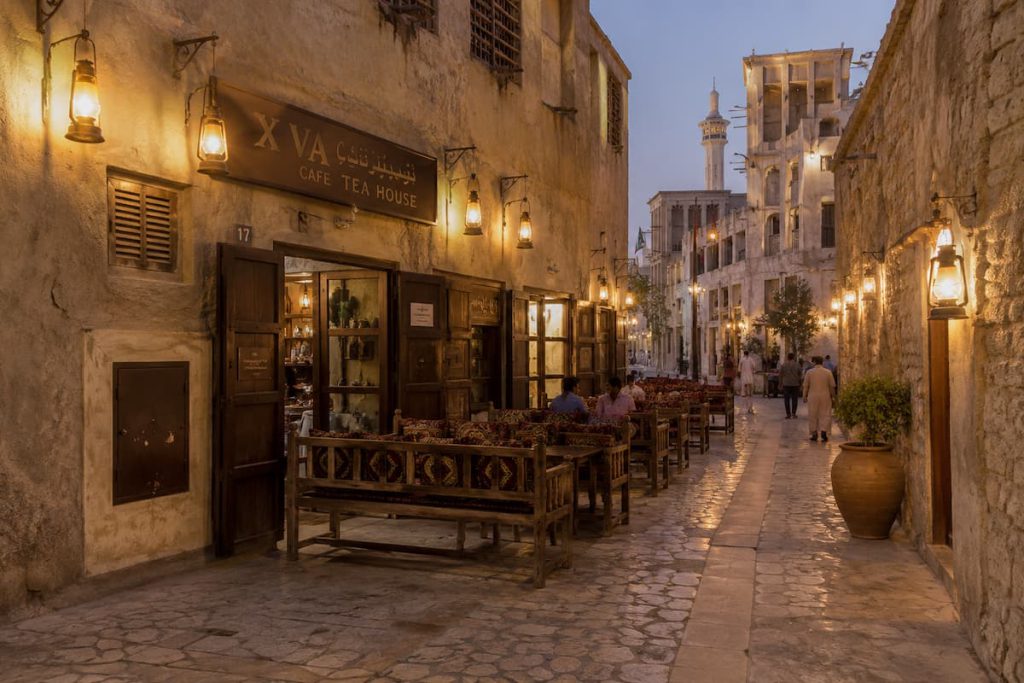
The single best place to run this whole menu: Arabian Tea House in Al Fahidi, serving Emirati breakfasts and mains inside a traditional wind-tower courtyard for over two decades — a heritage experience and a meal in one booking, and the natural lunch stop on any Old Dubai morning.
Vegetarian, Jain, and Halal: The Practical Answers
Vegetarian travellers have it easier in Dubai than almost any international city: fully-veg institutions (Saravanaa Bhavan and peers), strong veg spreads at every food court and safari camp buffet, and the Lebanese trinity of falafel-hummus-fattoush as the default non-Indian veg meal (a complete falafel wrap runs under AED 10). Jain requirements are servable — several Karama and Bur Dubai kitchens prepare no-onion-no-garlic on request — but call ahead rather than assuming; it’s a known request, not a standard one. Halal is the baseline: effectively all meat in the UAE is halal, so that concern simply dissolves. The reverse consideration: pork appears only in clearly-marked licensed venues and supermarket sections, and alcohol only at licensed (hotel-attached) venues — the entire budget canon above is unlicensed, which is why listings flag it. Plan the celebratory drink and the legendary cheap dinner as two different outings.
Where the Money Goes: Eating Cheap vs Eating the View
Dubai runs two parallel food economies and prices them honestly. The resident economy — cafeterias, street stalls, Old Dubai institutions — feeds you superbly for AED 20-50 a day of eating, because it’s priced for people who live here. The experience economy — fountain-view terraces at Souk Al Bahar, Marina waterfront tables, hotel brunches — charges AED 100-300+ per head largely for the setting, and sometimes the setting is worth it: one fountain-view dinner on a first trip is money well spent, as our Downtown guide argues. The trap is drifting through the whole trip in the second economy by default. The play: anchor your days in the first, buy the second deliberately, once or twice, for the occasions that earn it.
A One-Day Eating Route You Can Actually Walk
The route that stitches this guide together, built on the Old Dubai circuit: 8:30am — Emirati breakfast platter and karak at Arabian Tea House, Al Fahidi. Late morning — souks and the abra crossing (grocery-shop the Spice Souk for saffron and dates). 1pm — unlimited thali or dosa in Meena Bazaar. 4-6pm — the street-cart golden hour: pani puri, samosas, sugarcane juice as the lanes wake up. Evening — cross town for shawarma at Al Mallah or the full Ravi experience in Satwa, finishing with one more karak, because by now you’ll understand. Total spend: well under AED 100, and a better eating day than most AED 500 ones. In season, swap the evening for Global Village’s 200-stall progressive dinner instead.
For the Meena Bazaar half of that route on video — and the case for Dubai’s Indian food supremacy:
Frequently Asked Questions
Is Indian food easily available in Dubai?
Almost comically so — entire districts (Meena Bazaar, Karama) run on it, from AED 30 unlimited thalis to 47-year-old institutions, and many argue it’s the best Indian food outside India. Pure-veg options are everywhere.
What is karak chai and where do I try it?
The UAE’s unofficial national drink — strong tea boiled in milk with cardamom, descended from masala chai. AED 1-4 at cafeterias on practically every street; Al Fahidi’s tea houses and Meena Bazaar’s old-timers are classic first stops.
What Emirati dishes should Indians try?
Machboos (biryani’s Gulf cousin), harees (wheat-and-meat porridge), and luqaimat (dough balls in date syrup) — all three at Arabian Tea House in Al Fahidi.
How much does eating out in Dubai cost?
Shawarma AED 5-15, street snacks AED 5-20, cafeteria meals AED 15-40, food courts AED 30-60, mid-range AED 80-200 per head. Eating brilliantly and cheaply is easy if you follow the residents.
Is vegetarian and Jain food available?
Vegetarian abundantly, including fully-veg institutions; Jain preparations at several Karama and Bur Dubai kitchens — call ahead to confirm no-onion-no-garlic on the day.
Can you drink alcohol with dinner in Dubai?
Only at licensed (hotel-attached) venues. The budget legends are all unlicensed, so plan drinks and the great cheap dinner as separate outings.
The Bottom Line
Eat both Dubais. Let Karama and Meena Bazaar give you home cooking at expat standards and street prices; let karak, machboos, and a wind-tower courtyard give you the Gulf; and spend the view-restaurant money once, deliberately, where the fountain earns it. Food is the one part of a Dubai trip where the budget option and the best option are usually the same table.
Want the eating route built into your days — Old Dubai food morning, safari-camp buffet evening and all? Our Dubai tour packages plan around meals rather than treating them as afterthoughts, which any traveller who’s queued at Ravi will tell you is the correct priority order.
Trekhops Editorial Team is a Dubai Travel Specialist, who measures neighbourhoods by their karak.